
Diwali, Navratri and Holi in East York: Local Celebrations and Practical Rules
Celebrating Diwali in East York means living by City of Toronto rules, which surprise many families who moved here from other parts of the GTA. The district runs from the bungalow streets north of Danforth Avenue to the high-rise towers of Thorncliffe Park, and the rules for fireworks and open flames apply very differently to a backyard and a twentieth-floor balcony. Families who consult me in North York often ask what is actually allowed before they spend money on sparklers or plan a Holika Dahan. This guide brings together what the City's official pages say about fireworks, open-air burning and smoke alarms. It also describes how East York's Hindu, Muslim and many other communities share festival seasons, and how to keep home rituals safe and meaningful. In more than forty years of practice I have watched festivals become calmer once families stop worrying about fines and focus on the puja. Dates are left out deliberately; check a Toronto panchang each season.
Can you set off Diwali fireworks in East York?
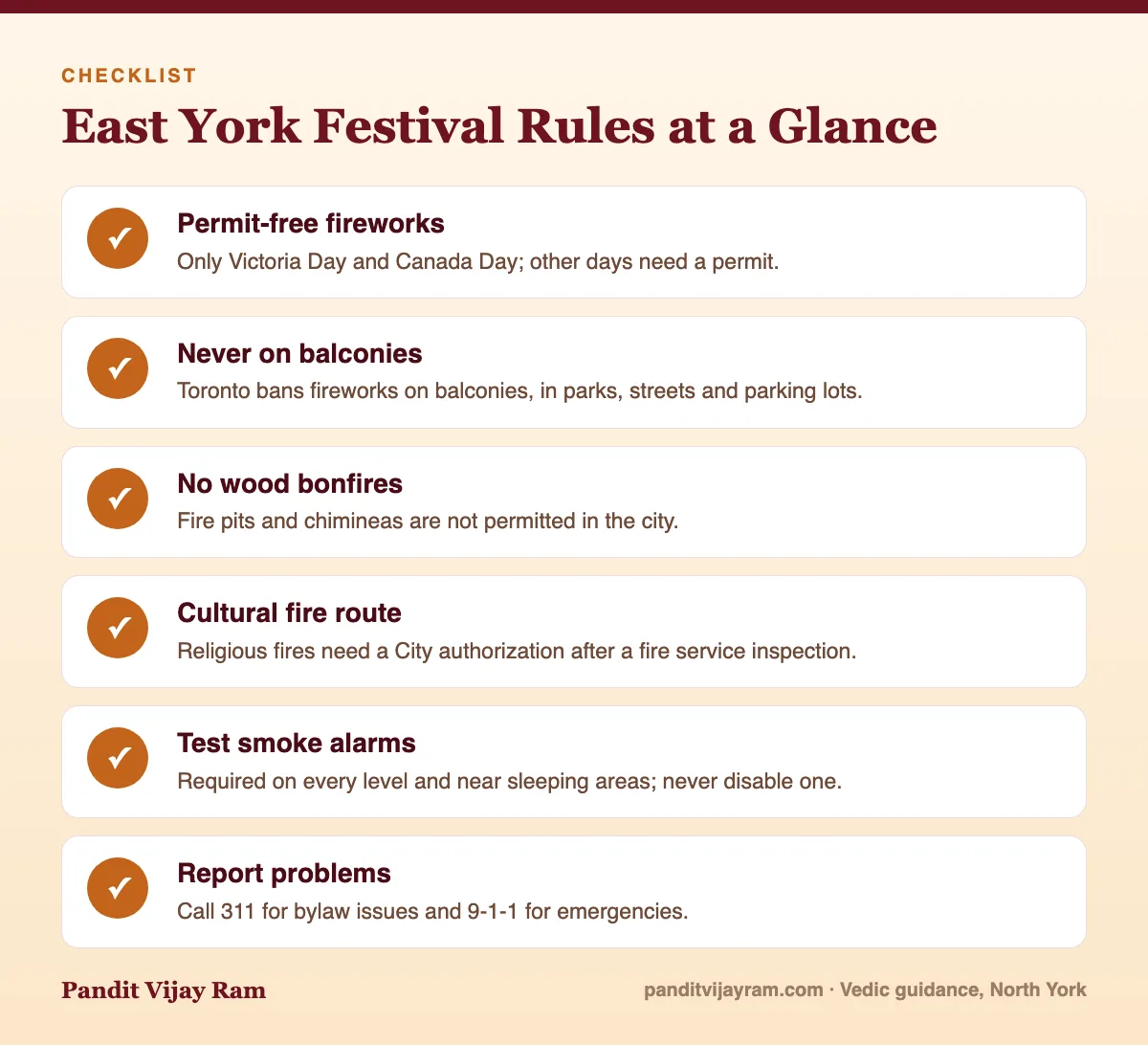
Not without a permit. The City of Toronto says Victoria Day and Canada Day are the only days that permits are not required. On any other day, including Diwali, you need the appropriate permit, and fireworks may be set off only on property you own, until 11 p.m. They are never allowed on balconies or in public parks.
Toronto's fireworks page sets out clear limits that apply across East York:
- Permit-free days. Only Victoria Day and Canada Day.
- Other days. Setting off fireworks on your own property is allowed until 11 p.m. with the appropriate permit.
- Where never. Public parks, beaches, streets and parking lots, balconies, and private property you do not own.
- Reporting. Contact 311 about fireworks in a park, illegal sales or misuse. Bylaw officers are not emergency responders.
These rules have real consequences in East York's housing mix. A homeowner on a bungalow street may apply for a permit for a backyard display. A tenant in a Thorncliffe Park or Flemingdon Park tower cannot use a balcony at all, and the shared lawns usually belong to the landlord, so permission is needed there too.
Many families now enjoy fireworks as spectators at an organised event and keep home celebrations to lamps, rangoli and sweets. Sparklers handed to children near loose clothing are a common cause of burns, so adults should supervise closely wherever they are used.
For a comparison of rules in other GTA cities, read Diwali fireworks rules across GTA cities. Families elsewhere in the city can read Diwali, Navratri and Holi in Toronto.
Is a Holika Dahan bonfire allowed in East York?
Ordinary backyard bonfires and wood fire pits are not permitted in Toronto. The City does offer a Cultural Fire Authorization for open-air burns connected to a specific cultural or religious practice, ceremony or event. Toronto Fire Services inspects the site before approving, and burns in city parks need an Event Letter from Parks and Recreation.
Toronto's open-air burning page is direct: open-air burning is not permitted, and wood-fuelled campfires, fire pits, chimineas and fire bowls are not allowed. The only general exception in the Ontario Fire Code is a small, confined fire used to cook food on a grill, barbecue or spit and supervised at all times.
There is a respectful route for genuine ceremonies. The City describes two approvals:
- Cultural Fire Authorization. For an open-air burn conducted in connection with a specific cultural or religious practice, ceremony or event.
- Open Air Burn Permit. For other purposes, such as private events not tied to a religious ceremony.
Before either is issued, Toronto Fire Services conducts a site inspection. Burns in designated areas of City parks also require an Event Letter from Parks and Recreation. In practice, a temple or community association is better placed than a single household to apply, because it can meet the safety conditions and invite the whole neighbourhood.
For a family at home, the meaning of Holika Dahan can be honoured without a bonfire. Light a single lamp, retell the story of Prahlada's devotion, offer grains and a coconut, and resolve to let go of one harmful habit. Our Holika Dahan guide for the GTA lists more alternatives.
How do East York's communities share the festival seasons?
East York's Hindu families celebrate Diwali, Navratri, Durga Puja and Holi beside large Muslim communities in Thorncliffe Park and Flemingdon Park who observe Ramadan and the two Eids. Temples, mosques, community hubs and school events carry much of the celebration, and neighbours often share sweets and greetings across traditions.
Festival life in East York is shaped by its people. The Bangladesh Canada Hindu Mandir on Dohme Avenue anchors Bengali Hindu celebrations, where Durga Puja is traditionally the high point of the autumn. Families from other regions may keep Navratri with garba, Diwali with Lakshmi puja, or Holi with colours in spring. Our East York temples and community centres guide describes the places of worship in more detail.
In Thorncliffe Park and Flemingdon Park, the Islamic Society of Toronto's centre on Overlea Boulevard serves a large congregation. Ramadan evenings, Eid prayers and community iftars bring crowds and traffic, just as Diwali does at a mandir.
Good neighbour habits during overlapping seasons:
- Greet neighbours on their festivals; a box of sweets travels well in both directions.
- Keep music and celebrations within reasonable hours in shared buildings.
- Avoid parking in mosque or temple lots reserved for worshippers on busy nights.
- Explain the meaning of your lamps or colours when children ask.
Navratri fasting and garba nights deserve their own planning, covered in Navratri in the GTA. Organisers booking a hall should agree capacity, sound levels and finishing times with the venue in writing.
How can you keep lamps and incense safe in East York homes and towers?
Use a few watched ghee lamps on metal trays and LED diyas elsewhere. Test smoke alarms before the festival, and never cover or disconnect one. Toronto requires working smoke alarms on every level and near sleeping areas. In apartments, check the lease or building rules on open flame and incense first.
East York's housing ranges from compact post-war bungalows to large rental towers, and each needs slightly different care.
Bungalows and semis. Rooms are small and ceilings low, so heat and smoke gather quickly. Keep lamps away from curtains and doorways, and open a window while incense burns.
Apartment towers. Alarms in corridors and units are sensitive, and a false alarm can evacuate a whole building. A single lamp at the shrine, watched throughout, is safer than rows of diyas along a window sill.
The City of Toronto's smoke alarm page sets out duties on both sides of a lease:
- Smoke alarms must be on every level of a home and near each sleeping area.
- Landlords must install and maintain them under the Ontario Fire Code.
- Tenants must not disable them and must tell the landlord if one is not working.
- If a landlord does not provide working alarms, call 311 for a referral to Toronto Fire Services.
Test alarms monthly, and especially the week before Diwali. Our guide to fire-safe diyas in condos and apartments has more detail, and home cleansing for East York housing offers smoke-free ways to prepare the home for Lakshmi.
How do you keep an East York Diwali meaningful as well as safe?
Put the puja at the centre. Clean the home, prepare the altar early, perform Lakshmi–Ganesh puja at the right muhurat, and explain the story of light over darkness to children. Celebrations stay joyful when they are lawful and considerate, and the quiet minutes at the shrine are what the family remembers.
Diwali celebrates the victory of light over darkness and good over evil. In a busy household that meaning can disappear beneath shopping, cooking and visits. A little structure brings it back.
- Cleanse first. Declutter and clean the home in the days before, finishing at the entrance.
- Plan the puja. Use a Toronto panchang or ask a pandit for the evening muhurat. Our step-by-step Lakshmi–Ganesh puja at home lists samagri and order.
- Include everyone. Let children draw rangoli, light a lamp under supervision or ring the bell.
- Remember those absent. A lamp for ancestors or for relatives abroad is a gentle tradition.
Bengali families in East York may centre the autumn on Durga Puja rather than Diwali. Vijay Ram ji can perform a Durga puja and havan on a family's behalf when they cannot attend a community celebration, and explain each step by video.
Vijay Ram ji is based in North York, a short drive from East York, and offers in-person consultations there as well as phone and video sessions. Because East York has no dedicated page on this site, local families can start from the Vedic astrologer page for Toronto.
The bottom line
Diwali in East York follows Toronto's rules: fireworks need a permit except on Victoria Day and Canada Day, and they are never allowed on balconies, in parks or on streets. Backyard bonfires are not permitted, though Toronto Fire Services can approve genuine cultural or religious fires after inspection. With tested alarms, watched lamps and care for neighbours of every faith, East York's festivals stay safe and full of meaning.
Key takeaways
- Toronto allows permit-free fireworks only on Victoria Day and Canada Day.
- Fireworks are banned on balconies, in parks, streets and parking lots.
- Wood bonfires and fire pits are not permitted; cultural fires need approval.
- Smoke alarms are required on every level and near sleeping areas.
- A watched lamp and a sincere puja carry the full meaning of Diwali.