
Obsessed With Someone You Don't Want? Spiritual and Practical Help

There is a particular kind of misery in thinking about someone you do not even want. You know they are wrong for you, or unavailable, or simply not interested, and yet your mind returns to them every few minutes. People describe an unwanted obsession with someone as exhausting and embarrassing, and many keep it secret. Some wonder whether a spell has been cast on them. I meet these people in North York and across the GTA, often after months of struggling alone. This article is meant to make you feel less alone and more equipped. It explains why fixations take hold, how to tell limerence from obsessive-compulsive patterns or grief, practical steps that genuinely reduce the hold, and a simple prayer of release you can use each day. In more than forty years of practice, I have learnt that the mind loosens its grip when it is treated kindly rather than fought. Spiritual practice can help a great deal, and so can a good doctor or counsellor. The two belong together here.
Why can't I stop thinking about someone I don't even want?
Because fixation runs on uncertainty, habit and the brain's reward system, not on what you rationally want. Mixed signals, loneliness, stress or a past wound can make one person feel unusually charged. The more you try to push the thought away, the more often it tends to return.
Several ordinary processes can combine to keep someone lodged in your mind:
- Intermittent reward. A person who is sometimes warm and sometimes cold creates a stronger pull than one who is reliably kind. The brain keeps checking for the next reward.
- Thought suppression. Telling yourself "don't think about them" tends to bring them back more often.
- Unmet needs. Loneliness, low self-worth or a stressful period can attach to whoever offered a moment of attention.
- Old patterns. Someone may resemble a parent, an ex or a hurt from long ago, which gives them borrowed intensity.
- Phone habits. Checking their profile becomes a loop that runs almost automatically.
In Vedic language, this is the restless mind, chanchala manas, that the Bhagavad Gita describes as hard to hold, like the wind. Krishna's answer to Arjuna is not to fight it but to train it gently through practice and detachment, abhyasa and vairagya.
If part of you suspects a spell, our article on signs of a love binding or obsession spell sets the reported signs beside these ordinary explanations, so you can look at both honestly.

Is an unwanted fixation limerence, OCD or something else?
It can be several things. Limerence brings longing and hope for return. Obsessive-compulsive patterns bring distressing, unwanted thoughts and urges to check or seek reassurance. Grief brings rumination after a loss. Trauma bonding ties you to someone who hurt you. A family doctor or counsellor can help tell them apart.
A rough guide to the most common patterns:
- Limerence: you daydream about the person and feel high when they notice you, low when they do not. The thoughts are not entirely unwelcome, even if the situation is.
- Obsessive-compulsive patterns: the thoughts feel intrusive and wrong. You may check, seek reassurance or replay events to quiet the anxiety, only for it to return. Some people experience this specifically about relationships.
- Grief rumination: after a breakup or loss, you circle the same memories and questions about what went wrong.
- Trauma bonding: you feel tied to someone who mistreated you, often because affection followed cruelty.
- Low mood or anxiety: depression and generalised anxiety can make the mind lock onto any source of pain or hope.
These can overlap, and you do not need to diagnose yourself. The point is that each one has well-understood, effective help. Obsessive-compulsive patterns, in particular, respond well to specific therapy, and a family doctor can refer you.
Spiritual support still has a place in every case. It works best when it calms the nervous system and gently redirects attention, rather than becoming another ritual to check and repeat. If you are also caught in a controlling relationship, the guide to breaking free when you feel bound covers safety alongside prayer.
How do I emotionally detach from someone I'm obsessed with?
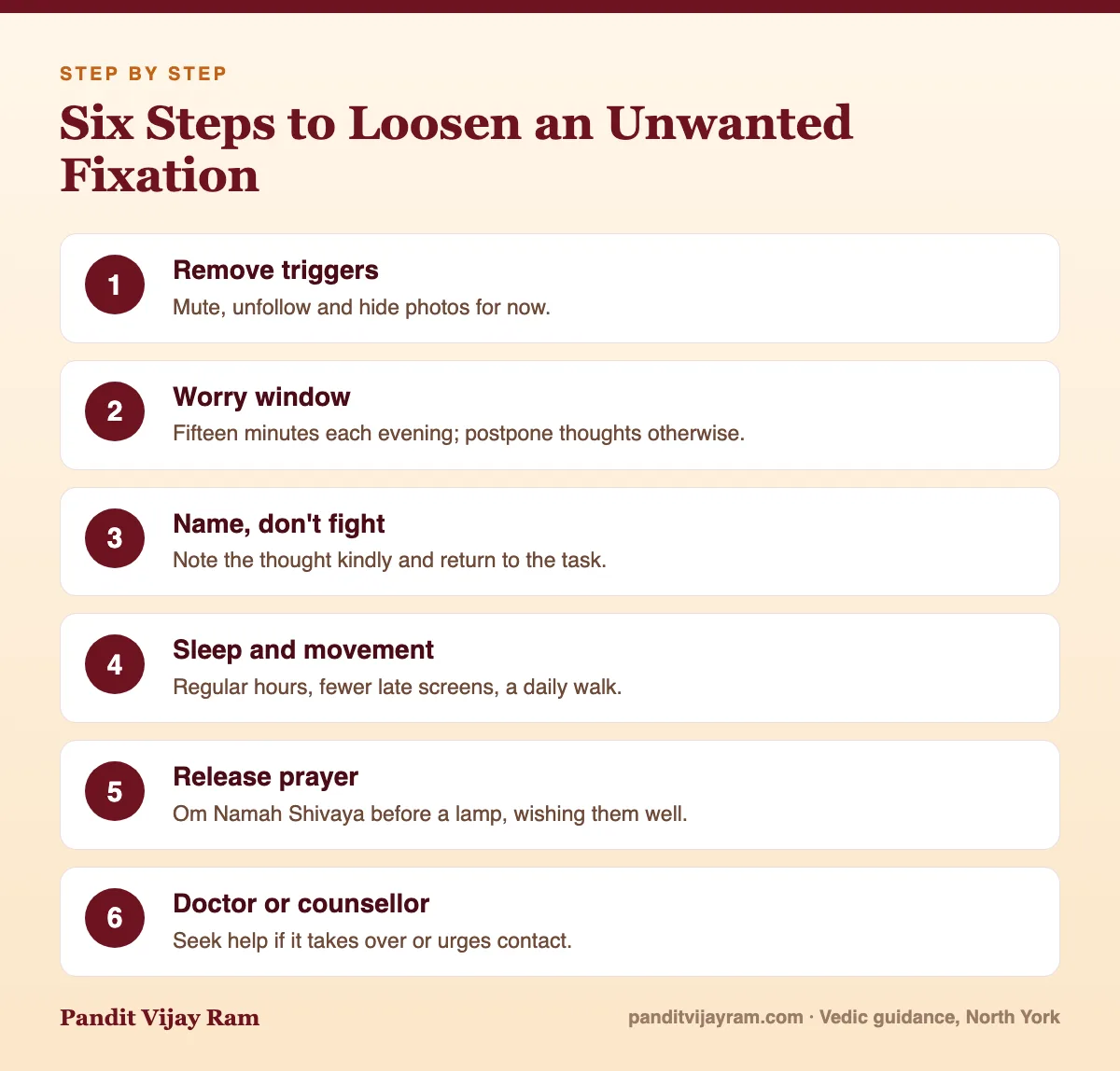
Reduce the cues that trigger thoughts, protect sleep and routine, set a short daily window for thinking about them, and fill the rest of the day with people and purpose. Notice thoughts without arguing with them. Detachment grows gradually as the mind learns the person is no longer the centre.
A practical plan that many people find workable:
- Remove triggers. Mute or unfollow them, archive old chats, move photos to a hidden folder. You do not have to delete everything; just stop seeing it daily.
- Schedule the worry. Allow fifteen minutes each evening to think, write or feel sad about them. When thoughts come at other times, note them and postpone them to that window.
- Name, don't fight. When the thought appears, say inwardly, "There's that thought again," and return to what you were doing.
- Protect sleep. Keep regular hours, avoid screens in bed, and limit caffeine after midday. A tired mind fixates more.
- Move your body daily. A brisk walk or yoga session lowers the restlessness that feeds rumination.
- Widen your world. Spend time with friends, family, temple or community groups. Fixation shrinks when life grows.
Expect slow progress with good and bad days. Many people find the intensity eases noticeably over a few weeks of steady effort.
If shared spaces keep bringing the person to mind, the article on cord-cutting after a past relationship offers a gentle ritual to mark the separation.
Is there a prayer to stop thinking about someone?
Yes. Many people use a short daily prayer of release to Shiva, the deity of stillness, who in legend turned Kamadeva's arrow of desire to ash. Chanting Om Namah Shivaya, sitting with a lamp for a few minutes and offering the person's wellbeing to the divine can loosen a fixation's hold.
The story of Shiva and Kamadeva is a helpful image here. When the god of desire disturbed Shiva's meditation with his flower arrow, Shiva opened his third eye and the arrow's power was consumed. It is a picture of a mind that can see desire clearly without being ruled by it.
A simple evening release practice:
- Light a small lamp and sit comfortably for five minutes.
- Chant Om Namah Shivaya slowly, one mala if you can.
- Picture the person briefly, wish them well, and say: "I release you to your own path, and I return to mine."
- Offer a flower or a little water as a sign of letting go.
- Gaze at the flame for a minute, then close your eyes and rest.
The Hanuman Chalisa is another good choice, especially for people who feel the obsession as an agitation they cannot control. Hanuman represents a mind fully mastered and turned towards devotion.
Keep the practice short and kind. If you notice it turning into another compulsion, such as repeating it many times out of fear, pause and talk to a counsellor. Vijay Ram ji's health and wellbeing guidance can help tailor a prayer routine that supports, rather than replaces, medical care. For people drawn to love deities, the Kamdev and Rati puja article explains the other side of this tradition.
When does an obsession with someone need medical help?
Seek medical or counselling help when the thoughts take hours of your day, cause shame or panic, disrupt sleep, eating or work, or push you towards checking on, following or contacting someone who has asked you to stop. Your family doctor is a good first step, and crisis help is always available.
Please reach out promptly if any of these apply:
- Thoughts of the person occupy much of your day and you cannot concentrate.
- You feel compelled to perform checks, rituals or reassurance-seeking to calm anxiety.
- You are not sleeping, have lost appetite or are using alcohol to cope.
- You have thoughts of harming yourself. Call or text 9-8-8, Canada's Suicide Crisis Helpline, any time.
- You find yourself driving by their home, making new accounts to watch them, or contacting their friends or partner.
That last point matters for the other person's sake as well as yours. Repeated, unwanted contact can frighten them and may amount to criminal harassment. Recognising the urge early and getting support is an act of responsibility and respect.
Counsellors and doctors see these situations often and will not judge you. Therapy for obsessive patterns and for limerence is effective, and sometimes medication helps for a period. There is no conflict between this care and your faith.
When you are ready, Vijay Ram ji can look at your chart for periods of emotional strain, often linked to the Moon, and suggest steadying remedies. The love problem consultation is a gentle place to start, and he will always encourage medical care where it is needed.
The bottom line
An unwanted obsession with someone usually grows from uncertainty, habit, loneliness or obsessive-compulsive patterns rather than anything mysterious. Practical steps such as removing triggers, scheduling worry time, protecting sleep and widening your life gradually weaken its hold. A short daily release prayer to Shiva or Hanuman can sit alongside counselling and medical care, which should come first whenever the fixation disrupts daily life or pushes you towards unwanted contact.
Key takeaways
- Fixation runs on uncertainty and habit, not on what you truly want.
- Limerence, OCD patterns, grief and trauma bonds can all feel similar.
- Remove triggers, schedule worry time and protect sleep.
- A short release prayer helps when kept gentle, not compulsive.
- See a doctor or counsellor if it disrupts life or urges contact.