
Love Binding Spell: Meaning, Ethics and Free Will

When love feels uncertain, the idea of a love binding spell can be very tempting. It promises that a partner will never stray, that an ex will feel pulled back, that the fear of losing someone can finally stop. Many people who contact me from North York and the wider GTA have already seen online sellers offering exactly that. Before you spend money or hope on it, it helps to understand what binding means, where the idea comes from, and what it asks of the other person. This guide explains the meaning of binding across traditions, why I will not perform a ritual that overrides someone's choice, and what the Vedic path offers instead. In more than forty years of practice, I have watched people discover that the bond they wanted was never something a ritual could hold. A relationship kept by force is not the relationship they were grieving. You will leave with a clear ethical test for any love ritual and a list of steps that respect both hearts.
What is a love binding spell?
A love binding spell is any ritual intended to fix someone's love, desire or faithfulness onto a chosen person, usually without that person's consent. Versions appear in ancient Greek and Roman curse tablets, European folk magic and some modern commercial spellwork. The shared feature is control over another person's will.
The word binding is old. In the ancient Mediterranean, people inscribed thin lead sheets, called curse tablets or defixiones, asking spirits to bind a rival, a competitor or a desired lover. Some of those tablets survive in museums today, and many ask that a woman or man burn with longing until they come to the petitioner.
Later folk traditions in Europe and the Americas kept versions of the idea, using cords, knots, photographs or personal items. In South Asia, some practitioners market vashikaran in similar terms, although classical texts use the word more broadly for influence and attraction. Online sellers have blended all of these into a single product: a ritual that supposedly locks someone's heart.
Across these forms, three elements usually repeat:
- A named target who has not agreed to take part.
- An object or image used to stand in for that person.
- A request that their feelings or choices change in the petitioner's favour.
The third element is the ethical problem. For how photographs, hair and belongings come into these claims, see myths about binding with photos and personal items.

Why won't Vijay Ram ji perform a binding spell on someone?
Because binding aims to remove another person's free choice, and Vedic ethics treat that as harm. Dharma asks us to act without violating another's will, and karma teaches that coercion returns to the one who seeks it. Vijay Ram ji works only with prayer for the client's own life and relationship harmony.
Vedic teaching holds that every person carries their own karma and their own path. A ritual that tries to seize someone else's heart treats them as an object to be managed. In traditional terms it falls closer to abhichara, harmful ritual, than to devotion.
There are practical reasons too. People who commission bindings often describe the same pattern afterwards:
- They stop trusting any affection they receive, wondering whether it is real.
- They become anxious about the ritual weakening and feel pushed to renew it.
- They pour money into repeat work instead of honest conversation.
- They delay grieving a relationship that may already have ended.
For these reasons, Vijay Ram ji's vashikaran guidance is framed around attraction in one's own life, personal confidence and harmony between people who both want the relationship. He will discuss your chart, your fears and your options openly. He will not take a photo of your partner and work on them without their knowledge. If you have already paid for a binding and feel uneasy, the article on reversing a love binding explains how that regret is approached with honesty and atonement.
Do love binding spells actually work?
There is no reliable evidence that a ritual can lock someone's affection. When a relationship resumes after a binding, ordinary factors such as loneliness, guilt, timing or genuine change usually explain it. Even in traditional belief, a bond won by force is described as unstable and harmful to both people.
People who believe a binding worked usually point to a message or a return visit soon after the ritual. But couples reconnect all the time for ordinary reasons. A former partner may be lonely after a move, reflecting after a holiday, or simply ready to apologise. Without the ritual, many of these reunions would have happened anyway, and many end again for the reasons that ended them before.
Consider what a successful binding would actually mean. If it truly overrode someone's will, you would be living with a person who did not choose you. Most people, when they picture that honestly, realise it is not what they want. They want to be chosen.
Commercial binding offers also share warning signs:
- A deadline, such as "the spell must be cast before the new moon."
- A claim that the work failed because of a hidden curse that costs extra.
- Pressure to keep the arrangement secret from family.
These signs are described more fully in our guide to fake love spell casters online. If you have been threatened or overcharged, report it to the Canadian Anti-Fraud Centre.
What are the ethical alternatives to a binding spell?
The ethical alternatives work on your own side of the relationship: kundli insight into timing and compatibility, prayer to Kamdev and Rati or Gauri-Shankar for harmony, honest conversation, and couples counselling when both partners are willing. Each respects the other person's freedom to choose you, or not.
Here is how the honest options line up with what a binding claims to do:
- Instead of forcing loyalty: a kundli reading shows the Venus, Moon and 7th house patterns behind trust issues, so you can address jealousy or insecurity directly.
- Instead of pulling someone back: prayer to Kamdev and Rati asks for love and attraction in your own life, without naming a captive.
- Instead of tying a spouse: Gauri-Shankar worship and the Katyayani mantra ask for a harmonious marriage, a theme our article on prayer rather than binding for marriage develops.
- Instead of secrecy: a frank talk, or sessions with a couples counsellor, where both people say what they need.
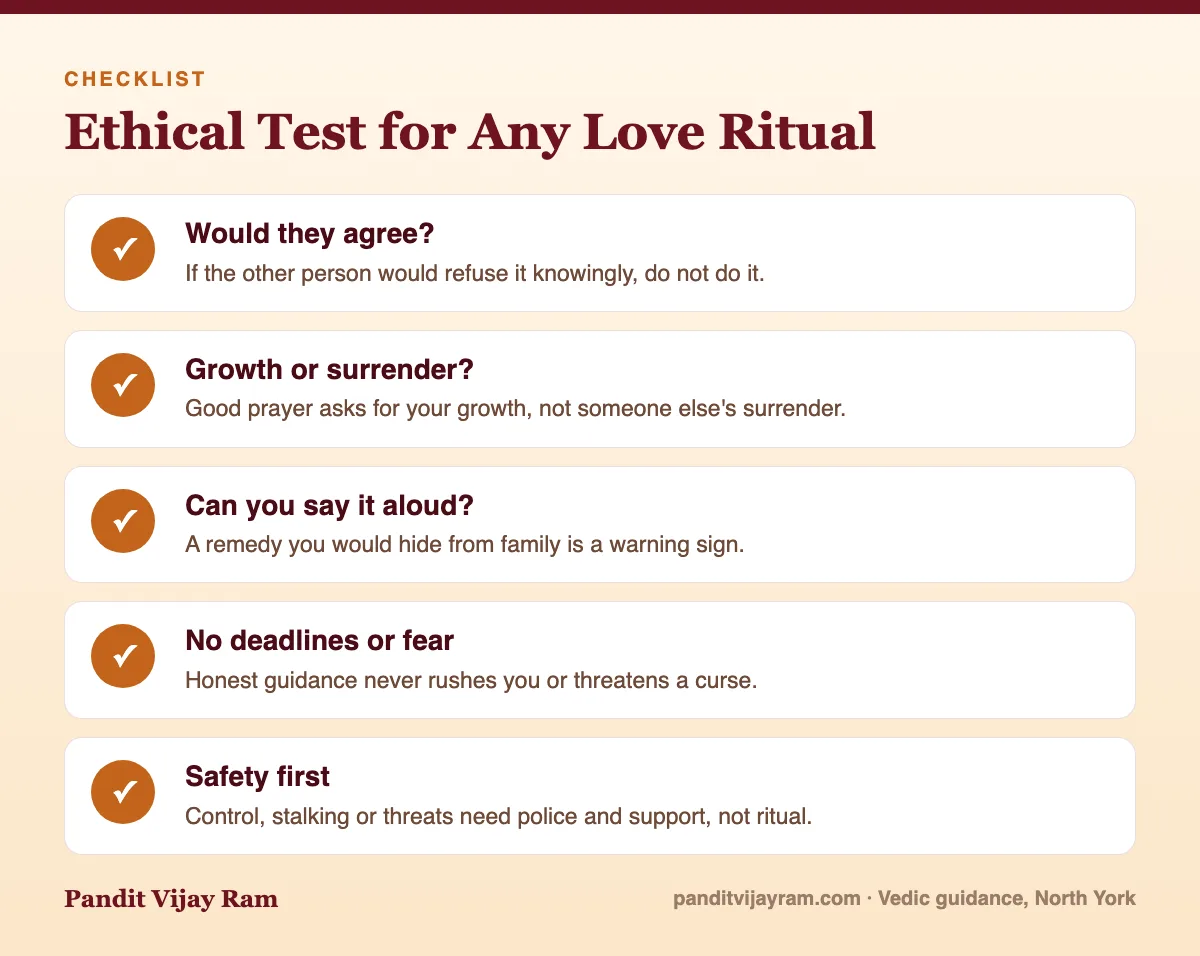
Use this ethical test before any love ritual, from any practitioner:
- Would the other person agree to this if they knew?
- Does it ask for my growth, or for their surrender?
- Could I describe it openly to my family?
If any answer is no, step back. A remedy that would embarrass you if spoken aloud is rarely one that brings peace.
When does wanting to bind someone mean I need support?
When the wish to bind comes from panic, sleeplessness, fear of abandonment or a sense that you cannot live without someone, it is worth speaking to a counsellor or your family doctor. Those feelings are common and treatable. Spiritual practice can sit alongside that care, but it should not replace it.
The longing behind a binding request is usually very human. Someone has been left, cheated on, or feels a partner drifting, and the pain is so sharp that control seems like the only relief. That is not wickedness. It is fear, and fear responds to care.
Consider reaching out for support if you notice:
- You are checking a partner's location, phone or accounts without their knowledge.
- You feel unable to eat, sleep or work since the relationship changed.
- You are thinking about following them, confronting a new partner or sending repeated messages after being asked to stop. That can become criminal harassment in Canada.
- You have thoughts of ending your life. Call or text 9-8-8 at any time.
If you are the one whose partner monitors, isolates or threatens you, that is not a spiritual problem first. It is a safety problem. Contact the police in an emergency and look for local support services.
Vijay Ram ji's love problem consultations start with listening. Sometimes the most useful thing he can offer is permission to grieve, a simple daily prayer, and encouragement to see a counsellor as well.
The bottom line
A love binding spell is a ritual meant to fix another person's feelings without their consent, and that is why Vijay Ram ji does not perform one. The idea is ancient, but evidence that it works is absent, and even tradition warns that a forced bond harms both people. Ethical alternatives such as kundli insight, Kamdev-Rati or Gauri-Shankar prayer, honest conversation and counselling work on your own life while respecting the other person's choice.
Key takeaways
- Binding means trying to fix someone's love without their consent.
- The idea is old, from Greek and Roman curse tablets to online sellers.
- Vedic ethics treat overriding free will as harm, not devotion.
- Prayer for harmony, kundli insight and counselling are the honest options.
- Panic or fear of abandonment behind the wish deserves real support.