
Kuber Mantra and Kuber Yantra: What They Are For
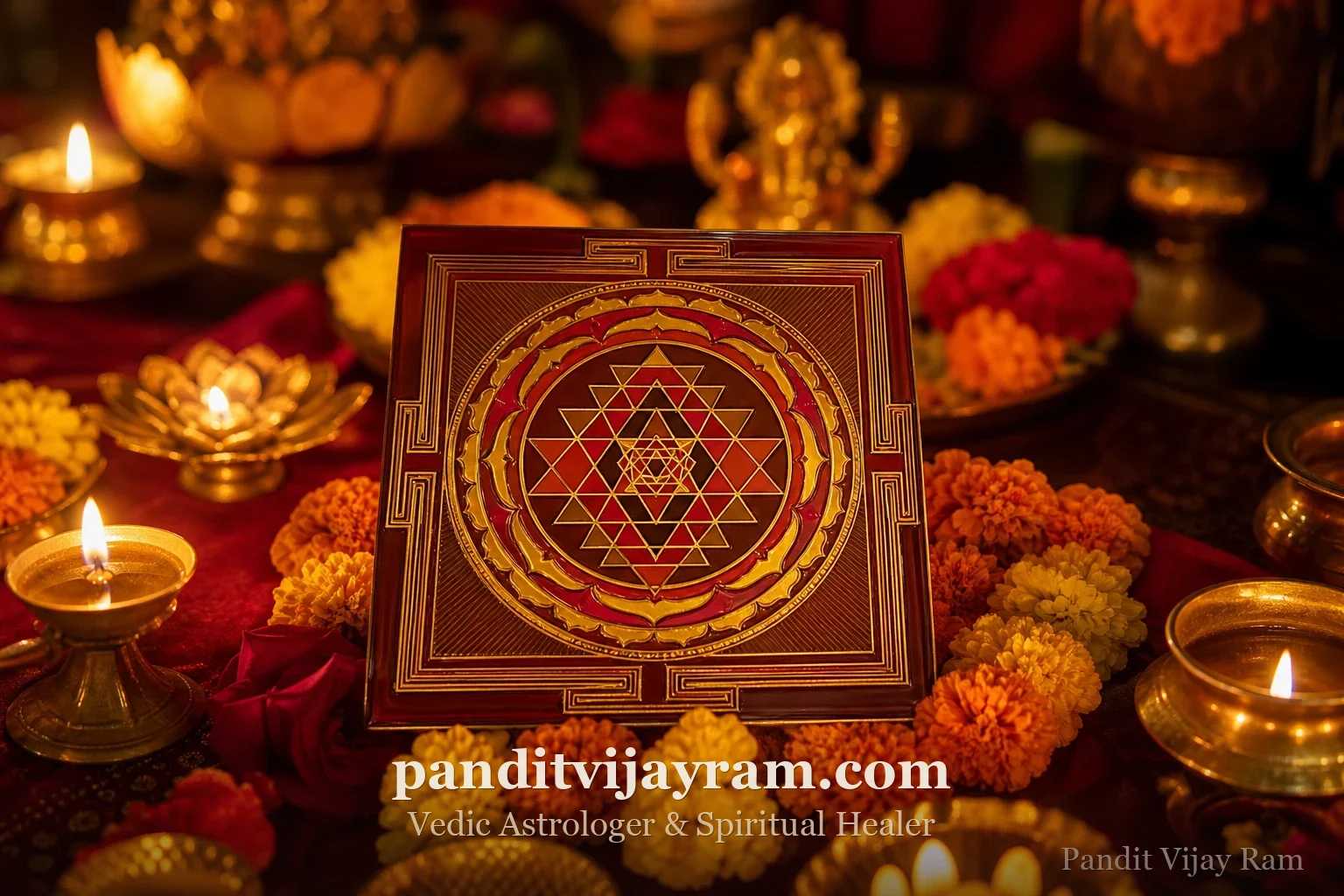
Search online for a wealth mantra and you will quickly meet Kubera, often alongside glossy yantras promising riches if you only place them correctly. Families in North York show me these purchases with a mixture of hope and embarrassment. They want to know what the Kuber mantra actually is, whether the yantra does anything, and whether they have been overcharged. Those are fair questions. Kubera is a genuine and ancient figure in Hindu, Buddhist and Jain tradition, and his worship has a real devotional meaning. That meaning is closer to careful stewardship than to sudden fortune. This article explains who Kubera is, how his mantra is recited, what a Kubera yantra is made of, and what the popular placement rules claim. It also gives you a clear way to spot the wealth-yantra scams that circulate on social media and in some shops. In more than forty years of practice, I have never seen a metal plate fix a family's finances, but I have seen regular, humble worship help people treat money with more care and less fear.
Who is Kubera in Hindu tradition?
Kubera is the god of wealth and king of the yakshas, semi-divine guardians of treasure. He is the regent of the north, one of the guardians of the directions, and is said to live in the city of Alaka in the Himalayas. Buddhists honour him as Vaishravana, and Jains also include him in their tradition.
Kubera's story is long and changes across texts. In early Vedic literature he appears as a chief of spirits, and only later, in the epics and Puranas, does he become a full deva. The Ramayana describes him as the original ruler of Lanka and owner of the flying chariot Pushpaka, until his half-brother Ravana took both. Kubera then settled in Alaka, on the slopes of the Himalayas.
He is usually shown as a stout figure with a pot belly, holding a money bag or a mongoose that spits jewels. His physical form is often described as imperfect, which some teachers read as a lesson: wealth does not bring beauty or virtue with it.
A useful distinction many families miss is the difference between Kubera and Lakshmi. Lakshmi is the source of prosperity and grace. Kubera is the treasurer who guards and distributes it. One well-known South Indian legend says that Lord Venkateswara borrowed from Kubera to pay for his wedding to Padmavati, a debt devotees say is still being repaid through offerings at Tirupati.
That image of a careful keeper of accounts is the heart of kuber puja. Our guide to a simple Lakshmi puja at home explains why families often worship the two together, especially at Dhanteras.

What is the Kuber mantra and how is it recited?
The best-known Kuber mantra is "Om Yakshaya Kuberaya Vaishravanaya Dhanadhanyadhipataye Dhanadhanyasamriddhim Me Dehi Dapaya Svaha". It addresses Kubera as lord of wealth and grain and asks for abundance. Many people recite it 108 times on a mala, often at Dhanteras or on a chosen weekday, after a short Ganesh prayer.
The mantra's phrases each carry a meaning. Yaksha refers to Kubera as king of the yakshas. Vaishravana is a family name meaning son of Vishrava. Dhanadhanyadhipati means lord of wealth and grain, a reminder that in an agricultural society food stores were the first form of riches. The final request, dehi dapaya, asks him to give and to cause others to give.
A short form, "Om Kuberaya Namah", is perfectly acceptable for daily use or for people still learning Sanskrit.
A simple way to recite it:
- Sit facing north, Kubera's direction, if your space allows.
- Light a lamp and greet Ganesh first.
- Recite the mantra slowly on a 108-bead mala, keeping count with the beads rather than your phone.
- Close by naming one practical step you will take with money that week, such as paying a bill on time.
The last step is my own suggestion, not scripture. I add it because a wealth mantra recited while ignoring the household budget becomes wishful thinking. If you would like the chart side of money explained, our article on the 2nd and 11th houses of wealth describes what astrologers read there.
Pronunciation
Regional accents differ. A recording from a recognised temple or a family elder is a good guide.
What is a Kubera yantra and where should it be placed?
A Kubera yantra is usually a three-by-three grid of numbers in which every row, column and diagonal adds to the same total, a pattern mathematicians call a magic square. It is engraved on copper, brass or silver. Popular advice places it on a north wall or inside a cash box, as a reminder of careful saving.
A yantra in Hindu practice is a geometric diagram used as a focus for meditation and worship. Some yantras are complex designs of triangles and lotus petals, such as the Shri Yantra. The Kubera yantra is simpler: a numerical square with matching sums, often framed with Kubera's image or mantra.
Magic squares have a long history across India, China, the Islamic world and Europe, and they were valued as symbols of balance and order. That history explains their spiritual use; it does not prove they attract money.
Common placement claims include:
- North wall or north-facing shelf. This follows vastu's association of the north with Kubera and with wealth.
- Inside a safe, locker or cash drawer. Shopkeepers often keep one where money is counted.
- Installed on Dhanteras or a Thursday or Friday. These dates are customary, not essential.
- "Energised" by a priest. In genuine practice this is done through mantra and puja, not a hidden price tier.
I treat placement as symbolic. Keeping a yantra in the place you handle money can remind you to count, record and save. If you want broader advice on your home or shop layout, a vastu consultation starts with practical changes and avoids costly gadgets, a point also made in our guide to vastu remedies without demolition.
Are wealth yantras sold online a scam?
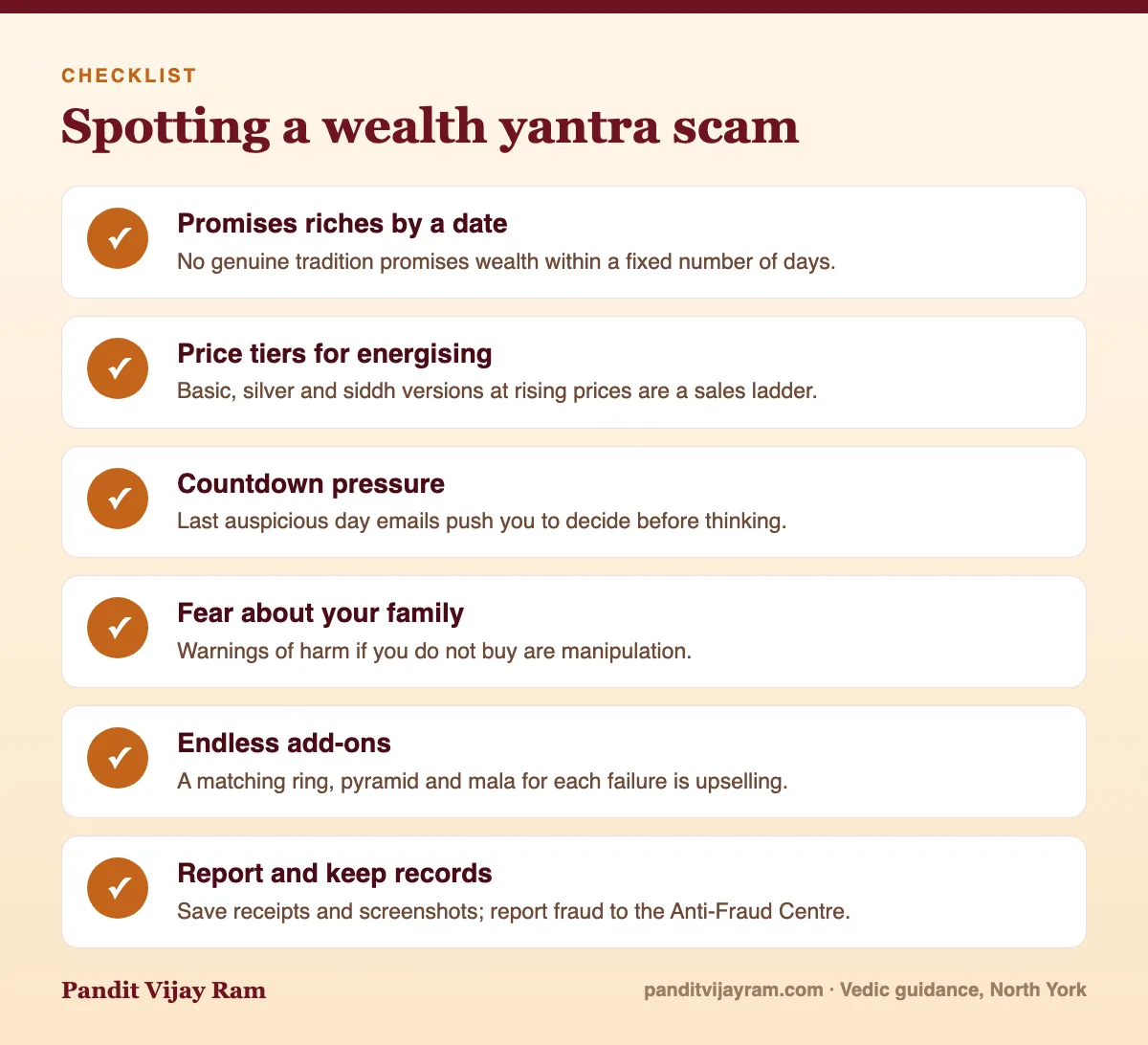
Many are. A plain copper Kubera yantra is an inexpensive devotional object. Warning signs of a scam include promises of certain riches, claims of rare energising that justify high prices, countdown offers, invented reviews and requests to buy more items when nothing changes. Report fraud to the Canadian Anti-Fraud Centre.
The wealth-yantra market grows whenever money is tight, because worried people are easier to sell to. Here is a checklist I share with families who show me their purchases:
- Outcome promises. "Become rich in 40 days" or "debt-free guaranteed" claims are not part of any genuine tradition.
- Secret energising tiers. A basic, silver and "siddh" version at rising prices is a sales ladder, not a spiritual distinction.
- Urgency. Countdown timers and "last auspicious day" emails create pressure to decide quickly.
- Fear language. Warnings that your family will suffer if you do not buy are manipulation.
- Upselling. When the first item "needs" a matching pyramid, rudraksha and ring, stop.
- Precious-metal claims. Silver or gold plating is easy to fake. Ask for a written description of the metal.
If you have paid for something that was misrepresented, keep receipts and screenshots and report it to the Canadian Anti-Fraud Centre. Our article on warning signs of spiritual scams covers related tactics.
A respectful kubera yantra does not need to be expensive. A simple copper plate, a clean cloth and sincere recitation are all a household needs.
How do Kubera and Lakshmi worship fit with good money habits?
Worship of Kubera and Lakshmi works best alongside budgeting, saving and honest dealing. Kubera represents careful stewardship, so his worship pairs naturally with tracking spending and paying debts. Kubera-Lakshmi puja at Dhanteras or Diwali marks gratitude and fresh discipline. Financial problems still need a budget, credit counselling or a licensed adviser.
The tradition itself links wealth with dharma. Money earned honestly, shared generously and managed with care is considered blessed. Money gained by deceit, hoarded or wasted is not. Kubera, the cautious treasurer, is a fitting symbol for that ethic.
Practical habits that honour this idea:
- Keep a simple monthly record of income and spending, perhaps beside the yantra if you have one.
- Set aside a small fixed amount for savings before discretionary spending.
- Give regularly, even modestly, to a temple, food bank or person in need.
- Pay workers and suppliers fairly and on time.
If debt is overwhelming, start with a non-profit credit counsellor and a realistic budget, as our guide to debt and money stress remedies explains. If a business is struggling, a cash-flow review comes first. I do not give investment or financial advice; a licensed professional should.
For families who want a formal Kubera-Lakshmi puja, such as at Dhanteras or a shop opening, the puja and anushthan service can arrange it with a sankalpa in your name. The purpose is gratitude and a fresh intention, not a payment in exchange for wealth.
The bottom line
The Kuber mantra honours Kubera, the guardian of wealth and regent of the north, and the Kubera yantra is a simple magic square used as a focus for that worship. Placement rules about north walls and cash boxes are symbolic reminders of careful saving, not mechanisms for attracting money. Expensive wealth yantras sold with promised results are a common scam, and fraud should be reported. Worship Kubera alongside Lakshmi with sincerity, and pair it with a budget and honest dealing.
Key takeaways
- Kubera is the treasurer of the gods, while Lakshmi is the source of prosperity.
- The Kuber mantra asks for abundance of wealth and grain and is often recited 108 times.
- A Kubera yantra is a magic square of numbers, usually on copper or brass.
- Placement advice is symbolic and should never justify a high price.
- Any object sold with a promise of sure wealth is a warning sign of fraud.