
Lakshmi Puja at Home: Meaning and a Simple Method

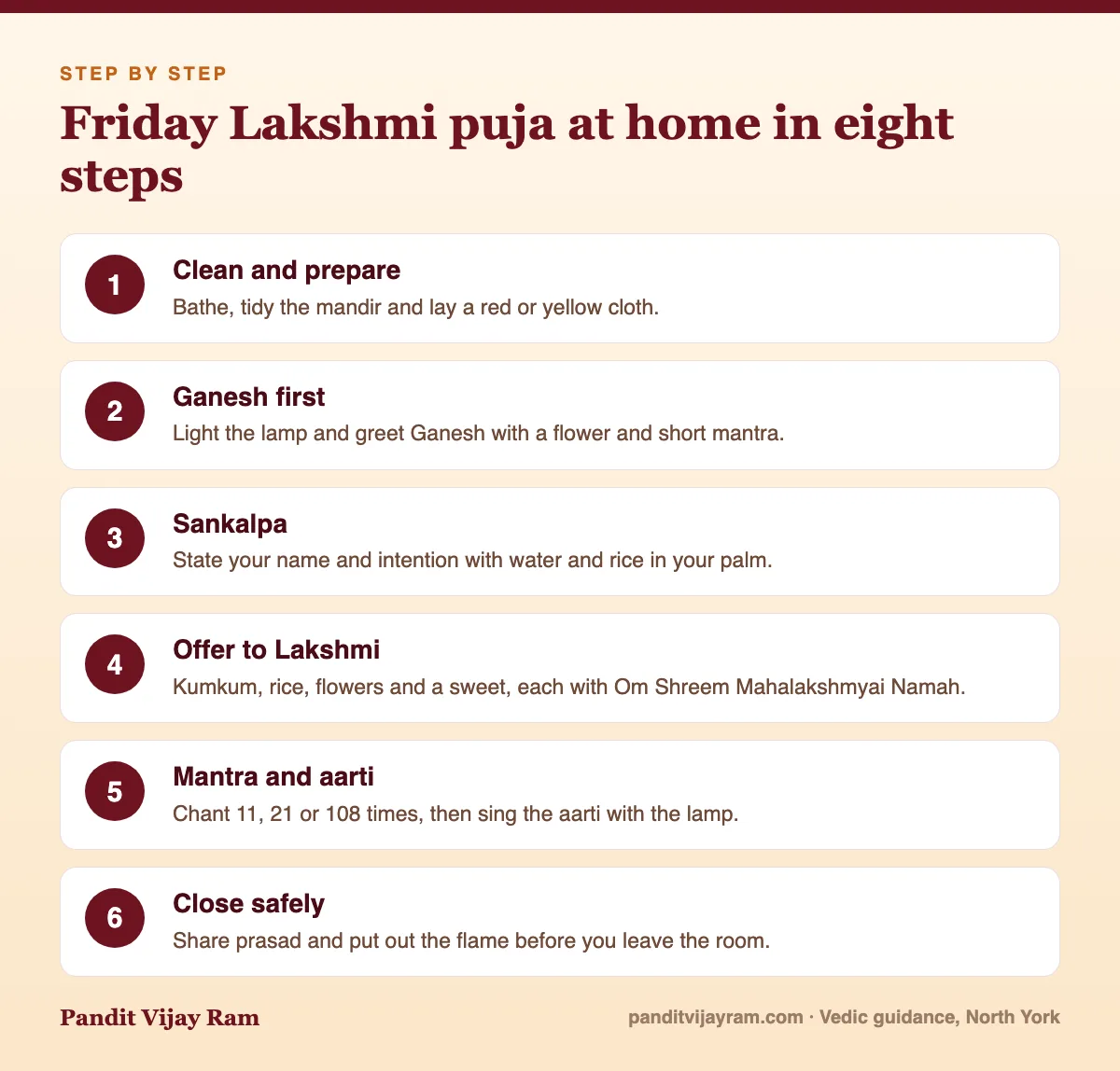
Many households keep a picture of Lakshmi near the entrance or in the mandir, yet feel unsure how to worship her outside of Diwali. Others worry that a small, simple observance will not count. Families in North York ask me about Lakshmi puja at home more than almost any other ritual, usually because they want a steady weekly practice rather than one big festival. This guide gives you exactly that. It explains what Lakshmi represents in Hindu tradition, why Friday is chosen, how regional customs such as Varalakshmi Vratam and Kojagari puja differ, and which mantra suits a beginner. You will find a short step-by-step method that fits a condo shelf as easily as a large puja room, with plain notes on lamp safety in Canadian homes. In more than forty years of practice, I have come to believe that the quiet weekly puja, done with a clean heart, teaches more about prosperity than any elaborate ceremony. The Diwali observance has its own guide, which I link below, so this one focuses on the ordinary week.
What is the meaning of Lakshmi puja?
Lakshmi puja honours the goddess of prosperity, fortune and auspiciousness, the consort of Vishnu. Tradition says she emerged from the churning of the cosmic ocean, seated on a lotus. Worshipping her expresses gratitude for what sustains a household, including health, food, harmony, courage and knowledge, as well as money.
Lakshmi is one of the most widely worshipped goddesses in Hinduism. She is usually shown seated or standing on a lotus, often with gold coins flowing from one hand and elephants pouring water beside her. The lotus grows from muddy water yet stays clean, a reminder that wealth should be earned and held without corruption.
The tradition of Ashta Lakshmi, the eight forms of Lakshmi, makes her meaning clear. Each form presides over a different kind of wealth:
- Adi Lakshmi, the primal form, linked with spiritual wealth.
- Dhana Lakshmi, money and material resources.
- Dhanya Lakshmi, grain and nourishment.
- Gaja Lakshmi, abundance and royal dignity.
- Santana Lakshmi, children and family continuity.
- Dhairya or Veera Lakshmi, courage.
- Vijaya Lakshmi, success and victory over difficulty.
- Vidya Lakshmi, knowledge.
Lists and names differ a little between regions, but the idea is constant: prosperity is wider than a bank balance. A family with steady meals, healthy children and peace at home is already blessed by Lakshmi.
That is why I discourage people from treating a prosperity puja as a way to attract sudden money. If you are in debt or financial stress, start with a budget and credit counselling, as our guide to money stress and Vedic remedies explains, and keep the puja as a source of gratitude and discipline.

Why is Lakshmi puja done on Friday?
Friday, or Shukravar, is ruled by Venus, the planet of comfort, beauty and refinement, and is traditionally dedicated to Lakshmi. Many families keep a Friday Lakshmi puja or the Vaibhav Lakshmi vrat. Regional festivals such as Varalakshmi Vratam in the south and Kojagari puja in the east follow their own lunar timing.
Each weekday in the Vedic calendar has a planetary ruler. Venus, called Shukra, rules Friday and signifies beauty, pleasure, art and household comfort. Lakshmi's associations with abundance and grace made Friday a natural day for her worship.
Customs vary widely across India and the diaspora:
- Weekly Friday puja. Common in many North Indian and Gujarati homes, sometimes kept as the Vaibhav Lakshmi vrat for a chosen number of Fridays.
- Varalakshmi Vratam. Observed mainly by married women in Andhra Pradesh, Telangana, Karnataka and Tamil Nadu on a Friday in the month of Shravana, with a decorated kalash representing the goddess.
- Kojagari Lakshmi puja. Kept in Bengal, Odisha and Assam on the full moon after Durga Puja, when families stay awake through the night.
- Diwali Lakshmi-Ganesh puja. The best-known observance, covered in our Diwali Lakshmi puja guide.
For festival timings, use a current Toronto panchang, since lunar dates shift each year and local sunrise affects them. For an ordinary week, any Friday morning or evening works. Many families light the lamp at dusk, when the household gathers.
If you choose to fast on Fridays, keep it gentle. People with diabetes, low blood pressure, pregnancy or regular medication should speak with their doctor before fasting.
Caribbean households
Many Indo-Caribbean families keep Lakshmi puja within larger Diwali and jhandi observances, with their own songs and customs.
What do you need for a simple Lakshmi puja vidhi?
You need a clean spot, a picture or murti of Lakshmi, a lamp with ghee or oil, incense, fresh flowers, kumkum or turmeric, uncooked rice, water and a simple sweet such as kheer or fruit. A small Ganesh image is placed nearby, since Ganesh is worshipped first.
A Lakshmi puja vidhi does not require a shopping trip. Most items are already in an Indian kitchen, and substitutes are fine.
- Seat for the deity. A low stool or clean shelf with a red or yellow cloth.
- Image. A framed picture or small murti of Lakshmi, plus Ganesh to her left from your view or as your family places him.
- Lamp. A brass or clay diya with ghee and a cotton wick. A sesame-oil lamp is also traditional.
- Water. A small kalash or cup with clean water for achaman and offering.
- Kumkum, haldi and rice. Unbroken rice grains, called akshata, mixed with a little turmeric.
- Flowers. Lotus is ideal but hard to find; red roses, marigolds or any fresh flower will do.
- Naivedya. Kheer, a homemade sweet, fruit or even sugar crystals.
- Incense or dhoop. Optional in apartments with sensitive alarms.
A fuller list, with substitutes for harder-to-find items, is in our puja samagri guide. Keep the space itself clean; the article on caring for your home mandir has a weekly routine.
Some families add coins, a shri yantra or a conch. These are traditional but not required. Do not buy expensive items out of worry that the puja will fail without them.
Which Lakshmi mantra should a beginner recite?
A beginner can recite "Om Shreem Mahalakshmyai Namah" 11, 21 or 108 times. The Lakshmi Gayatri is another short option. Families who want a longer recitation often use the Shri Suktam, a hymn attached to the Rigveda. Sincerity and steady practice matter more than perfect pronunciation.
Three recitations cover most home needs:
- Beej mantra. "Om Shreem Mahalakshmyai Namah." Shreem is the seed syllable linked with Lakshmi. It is short enough for children and new learners.
- Lakshmi Gayatri. "Om Mahalakshmyai cha vidmahe, Vishnupatnyai cha dhimahi, tanno Lakshmih prachodayat." It asks for understanding and inspiration from the goddess.
- Shri Suktam. A set of verses found in the khila, or supplementary hymns, of the Rigveda. It praises Shri as radiant and nourishing and is often recited on Fridays and at Diwali.
Pronunciation varies by region and teacher, and that is acceptable. If you are unsure, listen to a recording by a recognised temple or learn from a family elder. A slow, clear recitation is better than a fast one you cannot follow.
People sometimes ask whether to pair Lakshmi with Kubera, the treasurer of wealth. Some families do, particularly around Dhanteras. Our article on the Kuber mantra and yantra explains the difference and why you should be sceptical of costly "wealth" objects.
For a family occasion such as a housewarming or a new business, a priest-led observance may suit you better. The puja and anushthan service can arrange a fuller Lakshmi puja with sankalpa in your family's name.
How do you keep a home puja safe in a Canadian condo or house?
Place the lamp on a stable, heat-proof plate away from curtains, keep it out of reach of children and pets, and never leave a flame unattended. In condos, use a small ghee lamp rather than heavy incense near smoke detectors. Disposing of offerings kindly and keeping fasts gentle are part of safe practice.
Fire is part of every puja, and Canadian homes have features that call for extra care: sealed windows in winter, sensitive alarms and shared hallways in condos.
- Stable base. Set the diya on a metal plate or tile. Keep it a safe distance from cloth, paper pictures and dried flowers.
- Never unattended. Put the lamp out before you leave the room or go to sleep, or watch it until it burns down.
- Smoke detectors. Do not cover or disable them. Choose low-smoke ghee lamps and skip heavy dhoop if the alarm is close.
- Children and pets. Raised shelves and closed doors prevent accidents with flames and hot oil.
- Battery diyas. In rentals or hospital rooms, an electric lamp is an acceptable devotional choice.
- Offerings. Share prasad with family. Place wilted flowers in garden soil or green-bin compost, not in lakes or rivers.
Respect for the goddess includes respect for neighbours and for your own household's safety. A small, well-tended lamp honours Lakshmi just as fully as a large one.
The bottom line
Lakshmi puja at home is a simple, weekly act of gratitude for everything that sustains a family, from food and health to courage and knowledge. Friday is the traditional day, and regional customs such as Varalakshmi Vratam and Kojagari puja show how varied the practice is. A lamp, flowers, a sweet and one short mantra are enough to begin. Keep the flame safe, keep the house harmonious, and let the puja shape how you earn and share.
Key takeaways
- Lakshmi represents many kinds of prosperity, as the eight forms of Ashta Lakshmi show.
- Friday is traditional because Venus rules the day and Lakshmi is honoured on it.
- A lamp, flowers, rice, kumkum and a simple sweet are enough for a home puja.
- Om Shreem Mahalakshmyai Namah is a suitable mantra for beginners.
- Never leave a lamp unattended, and keep smoke detectors working.