
Toxic Relationship Signs: A Clear List

Toxic is a word people use loosely, so it helps to be precise. Every couple has bad days, sharp words and seasons of distance. A toxic relationship is different: the harm is a pattern, and it slowly wears down your confidence, your health and your sense of who you are. When people in North York ask me about toxic relationship signs, they often already sense something is wrong but doubt their own judgement. This post gives you a clear list you can check against your own experience, explains the difference between an unhealthy relationship and an abusive one, describes what tends to happen next, and points you to real safety resources in Ontario. In more than forty years of practice I have learned that the most important question is not what the chart says. It is whether you feel safe and respected in your own home. If the answer is no, that matters more than anything else in this guide.
What are the signs of a toxic relationship?
Key signs include feeling worse about yourself since the relationship began, constant criticism or mockery, being blamed for everything, frequent lies, jealousy that limits your freedom, scorekeeping, and fear of your partner's reactions. One bad moment is not toxic. A steady pattern of these behaviours is what defines it.
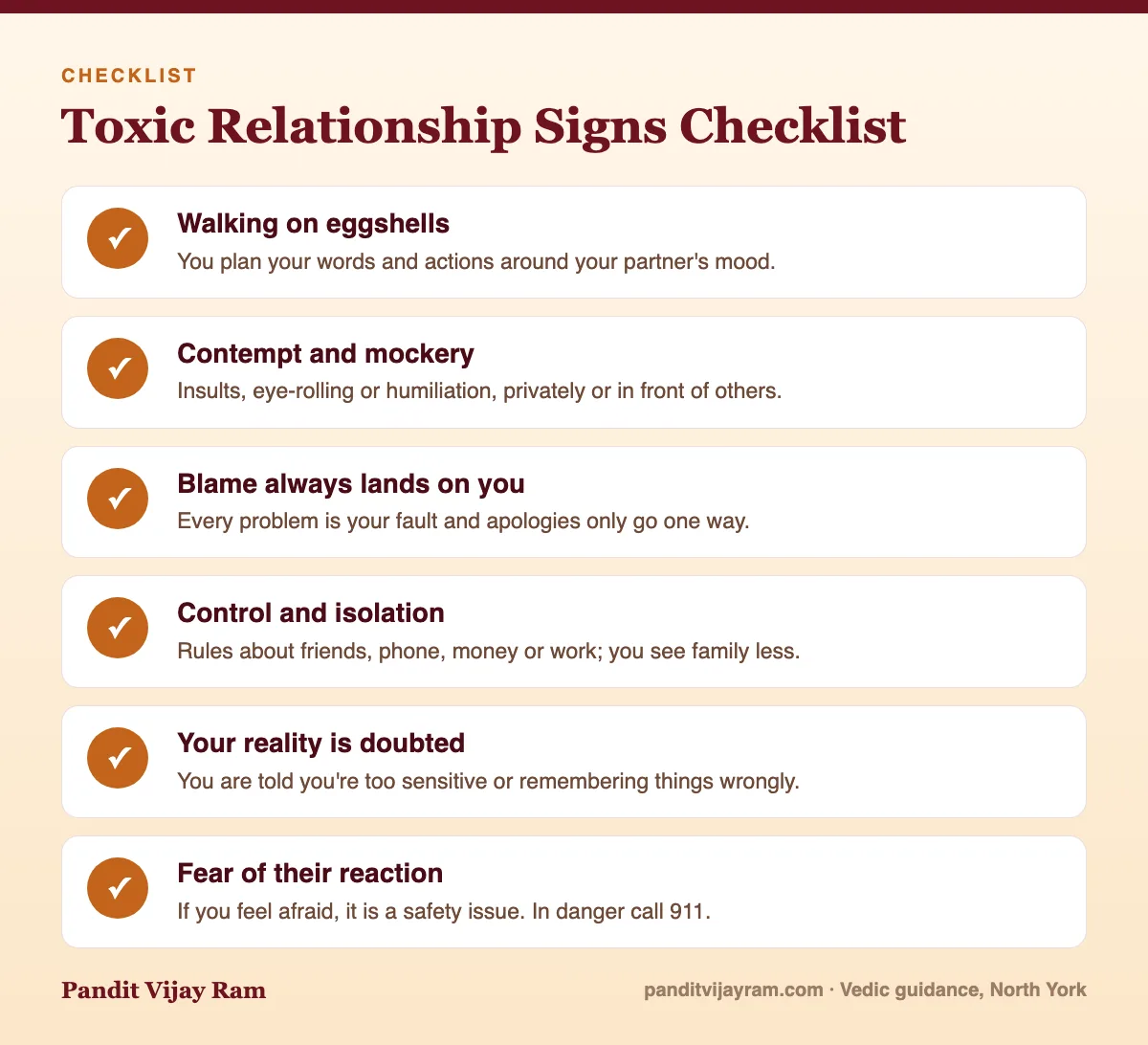
Read this list slowly and notice which items describe your life most weeks, not just on a bad day:
- You walk on eggshells, planning words and actions around their mood.
- Contempt: mocking, name-calling, eye-rolling or humiliation, including in front of others.
- Constant blame: every problem becomes your fault, and apologies only flow one way.
- Dishonesty: repeated lies, hidden spending or secret contact that is denied when raised.
- Controlling jealousy: rules about friends, clothes, work or phone use.
- Isolation: you see family and friends less because it causes trouble at home.
- Scorekeeping: past mistakes are kept and used as weapons in every argument.
- Your reality is questioned: you are told you are too sensitive or remembering wrongly.
- Your health is slipping: poor sleep, anxiety, headaches or low mood since the relationship began.
- Fear: you are afraid of what they might do if you disagree or leave.
A rough decision rule: two or three items that both partners acknowledge and want to change suggest an unhealthy pattern worth working on. Items eight and ten, or several items together, point toward abuse and safety comes first.

What is the difference between a toxic relationship and an abusive one?
An unhealthy or toxic relationship can involve two people hurting each other through poor habits, and both may be able to change. Abuse is a pattern where one person uses fear, control, threats, humiliation or violence to dominate the other. The key questions are who holds power and whether you feel afraid.
The word toxic is sometimes used for mutual dysfunction: both partners shout, both sulk, both keep score. That is painful, and counselling can help when both are willing.
Abuse has a different shape:
- Power is one-sided. One partner makes the rules, controls money or decides who you see.
- Fear is present. You change your behaviour to avoid anger, punishment or violence.
- It escalates. Incidents tend to become more frequent or more serious over time.
- Apologies follow a cycle. Remorse and affection after an incident, then rising tension again.
Abuse is not always physical. Emotional, financial, sexual and spiritual abuse, including threats to curse you or shame you before the community, can be just as damaging. Two related patterns have their own guides: gaslighting signs, where your memory and judgement are undermined, and controlling partner signs, which covers coercive control in detail.
Couples counselling is generally not recommended where one partner is abusing the other, because the person being harmed may not be able to speak safely in the room.
Can a toxic relationship become healthy again?
Sometimes, when the problems are mutual habits rather than abuse, and when both partners admit the harm and commit to change with professional help. Real change shows up in behaviour over months, not in promises. If change depends on you trying harder while your partner stays the same, it is unlikely to last.
Signs that repair may be possible:
- Both partners can name their own harmful behaviour without being prompted.
- Neither person is afraid of the other.
- Both attend counselling and practise what they learn between sessions.
- Improvements continue even when life gets stressful.
Signs that it probably cannot become healthy as things stand:
- Only one partner admits a problem.
- Apologies are frequent, but behaviour returns to the same pattern.
- Your partner blames you, alcohol, stress or their family for everything they do.
- You feel you are disappearing as a person.
For a full decision guide, read is my relationship worth saving. If there is a cycle of breaking up and reuniting, the post on on-and-off relationships explains how trauma bonds keep people returning.
Give any promised change a fair test: agree what will be different, notice what actually happens over the following months, and trust what you see. Leaving a toxic partner is a valid and often healthy choice. It is not a failure of love or of faith.
Where can I get help if my relationship is toxic or abusive in Ontario?
In immediate danger, call 911. The Assaulted Women's Helpline offers free, confidential crisis support across Ontario at 1-866-863-0511, and 211 connects you with local shelters and counselling. If you feel hopeless or unsafe with your own thoughts, call or text 988. Your family doctor can also help and refer you.
You do not need to be certain it is abuse before reaching out. Helplines talk with people who are unsure every day.
- Emergency: call 911 if you or your children are in danger now.
- Assaulted Women's Helpline: 1-866-863-0511, around the clock, with interpretation support available. On several mobile networks you can dial #SAFE (#7233).
- 211 Ontario: dial 211 to find shelters, counselling and support for men, women and LGBTQ+ people in your area.
- 988: the Suicide Crisis Helpline, by call or text, for anyone in emotional crisis.
- Your family doctor can document injuries or health effects and refer you to counselling.
Our GTA domestic violence help guide lists verified services by region, and the legal aid guide for families explains where to find advice about separation and custody.
If someone checks your phone or browser, consider using a device they cannot access, such as a friend's phone or a library computer, when looking for help.
How can spiritual support help after a toxic relationship?
Spiritual practice can help rebuild calm, self-respect and a sense of meaning after a draining relationship. Prayer, mantra and a supportive community steady the mind. It works best once you are safe, and alongside counselling. A genuine practitioner will never tell you to stay in an abusive situation for spiritual reasons.
After a toxic relationship many people describe feeling heavy, foggy or as if they lost themselves. Gentle practices can help you reconnect with who you are:
- A short morning prayer or lamp-lighting that belongs only to you.
- Chanting the Hanuman Chalisa or a Durga mantra for courage, if that suits your faith.
- Returning to temple, gurdwara, mosque or church community where you felt accepted.
- Journalling about what you value and want in future relationships.
In a marriage problem consultation I may read the chart for difficult periods and suggest prayers for strength and clear thinking. I do not tell anyone that suffering at home is their karma to endure, and I will never offer a ritual to make an abusive partner change while you remain in danger. Safety and professional help always come before spiritual remedies.
If grief follows the end of the relationship, the post on relationship grief offers a gentle framework.
The bottom line
Toxic relationship signs include contempt, constant blame, controlling jealousy, isolation and walking on eggshells, and the pattern matters more than any single incident. Mutual unhealthy habits may improve with honest effort and counselling, but fear, threats and control are abuse. In danger call 911, and use the Assaulted Women's Helpline, 211 or 988 for support.
Key takeaways
- A toxic relationship is defined by a repeated pattern, not one bad day.
- Fear and one-sided control mark the line between unhealthy and abusive.
- Real change shows in behaviour over months, not in repeated promises.
- Ontario helplines and 911 are there even if you are unsure it is abuse.
- No spiritual reason ever requires you to stay where you are unsafe.