
Ex Came Back and Left Again: Breaking the On-Off Cycle

The first breakup hurt. The second one hurt in a different way, because you had believed this time would be different. By the third or fourth, you may feel embarrassed to tell friends, and unsure whether you are in love or simply stuck. An on and off relationship can be one of the most exhausting experiences a person goes through, because the relief of each reunion is always followed by the dread of the next ending. People from North York and right across the GTA describe this pattern to me often, usually with the words: my ex came back again, and then left again. This guide explains why these cycles happen, what a trauma bond is and how to recognise one, whether an on-again, off-again relationship can ever settle, practical steps to break the loop, and how Vedic astrology views a bond that keeps breaking and mending. In my forty-plus years of listening to couples, I have learned that clarity rarely arrives during a reunion or a breakup. It comes in the calm in between, and that is where this guide asks you to make your decision.
Why do on and off relationships keep happening?
Cycles usually repeat because the core problem behind each breakup is never resolved. Strong chemistry, fear of being alone, shared friends, family expectations and the comfort of the familiar all pull couples back together. The reunion brings relief, the old issue returns, and the relationship ends again for the same reason it ended before.
If you look back at each breakup in an on-off relationship, you will often find the same reason dressed in different clothes. One partner wants commitment and the other does not. One wants to live near family and the other does not. Jealousy flares, someone lies, someone withdraws. The details change; the root does not.
Common forces that pull couples back:
- Chemistry and familiarity. Physical closeness and shared history create a strong pull, especially in lonely moments.
- Fear of starting over. Dating again, explaining the breakup to family, the thought of being single at a certain age.
- Shared lives. Mutual friends, a lease, a car, a pet or plans for a wedding.
- Cultural pressure. In some families a broken engagement or a known relationship that ends brings gossip, so reuniting feels easier than explaining.
- Hope. Each reunion begins with promises, and the early days after reuniting often feel wonderful.
What tends to be missing is a serious conversation, while calm, about the reason for the last breakup and what specifically will be different. Without that, the reunion is a pause, not a repair.
Anxiety can also drive the cycle. If you notice constant worry about whether your partner will leave, our guide on relationship anxiety offers calming practices and points to therapy that helps.

What is a trauma bond, and is that why my ex keeps coming back?
A trauma bond is a strong emotional attachment formed through a repeated cycle of harm followed by affection, usually with a power imbalance. The unpredictable mix of pain and relief makes the bond feel intense and hard to leave. Not every on-off relationship is a trauma bond, but cycles involving cruelty, control or fear often are.
The term trauma bonding was developed by researchers studying abusive relationships. They noticed that people often felt most attached to partners who alternated between harm and warmth. The pattern works like this: tension builds, something hurtful happens, then comes an apology, affection or a romantic reunion. The relief is so powerful that it feels like love, and the memory of it keeps people hoping.
Signs your cycle may be a trauma bond rather than an ordinary on-off pattern:
- You feel afraid of your partner's moods and adjust your behaviour to avoid them.
- Breakups often follow put-downs, threats, lies or control, not just disagreements.
- Reunions involve intense affection or gifts, sometimes called love bombing, which then fades.
- Friends and family worry about you, and you have stopped telling them what happens.
- You defend your partner to others while privately feeling worse each time.
Our article on love bombing explains how that intense reunion phase works. If any of these signs involve violence, threats or control, please treat this as a safety matter. Our guide to domestic violence help in the GTA lists shelters and helplines, and 911 is for immediate danger.
A trauma bond is not a weakness. It is a predictable human response to an unpredictable pattern. Leaving one usually needs support from a counsellor, friends, family or a specialist service.
Can an on-again, off-again relationship ever work?
Some couples who separate and reunite do build lasting relationships, especially when the earlier breakups came from immaturity, timing or outside pressure and both people have since changed. It rarely works when the same issue causes every split. The deciding question is simple: what is concretely different this time, and can you both name it?
Not every couple who breaks up more than once is doomed. Some people meet young, separate to grow, and return as more settled adults. Others break up during a crisis such as a family illness or a move, then reunite when life calms down.
Use this decision rule before agreeing to another reunion:
- Name the reason for the last breakup in one sentence. If you cannot, you are not ready.
- Ask what has changed about that reason. Not feelings, but facts: a new job, counselling completed, sobriety maintained, a decision about marriage.
- Check whether the change is sustained. Weeks of good behaviour during a reunion attempt do not count. Months of change while apart do.
- Check safety. If either of you has felt afraid of the other, stop and get support.
- Agree on what happens if the issue returns. Couples counselling, a pause, or a final ending, decided now while calm.
If you can answer the first three clearly and the fourth is a firm no to fear, a careful reunion may be reasonable. Our checklist on whether to get back with your ex goes into this decision in more depth.
If you cannot answer them, another reunion is likely to end the same way. That is not a judgement on your love. It is a pattern asking to be seen.
How do you break the on and off cycle for good?
Map the past cycles on paper, decide while calm rather than mid-reunion or mid-breakup, set a firm rule for future contact, tell someone you trust, and plan for the moments that usually pull you back. Reduce contact, mute or block if needed, and get counselling support. The cycle loosens when you stop deciding in emotional peaks.
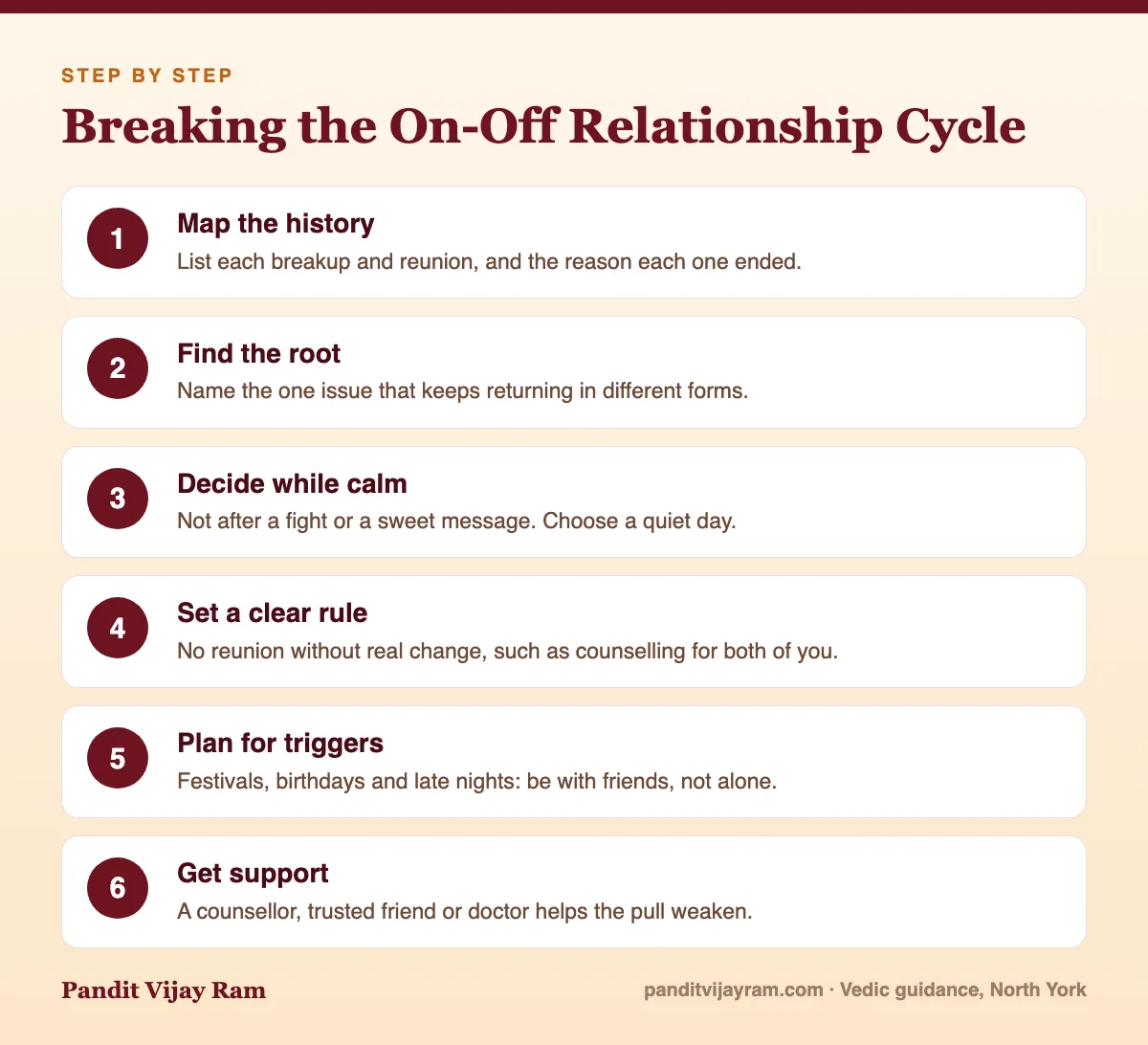
Cycles depend on decisions made in intense moments. Breaking them means moving decisions to calmer ground. These steps help:
- Write the history. List each breakup and reunion: when, why it ended, why you went back, how long it lasted. Patterns become obvious on paper.
- Choose a calm decision day. Not after a fight and not after a sweet message. A quiet morning, ideally after talking with someone neutral.
- Set a rule. For example: no reunion without three months of separate counselling for both of us. Or: this ending is final.
- Tell one trusted person. Someone who will remind you of your decision without judging you.
- Know your triggers. Birthdays, Diwali, Eid, Christmas, Valentine's Day, late nights and drinking are classic reunion moments. Plan to be with friends.
- Reduce access. Mute, archive or block. Return belongings in one go. Remove the shortcuts to their profile.
- Make your own closure. You do not need one more conversation to end it. Our guide on closure after a breakup offers methods that do not depend on them.
Expect the pull to be strong for a while. Each time you do not act on it, the cycle weakens. If low mood, sleeplessness or panic continue for weeks, see your family doctor, and for crisis moments call or text 988.
How does Vedic astrology view a relationship that keeps breaking and returning?
Vedic astrology may describe a repeating pattern through the Rahu and Ketu axis, an afflicted or restless Moon, or changing dashas that bring attraction and separation in turns. These describe tendencies and seasons. They do not mean you are fated to keep returning, and a karmic label should never be used to excuse harm or control.
People sometimes tell me a previous reader called their on-off partner a karmic soulmate, and that they must keep trying until the debt is paid. I gently disagree with how that idea is often used.
In a careful reading, I might look at:
- Rahu and Ketu across the first and seventh houses, often read as intense attraction alongside a pull towards letting go.
- The Moon, the mind and emotional rhythm. A Moon under strain may show strong swings between longing and withdrawal.
- Venus and the seventh lord for how you tend to love and choose partners.
- Dasha changes, which can coincide with periods of reunion and separation.
These factors describe tendencies to understand, not orders to obey. The idea of karmic bonds, sometimes called rinanubandhan, is discussed in our guide to karmic relationships in Vedic thought. Even if a bond is karmic, the tradition values ahimsa, non-harm, above staying in pain.
Remedies I suggest focus on your own clarity: a short Monday prayer to Shiva for a steady mind, chanting Om Namah Shivaya during restless evenings, and acts of seva that ground you. Through a get ex love back consultation I can read both the chart and the pattern with you, but I will not perform rituals to hold anyone in a cycle or pull them back into it.
The bottom line
An on and off relationship repeats when the reason for each breakup is never resolved, and the relief of each reunion can deepen a bond that feels like love but behaves like a trap. Some couples do succeed after reuniting, but only when they can name what has concretely changed and both feel safe. Break the cycle by mapping its history, deciding in calm moments and planning for triggers. Astrology can describe the pattern, never require you to stay in it.
Key takeaways
- On-off cycles usually repeat because the original problem is never solved.
- A trauma bond forms through alternating harm and affection, often with a power imbalance.
- Ask what has concretely changed before agreeing to any reunion.
- Make decisions in calm moments, not at emotional peaks.
- A karmic label never justifies staying in a harmful pattern.