
Relationship Grief: Understanding What You Are Going Through

When a relationship ends, people around you may treat it as a setback you should be over in a few weeks. Yet you may feel something closer to bereavement: a hollow ache, waves of disbelief, sudden tears in the grocery store. That is relationship grief, and it deserves to be taken seriously. Many people in North York tell me they feel foolish for mourning someone who is still alive and living across town. I tell them that grief follows love, not death certificates. This guide explains what you are going through: the many losses hidden inside one breakup, how the familiar stages of grief really work, and why the process moves back and forth. It gives honest expectations about how long grief lasts and what makes it longer, along with signs that grief has become stuck and needs help. Across more than forty years of sitting with grieving people, I have found that naming the loss clearly is one of the most healing things a person can do. When you know what you are mourning, you can mourn it fully and then begin, slowly, to live forward.
Is it normal to grieve the end of a relationship?
Yes. Grieving a relationship is a normal response to losing someone you loved and a life you built together. The feelings, such as sadness, anger, numbness and longing, closely resemble other kinds of grief. Because the other person is still alive, this loss is often less recognised, which can make it lonelier.
Grief researchers use the phrase disenfranchised grief for losses that others do not openly acknowledge. Breakups often fall into this group. There is no funeral, no condolence visit, no time off work. Friends may say "plenty of fish in the sea" when you are still in shock.
Relationship grief can be especially unacknowledged when:
- The relationship was secret from family, so nobody knew there was anything to lose.
- You were the one who ended it, and others assume you should feel only relief.
- It was an engagement or a long courtship that never reached marriage.
- The relationship was same-sex, interfaith or across caste and was not accepted around you.
- You were together only a short time, but the bond was intense.
In diaspora communities, a broken engagement carries its own weight of gifts, guests and questions. The guide to when an engagement is broken off covers those practical and family matters. The broader cultural silence is discussed in heartbreak in South Asian families.
Whatever others say, your grief is valid. You do not need anyone's permission to mourn a love that mattered to you.

What are the stages of grief after a breakup?
The commonly cited stages are denial, anger, bargaining, depression and acceptance, from the model popularised by Elisabeth Kübler-Ross. She described them for people facing death, and later writers stressed they are not a fixed sequence. After a breakup, people move between these states in waves, revisiting some many times.
How the five stages often look in a breakup:
- Denial: "They'll call tomorrow. This is just a break."
- Anger: at them, at yourself, at the family or friends you blame.
- Bargaining: "If I change this, if I pray enough, if I say the right thing, they'll come back."
- Depression: heaviness, tears, withdrawal, a loss of interest in ordinary life.
- Acceptance: the ending becomes part of your story, not the whole of it.
A more realistic picture comes from what researchers call the dual process view of grief. A grieving person swings between two modes. In one, you face the loss: crying, remembering, feeling. In the other, you face life: work, meals, new routines, small pleasures. Healthy grief moves between both. Spending every hour in the first can drown you; spending every hour in the second can freeze the grief in place.
Bargaining deserves special care. It is where some people are drawn to promises of rituals that will force a partner back. A genuine practitioner will not offer that, because another person's choice is theirs to make. If you are tempted, read is it possible to get your ex back for an honest view of what decides reconciliation.
What exactly am I grieving when a relationship ends?
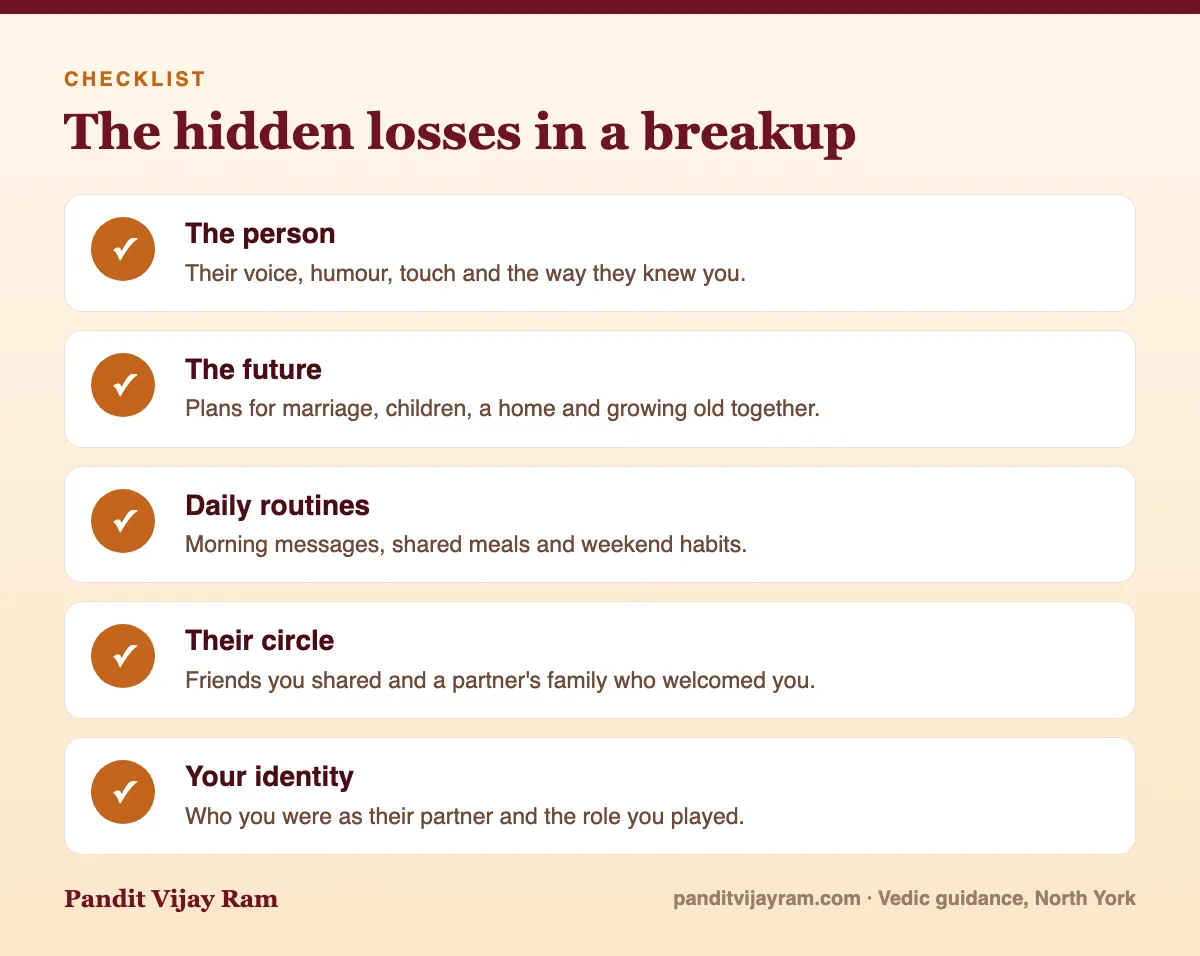
You are grieving more than one person. A breakup brings secondary losses: the future you planned, daily routines, shared friends, a partner's family, a home, sometimes a pet or a city. You may also grieve the version of yourself you were in that relationship. Naming each loss makes grief more understandable and manageable.
Try this simple exercise. Take a sheet of paper and write "What I have lost" at the top. Then list everything you can think of under five headings.
- The person: their voice, humour, touch, the way they knew you.
- The future: the wedding, the children's names, the trip you planned, growing old together.
- The everyday: good-morning texts, Sunday routines, cooking together.
- The people around them: a mother-in-law who loved you, friends you shared, their nieces and nephews.
- Yourself: who you were with them, the identity of being someone's partner.
Many people find the loss of future is the sharpest. That loss of an imagined life can hurt even when the present relationship was difficult. You are not only missing what was. You are mourning what will now never be.
Once the list is written, choose one loss each week to acknowledge. Light a lamp, sit with that loss for a few minutes, and say a short prayer of gratitude for what it gave you. The guide on journaling and prayer after a breakup has prompts that build on this. If you are still trying to accept that the relationship has really ended, see finding closure after a breakup.
How long does relationship grief last?
There is no honest fixed number. Many people find the most intense pain softens over several months, while waves can return for a year or more around anniversaries and reminders. Long relationships, marriages, sudden endings, children involved and a lack of support usually lengthen grief. Healing looks like waves becoming less frequent and less intense.
You may have heard formulas such as "half the length of the relationship". These are not based on solid evidence and can make people feel they are failing if they take longer. Grief does not follow a calendar.
Factors that usually make grief longer or harder:
- A marriage or many years together.
- Children, shared property or a shared business.
- A sudden, unexplained or betrayal-related ending.
- Moving countries, losing a visa plan or a partner's family support.
- Little social support or a family that disapproved of the relationship.
- Earlier losses that this breakup reawakens.
Factors that usually help:
- Friends and family who let you talk.
- Regular sleep, meals and movement.
- Meaningful work, study or service.
- A spiritual practice that offers steadiness.
- Counselling when needed.
The Gita offers a gentle perspective: feelings of joy and sorrow come and go like seasons, and the wise learn to bear them patiently. That verse does not ask you to stop feeling. It reminds you that this season, too, is passing. Let it pass at its own pace, and keep caring for yourself while it does.
When does breakup grief need professional help?
Seek help when grief stays intense for months without any easing, when you cannot work, eat or sleep, when you withdraw from everyone, or when you use alcohol or drugs to cope. Thoughts that life is not worth living need urgent support. Call or text 9-8-8 in Canada, and 911 in an emergency.
Grief and depression share many features, and one can lead to the other. Grief usually comes in waves, with moments of relief, humour or interest still possible. Depression tends to be more constant and flat, with a pervasive sense of worthlessness or hopelessness.
Warning signs that grief has become stuck or turned into something more:
- No easing at all after several months.
- Constant self-blame or feelings of worthlessness.
- Neglecting basic care, such as hygiene, meals or bills.
- Avoiding every reminder so completely that life shrinks.
- Persistent physical symptoms with no medical cause found.
Start with your family doctor, who can assess you and refer you. Counsellors and psychotherapists help people work through complicated grief, and many offer sessions in different languages. The article on breakup depression explains the signs in more detail, and the South Asian mental health guide for the GTA lists culturally responsive services.
Spiritual care can walk beside this. A calm reading and prayer through the love problem consultation can offer steadiness and perspective. It does not replace a doctor, and it never involves trying to bring someone back against their will.
The bottom line
Relationship grief is real mourning for a person, a shared future and a part of yourself. The familiar stages describe feelings that arrive in waves, not a neat ladder to climb. Naming each loss and moving between grieving and living helps the waves soften over time. If grief stays heavy or turns to hopelessness, a doctor and counsellor belong in your support.
Key takeaways
- Grieving a breakup is a genuine form of grief, even if others do not see it.
- The five stages come in waves, not a fixed order.
- A breakup hides many losses, including the future you imagined.
- No formula can tell you how long grief should last.
- Grief that never eases or brings hopelessness needs professional help.