
Controlling Partner Signs and Where to Get Help

Control rarely starts with a slammed door. It often starts with care that slowly becomes rules: text me when you get there, why do you need to see your sister again, let me look after your pay. Over months the rules multiply, and you find yourself asking permission for ordinary things. People in North York sometimes describe this to me as a husband or wife who is very protective, and only later realise how small their life has become. This guide explains common controlling partner signs, what coercive control means, why it is dangerous even without physical violence, how to begin safety planning, and where to find help in Ontario, including police. In more than forty years of practice I have learned that control often hides behind words like love, honour and family duty. Respect for elders and partners is a real value in our traditions. Being afraid to make your own choices is not part of it.
What are the signs of a controlling partner?
Signs include checking your phone, messages or location, demanding passwords, limiting contact with friends and family, controlling money or work, deciding what you wear, accusing you of cheating without reason, monitoring your time, and making threats if you disobey. Any one sign deserves attention; several together form a pattern of control.
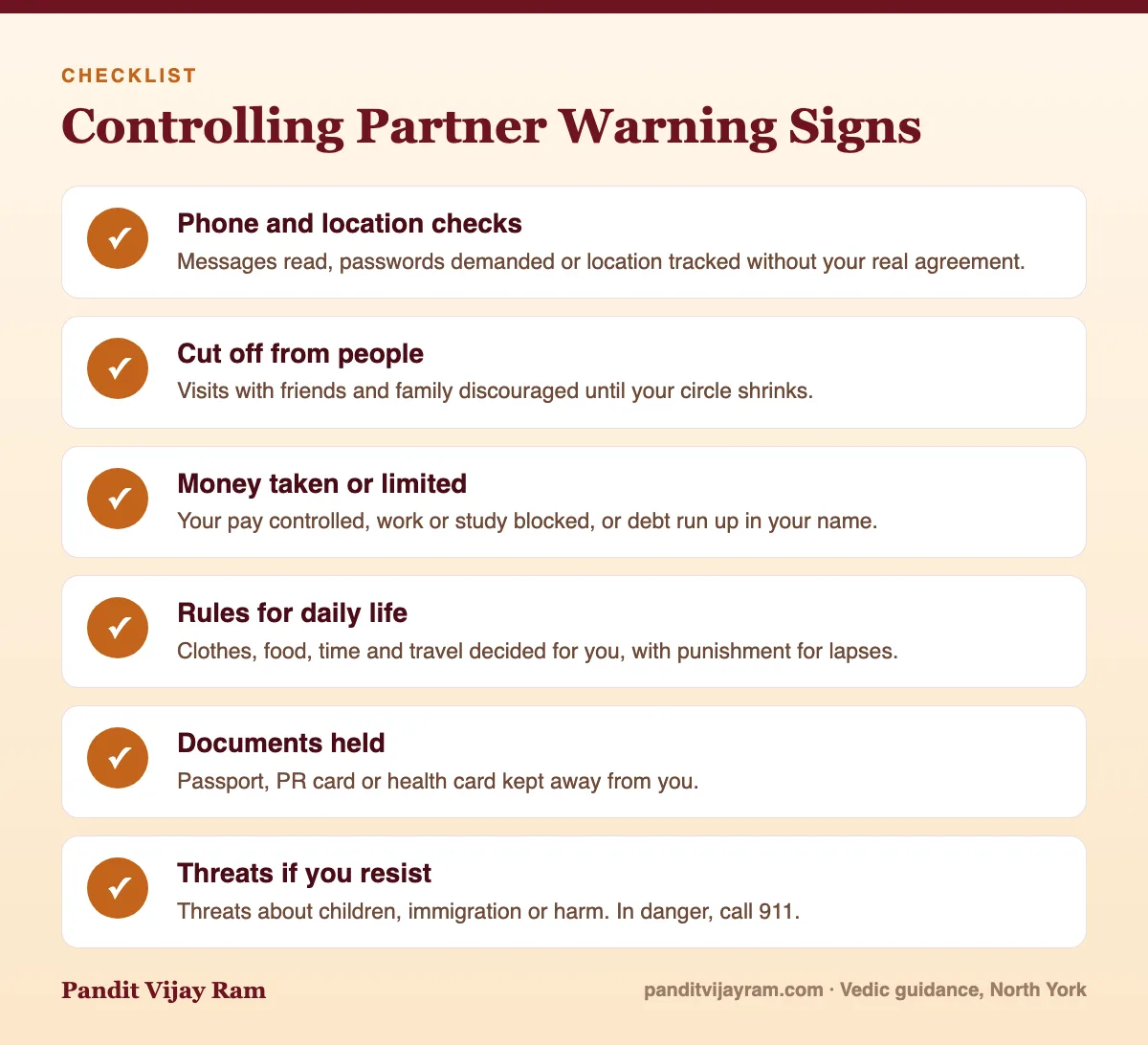
Controlling behaviour usually falls into several areas of life at once:
- Phone and online life: checking messages, demanding passwords, tracking location, installing apps on your phone, or deciding who you can follow.
- Social life: discouraging visits to family, picking fights before outings, embarrassing you in front of friends so you stop seeing them.
- Money: taking your pay, giving an allowance, hiding household finances, preventing you from working or studying, or running up debt in your name.
- Time and movement: needing to know where you are at all times, limiting use of the car, punishing lateness.
- Body and appearance: rules about clothes, makeup, food or weight.
- Documents: holding your passport, permanent resident card or health card.
- Threats: to leave you penniless, take the children, harm pets, harm themselves, report you to immigration, or shame you in the community.
Jealousy is often how control begins. Our guide to jealousy in a relationship explains where ordinary insecurity ends and controlling behaviour starts.

What is coercive control?
Coercive control is an ongoing pattern of behaviour used to dominate a partner through intimidation, isolation, monitoring, humiliation and restriction of freedom. It focuses on the cumulative effect rather than single incidents. Researchers and support services recognise it as domestic abuse, and it often comes before or alongside physical violence.
The idea of coercive control helps explain why some people feel trapped even though they have not been hit. Each rule or comment may look small on its own. Together they take away a person's independence, confidence and safety, a little at a time.
Some features that support workers look for:
- Micro-regulation of daily life, from what you eat to when you sleep.
- Isolation from anyone who might notice or help.
- Degradation, such as name-calling and humiliation.
- Fear of what will happen if you break a rule.
- Loss of self, where you no longer feel able to decide anything.
Some countries, including England and Wales and Scotland, have made coercive control a specific criminal offence. In Canada, many behaviours involved in it, such as threats, assault and criminal harassment, are already offences under the Criminal Code. Laws change, so a lawyer or legal clinic can explain how the current law applies to you. Our legal aid guide for GTA families shows where to start.
Coercive control often includes making you doubt your memory. Our guide to gaslighting signs covers that part in detail.
Is checking my phone a sign of a controlling partner?
Occasionally glancing at a shared screen is ordinary. Regularly reading your messages, demanding passwords, tracking your location without agreement or getting angry when you want privacy are signs of control. Healthy couples may choose to share information, but neither partner forces access or punishes the other for having private conversations.
Phone checking is one of the most common worries people raise, so a clear comparison helps:
- Healthy: both partners choose to share some things, either can say no, privacy is respected, and concerns are talked about openly.
- Insecure but workable: one partner feels anxious and sometimes asks to see messages, but recognises it as their own issue and works on it.
- Controlling: access is demanded, refusal causes anger or punishment, location is tracked without real agreement, and messages are used against you.
Technology can make control easier. Signs your devices may be monitored include a partner knowing details of private conversations, battery draining quickly, unfamiliar apps, or settings changed without your knowledge. If you suspect this, do not remove the apps suddenly, as that can alert a dangerous partner. Use a safer device to contact a helpline, which can advise on technology safety.
If phone checking comes from your own worries rather than your partner's, the post on trust issues in a relationship may help you understand them.
How do I make a safety plan if my partner is controlling?
A safety plan is a personal set of steps for staying safer now and if you decide to leave. It includes trusted contacts, a code word, copies of key documents, some accessible money, a bag ready to go and a plan for children and pets. Helpline workers can help you build one confidentially.
Safety planning is best done with a trained advocate, but these basics are a starting point:
- Know your emergency number. Call 911 if you are in danger. If you cannot speak, stay on the line if it is safe.
- Choose a trusted person and agree on a code word that means call the police.
- Gather documents: passport, PR card or citizenship papers, health cards, birth certificates, bank details. Keep copies or photos somewhere safe outside the home.
- Set aside some money and a spare key if you can do so without being noticed.
- Prepare a bag with medicines, chargers and clothes, kept with a friend if hiding it at home is risky.
- Plan for children and pets, including where they would stay.
- Think about the moment of leaving. Support services warn that risk can rise around separation, so plan this step with expert help.
The Assaulted Women's Helpline is free, confidential and open at any hour across Ontario at 1-866-863-0511. Men and LGBTQ+ people can dial 211 for suitable services. Our GTA domestic violence help guide lists verified shelters and programmes, and anyone who feels hopeless can call or text 988.
If you were sponsored to come to Canada and your partner threatens your status, speak with a legal clinic or immigration lawyer rather than relying on what your partner tells you.
Where can spiritual support fit when a partner is controlling?
Spiritual support can strengthen courage, calm and hope while you take practical safety steps. It should never be used to keep someone in a controlling relationship, and no ritual can make a controlling partner safe. A trustworthy spiritual adviser will encourage helplines, police and counselling first and pray with you alongside.
People from devout families sometimes hear that enduring a difficult spouse is their duty, their karma or a test of faith. Many religious teachers reject that view when it comes to abuse. Dharma includes protecting yourself and your children from harm.
Spiritual practices that support you through this time include:
- Short prayers to Durga or Hanuman for strength and protection, said privately.
- Breathing slowly with a mantra when fear rises, to steady your thinking before decisions.
- Reaching out to a temple, gurdwara or mosque community that you trust to keep your confidence.
In a marriage problem consultation, if a client describes control or fear, I put the safety conversation before any chart reading. I will not offer a ritual to tame or bind a partner, and I will not suggest that staying is spiritually required. If you are worried about someone who is controlling and frightening you, please also read is my relationship worth saving, which explains why abuse is never just a rough patch.
The bottom line
Controlling partner signs include phone monitoring, money restrictions, isolation, rules about daily life and threats, and together they form coercive control. It is a recognised form of domestic abuse even when no one has been hit. Make a safety plan with a helpline, call 911 in danger, and let spiritual practice give you strength alongside that practical help.
Key takeaways
- Control often begins as care or jealousy and slowly becomes rules.
- Coercive control is about the overall pattern, not single incidents.
- Demanded phone access and tracking are control, not proof of love.
- A safety plan covers contacts, documents, money, children and leaving.
- No ritual makes a controlling partner safe; safety services come first.