
Red Flags or a Rough Patch? Is This Relationship Worth Saving?

"Is my relationship worth saving?" is a question people often ask quietly, late at night, after another hard argument or another long silence. Some are in an ordinary season of strain. Others have been told for years that what is happening to them is normal, when it is not. Couples and individuals in North York bring me this question more than almost any other, and I try to help them see clearly before I say anything spiritual. This guide offers a practical way to think it through. It explains what makes a relationship worth working on, the red flags that mean safety must come first, what a normal rough patch looks like, a set of honest questions to ask yourself, and what astrology can and cannot add to the decision. In more than forty years of practice I have learned that the right answer differs for every couple, but one rule never changes: abuse is not a rough patch, and nobody should be asked to pray their way through it. Whatever you decide, you deserve to decide it safely and freely.
How do I know if a relationship is worth fighting for?
A relationship is usually worth working on when you both feel safe, both still respect each other, both want to repair it, and your core values and life goals broadly fit. Problems can be large, such as debt, distance or even infidelity, as long as both partners take responsibility and act, not just promise.
Here is a simple decision rule I share with people who are torn. Look for four foundations:
- Safety. You are not afraid of your partner, physically, sexually, financially or emotionally.
- Respect. Even in anger, neither of you uses contempt, humiliation or threats.
- Willingness. Both partners want to repair things and will do the work, including counselling if needed.
- Shared direction. You broadly agree on things like children, faith, money and where to live, or can find fair compromises.
If all four are present, even a serious problem may be workable. If safety is missing, the other three do not matter until you are safe. If willingness is missing on one side, you cannot repair the relationship alone, however much you pray or try.
Many problems that feel enormous are fixable with effort: poor communication, money stress, intimacy issues, in-law tension. Even after infidelity, some couples rebuild well; our guide to rebuilding trust after cheating describes what genuine accountability looks like. The question is less about the size of the problem and more about whether both people are honestly working on it.

What relationship red flags mean you should not stay and wait?
Violence or threats of violence, sexual pressure, monitoring and isolation, control of money or documents, threats about children or immigration status, and constant humiliation are red flags. They are forms of abuse, not rough patches. They tend to escalate over time, and they call for safety planning and support rather than patience or prayer alone.
Some behaviours are not disagreements to be resolved. They are harm. Please take these seriously:
- Physical harm or threats. Hitting, pushing, breaking things, blocking doors, threatening with weapons.
- Sexual coercion. Pressure, guilt or force around sex. Marriage does not remove the right to say no.
- Coercive control. Checking your phone, tracking you, cutting you off from friends and family, deciding what you wear.
- Economic abuse. Taking your pay, hiding household money, stopping you from working.
- Threats about leverage. Threats to take the children, report your status, or harm pets or themselves.
- Constant contempt. Name-calling, mocking, making you doubt your own memory.
If you are in danger, call 911. Calling 211 connects you to shelters, women's helplines and support for men experiencing abuse anywhere in Canada. For thoughts of self-harm, call or text 988. Leaving can be the most dangerous time, so plan with a professional where you can.
Controlling jealousy is often where these patterns start; our article on jealousy in a relationship explains the line between insecurity and control. I will not offer a ritual to keep anyone in an abusive home.
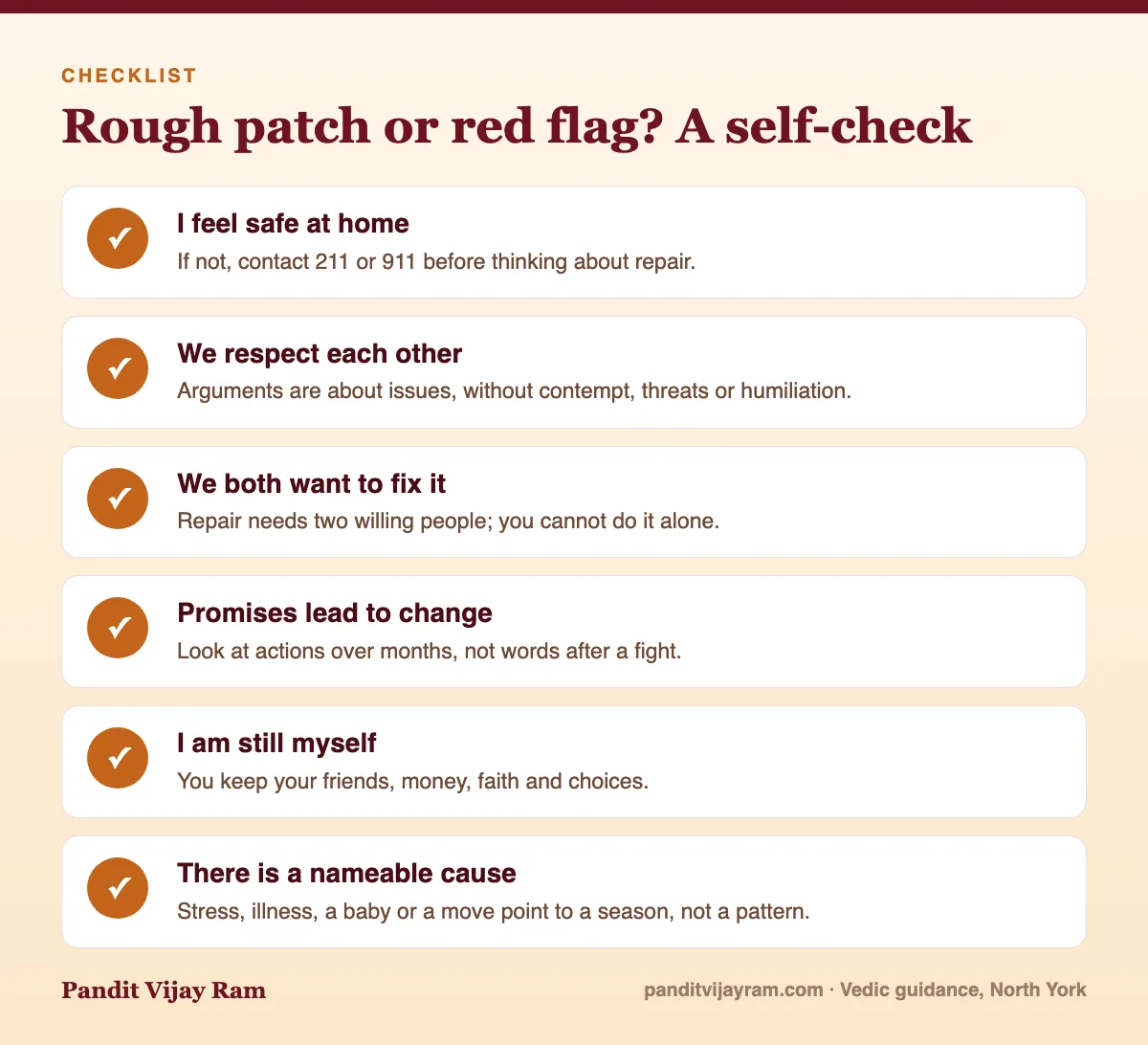
What does a normal rough patch in a relationship look like?
A rough patch is a period of more conflict, distance or stress, usually linked to something identifiable such as a new baby, job loss, illness, a move or caring for parents. Both partners still feel safe and respected, even if frustrated. Arguments are about issues, not attacks on each other's worth, and repair attempts are possible.
Every long relationship has seasons. Signs that you are in one of the ordinary hard ones:
- There is a cause you can name. Exhaustion after a baby, money pressure, a health scare, grief.
- Fights end. Even if badly, someone eventually apologises or softens.
- You still like each other underneath. There are moments of warmth, humour or teamwork.
- Neither of you is afraid. You can disagree without fearing the consequences.
- Effort is shared. Both partners try, even clumsily.
Rough patches respond to rest, fair sharing of the load, better communication and sometimes counselling. They can still be painful and long. They are not a sign that you chose the wrong person.
When the hard season is mainly arguments, the steps in our guide to husband and wife arguments may help. A marriage problem consultation can add chart timing and shared prayer, once it is clear that both partners are safe and willing.
Should I stay or leave? What questions should I ask myself?
Ask whether you feel safe, whether you are more yourself or less yourself in this relationship, whether your partner takes responsibility, whether things have changed after past promises, and what you would tell a friend in your place. Honest answers, written down over a few weeks, usually show a clearer pattern than a single painful night.
Try writing answers to these questions over two or three weeks, at different moods:
- Do I feel safe with my partner, in every way?
- When we disagree, do I feel heard or dismissed?
- Has my partner changed anything after promising to, or only promised?
- Do I still respect them, and do they respect me?
- Am I staying from love, or mainly from fear, guilt, money or what people will say?
- What would I advise my sister, brother or closest friend to do?
- If nothing changed for five more years, could I live with that?
Family pressure deserves special mention. In many communities, separation still carries stigma, and elders may urge you to adjust. Listen with respect, but your safety and wellbeing are your decision. Children also do better in a calm home than in one full of fear, whatever the household arrangement.
Get practical information before deciding: a family lawyer or legal clinic about rights and property, a counsellor about your emotions, and a doctor if you are not sleeping or eating. If you do separate, our guide to life after divorce or separation covers the road ahead with honesty.
Can astrology tell whether a relationship will last?
No chart can decide that for you. Vedic astrology can describe tendencies, such as Saturn or Rahu affecting the seventh house, and the timing of difficult dashas. That can help a couple understand a hard period. It cannot measure safety, respect or willingness, which matter far more than any placement.
People sometimes hope a reading will make the decision for them. I understand why; it can feel easier than deciding yourself. But a chart is not a judge.
What a careful reading can offer:
- Timing context. If a demanding Saturn transit or dasha coincides with your hardest months, it may help you see the season as a season.
- Self-understanding. The Moon, Venus and Mars describe how each partner tends to love, fear and fight.
- Prayer suggestions. Shiva-Parvati worship, Friday Lakshmi prayer or simple charity, matched to what the chart emphasises.
What it cannot do:
- Override signs of abuse. No placement makes violence acceptable or excusable.
- Predict divorce with certainty. Our post on divorce yoga in a kundli explains why such combinations are tendencies, not verdicts.
- Replace the four foundations of safety, respect, willingness and direction.
Be wary of anyone who reads your chart and says you must stay, or must leave, or must buy a costly ritual to fix it. A good relationship compatibility reading leaves the decision with you.
The bottom line
Asking "is my relationship worth saving" is easier once you separate rough patches from red flags. Safety, respect, shared willingness and broad direction make repair possible, while violence, coercive control, sexual pressure and contempt are abuse that needs safety support first. Write down honest answers over time, gather practical advice, and treat astrology as context, never as the judge.
Key takeaways
- Abuse is never a rough patch, and safety comes before any repair.
- Repair is possible when both partners feel safe, show respect and are willing to work.
- A rough patch has a nameable cause and still allows warmth and apology.
- Written answers over several weeks show patterns more clearly than one bad night.
- Astrology gives timing and context; it does not decide whether to stay or leave.