
Gaslighting Signs and What to Do

You remember the argument clearly. Your partner insists it never happened, or that you started it, or that you are overreacting again. Over months you start writing things down, second-guessing yourself and apologising for things you did not do. If this sounds familiar, you may be looking for gaslighting signs because part of you knows something is wrong. People in North York sometimes come to me asking whether they are losing their mind, or whether someone has put a spell on them to confuse them. Often the confusion has a human source. This guide explains what gaslighting is, gives examples of how it sounds in everyday life, shows how to check your own reality, and describes safe steps and support in Ontario. In more than forty years of practice I have learned that a person who keeps asking whether they are imagining things usually is not. Your perception deserves to be taken seriously, including by you.
What is gaslighting in a relationship?
Gaslighting in a relationship is a repeated pattern where one partner denies, twists or rewrites reality so the other begins to doubt their own memory and judgement. The name comes from the play and film Gas Light, in which a husband manipulates his wife into believing she is going mad. It is a recognised form of emotional abuse.
Gaslighting is not the same as an honest disagreement about what happened. Two people can remember a conversation differently and still respect each other. Gaslighting is different because of its pattern and purpose:
- It is repeated. The denials and rewrites happen again and again, not once.
- It shifts power. Over time, the gaslit partner relies on the other's version of events.
- It targets your confidence in your own mind, not just your opinion on one topic.
- It often comes with other control, such as isolation, money restrictions or jealousy.
Some people gaslight deliberately; others have learned it as a way of avoiding blame. Either way, the effect on the person receiving it is real: anxiety, confusion, low self-worth and difficulty making decisions.
Gaslighting frequently sits within a wider pattern of control. If you recognise other restrictions in your life, our guide to controlling partner signs explains coercive control, and toxic relationship signs offers a broader checklist.

What are examples of gaslighting phrases?
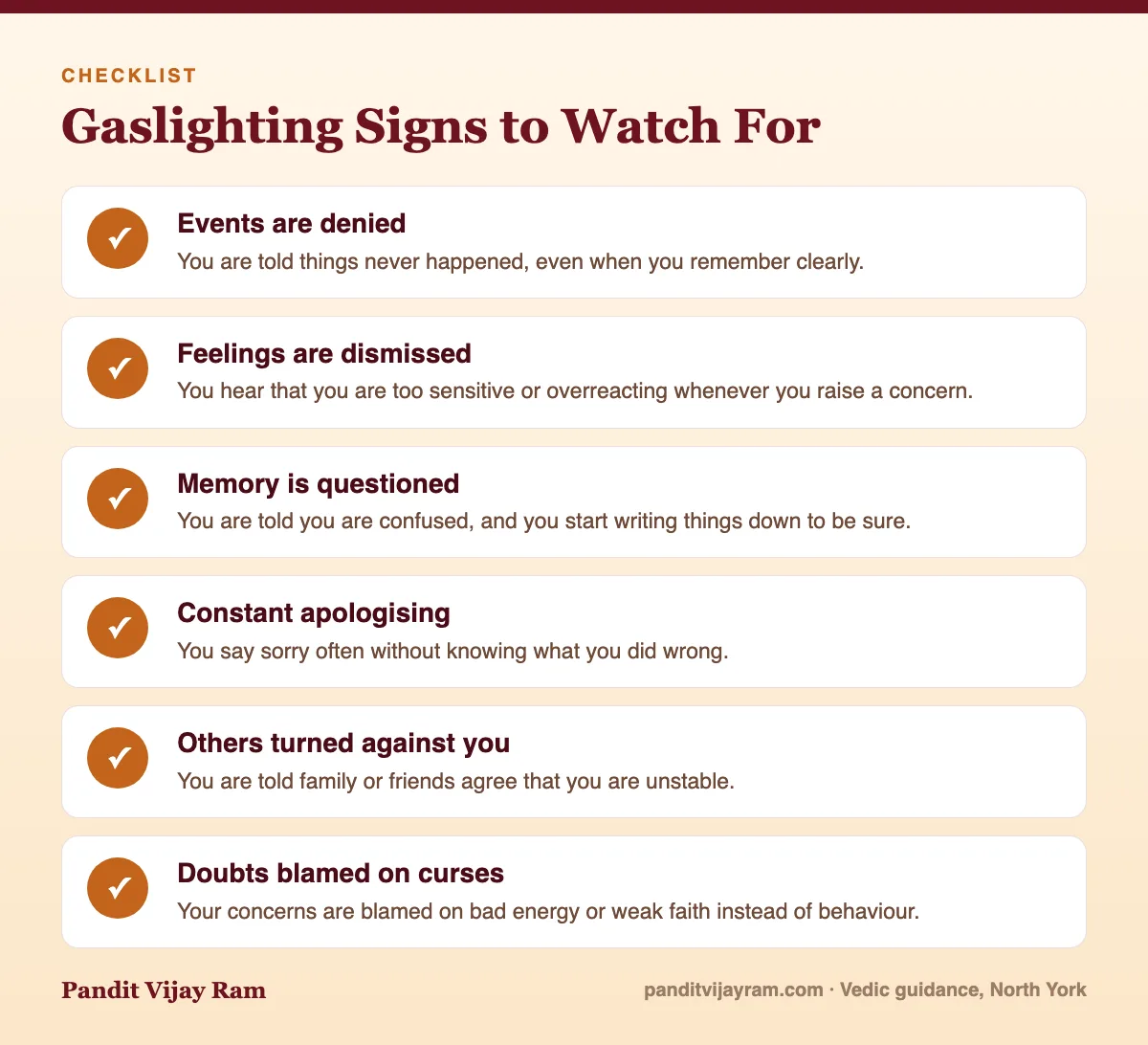
Common gaslighting phrases include that never happened, you're imagining things, you're too sensitive, you always twist my words, everyone thinks you're unstable, and I was only joking. On their own any phrase can be innocent. Used repeatedly to dismiss your experience, they become a pattern of manipulation.
Gaslighting tends to fall into a few recognisable types. Here are examples of each:
- Denial: I never said that. That didn't happen. You're making things up.
- Trivialising: You're overreacting. It was a joke. Why do you make everything a big deal?
- Questioning memory: You always remember things wrong. You must be confused again.
- Diverting: Changing the subject to your faults whenever you raise a concern, or saying your family put ideas in your head.
- Turning others against you: Even your parents think you're unstable. Everyone agrees with me.
- Moving or hiding things: Objects disappear and reappear, and you are told you misplaced them.
- Spiritual framing: Telling you that your doubts come from bad energy, a curse or weak faith, so you stop trusting your own observations.
That last form deserves attention in our communities. Some people are told their worries are nazar or black magic so that they look inward instead of at the partner's behaviour. Our guide on signs someone cast a spell on you explains why ordinary human causes should always be considered first.
How do I know if I'm being gaslighted?
Warning signs in yourself include constantly second-guessing your memory, apologising often without knowing why, feeling confused after conversations with your partner, hiding things from friends to avoid explaining, and feeling you were once more confident. If you keep records just to prove what happened, that is a strong signal.
Gaslighting is often easier to notice through its effects on you than through any single conversation. Ask yourself these questions honestly:
- Do I often wonder whether I am too sensitive?
- Do I feel confused or foggy after disagreements?
- Do I apologise even when I am not sure what I did wrong?
- Do I make excuses for my partner to friends or relatives?
- Have I started writing down conversations so I can trust my own memory?
- Do I find it hard to make simple decisions now?
- Do I feel I am not the person I used to be?
If you answer yes to several, take it seriously. These effects are common in people experiencing emotional abuse.
Gaslighting is different from relationship anxiety. With anxiety, the doubt comes from inside and usually eases with gentle reassurance. With gaslighting, your partner is the source of the doubt and reassurance from them makes things worse. If you are unsure which applies, our post on relationship anxiety can help you compare.
What should I do if my partner is gaslighting me?
Start by checking your reality privately: keep notes in a safe place, talk with a trusted friend, and notice patterns. Avoid long arguments about what really happened, which rarely help. Seek support from a counsellor or helpline. If you feel afraid, plan for your safety, and call 911 if in danger.
Practical steps that protect your mind and your safety:
- Keep a private record. Short, dated notes of what was said or done, kept somewhere your partner cannot see, such as an email account only you use.
- Reality-check with trusted people. Choose one or two friends, relatives or faith leaders who know you well and will listen without taking sides immediately.
- Step out of the debate. You do not need your partner to agree with your memory. A calm line such as I remember it differently, and I'm not going to argue about it, is enough.
- Talk with a professional. An individual counsellor, rather than couples counselling, is usually safer at first. A family doctor can refer you.
- Plan for safety if gaslighting comes with threats, monitoring or anger. Keep key documents and some money accessible, and know who you could call or stay with.
Across Ontario, the Assaulted Women's Helpline answers at any hour on 1-866-863-0511. Dial 211 for local counselling and shelters, 988 if you feel hopeless, and 911 in an emergency. Our domestic violence help guide for the GTA lists verified services region by region.
Can spiritual practice help after gaslighting?
Yes, as a support for rebuilding trust in your own mind once you are safe. Daily prayer, mantra, quiet reflection and a caring community can steady you and restore self-respect. Spiritual practice should never be used to dismiss your experiences, and it works best alongside counselling with a qualified professional.
After long periods of gaslighting, many people feel they cannot trust their own perceptions. Simple, regular practices can help you hear your own voice again:
- A daily sankalpa of truth. Each morning, quietly state one thing you know to be true about yourself.
- Silent sitting. Five minutes with a diya, simply noticing your breath, builds a sense of steady inner ground.
- Devotional reading. Passages on courage and clarity, such as verses from the Bhagavad Gita, can feel strengthening.
- Community. Spending time with people who respect you is one of the fastest ways to recover confidence.
When people consult me about confusion, fog or a heavy feeling at home, I look carefully at ordinary causes first, including the way others treat them. In a love problem consultation I may read the chart for difficult periods and suggest prayers for clarity. I do not tell anyone their doubts are a curse when their partner's behaviour explains them. Feeling clear-headed again usually begins with being believed.
The bottom line
Gaslighting signs include repeated denial of events, being told you are too sensitive or confused, and feeling you can no longer trust your own memory. Keeping private notes, reality-checking with trusted people and stepping out of endless debates protect your mind. Individual counselling, Ontario helplines and 911 in danger offer real support while prayer helps you rebuild inner steadiness.
Key takeaways
- Gaslighting is a repeated pattern of making someone doubt their own reality.
- The effects on you, such as confusion and constant apologising, are key clues.
- You do not need your partner to agree with your memory to trust it.
- Individual counselling is usually safer than couples counselling at first.
- Blaming your doubts on curses or bad energy can itself be a form of gaslighting.