
Partner Not Talking to Me: The Silent Treatment Explained

Few things feel as unsettling as a partner who suddenly stops talking. Messages go unanswered, questions get one-word replies, and the house fills with a heavy quiet that can last hours or days. You may find yourself apologising for things you did not do, just to end it. The silent treatment is one of the most common complaints I hear from couples in North York, and also one of the most misunderstood. Sometimes silence is a partner who is overwhelmed and needs space. Sometimes it is deliberate punishment. The two can look identical from the outside, but they feel very different and call for different responses. This guide explains how to tell healthy cooling off from harmful silence, how stonewalling fits in, why being ignored hurts so much, and how to respond without chasing or giving up your dignity. It also covers what to do if you are the one who goes silent, and when silence has become part of a controlling pattern. Over forty years of working with couples, I have found that naming silence calmly, without blame, often opens the door that pleading keeps closed.
What is the silent treatment in a relationship?
The silent treatment is when one partner deliberately withdraws communication, refusing to speak, reply or acknowledge the other, typically after conflict. It may last hours or days. What defines it is that the silent partner holds the power to end it, and the other is left uncertain, anxious and often trying to win back contact.
Silence takes several forms:
- Not answering calls or messages, while being active elsewhere.
- Speaking only in clipped, cold replies.
- Ignoring a partner in the same room, or speaking to others but not to them.
- Withholding affection, eye contact or shared meals.
- Refusing to say what is wrong: "Nothing. I'm fine."
Psychologists who study being ignored describe it as a form of social exclusion. Research on ostracism suggests that even brief experiences of being ignored can produce strong distress, threatening a person's sense of belonging and control. That is why a day of silence from someone you love can feel more painful than a loud argument.
In many families, silence is a familiar way of showing displeasure. A parent may have stopped speaking to a child for days after disobedience, or an elder may have used it to signal disapproval. People who grew up this way sometimes repeat the pattern without realising how painful it is.
Not every silence is punishment, though. To respond well, you first need to understand which kind you are facing.

Is the silent treatment the same as needing space to cool off?
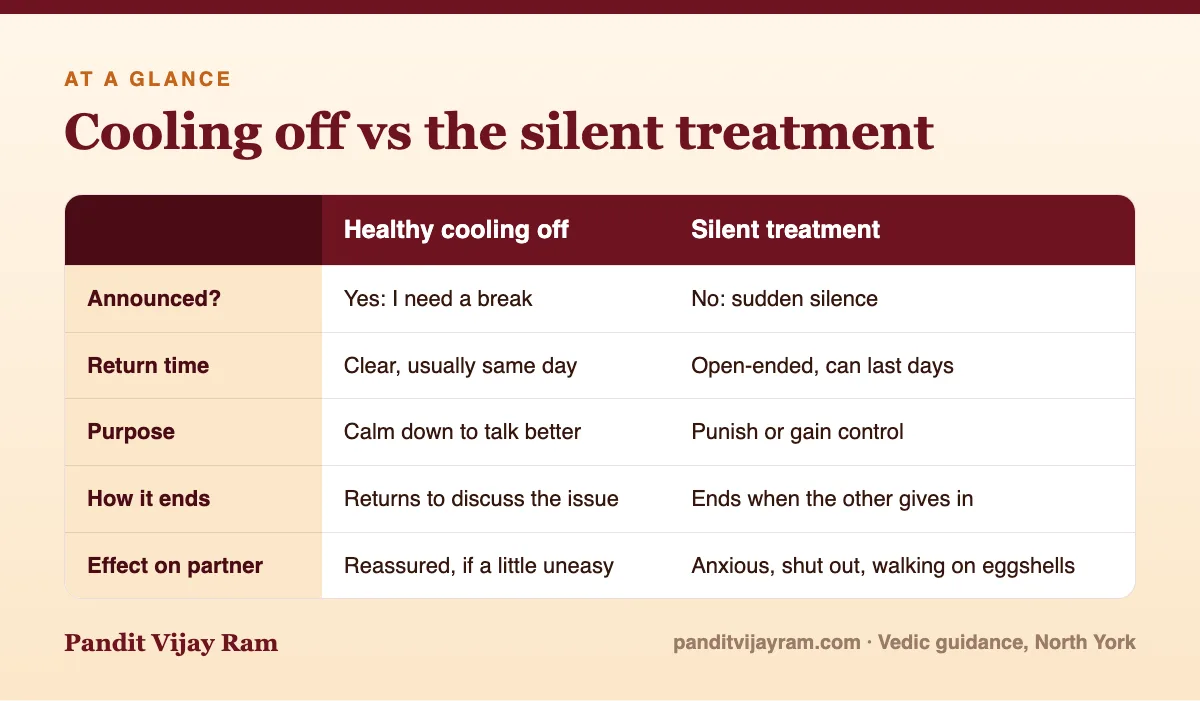
No. Cooling off is an announced, temporary pause with a plan to return, used to calm down before talking. The silent treatment is unannounced, open-ended and used to make the other person feel punished or anxious. The key differences are communication about the break, a return time, and whether it is used to control.
A quick way to tell them apart:
- Cooling off sounds like: "I'm too upset to talk well right now. Can we pick this up after dinner?" The person returns as promised and is willing to discuss the issue.
- The silent treatment looks like: walking away without a word, ignoring messages for days, then acting as if nothing happened, or waiting until you apologise first.
There is a third pattern, often confused with both. The psychologist John Gottman described stonewalling as one partner shutting down during conflict, going blank, looking away and not responding. Stonewalling usually happens because the person feels flooded, with a racing heart and overwhelmed mind. It is not always deliberate, but it still damages the relationship if it becomes a habit.
The difference matters for how you respond. With cooling off, you respect the break. With stonewalling, you agree on time-outs together so the overwhelmed partner can return. With punishing silence, you protect yourself and address the pattern directly.
If your arguments usually follow a cycle where one person chases and the other retreats, the guide to why couples fight so much explains that dance. For a step-by-step way to build healthy time-outs, see the calm reset plan for constant arguments.
How should I respond when my partner is ignoring me?
Respond calmly and briefly. Acknowledge the silence once, say you are ready to talk when they are, and then stop chasing. Do not bombard them with messages, beg, or match the silence with your own. Look after yourself in the meantime. When they return, discuss both the original issue and the silence itself.
A five-step response that protects both the relationship and your dignity:
- Pause before reacting. Breathe, and avoid sending a rush of messages in panic.
- Name it once, gently. "I notice you've gone quiet. I'd like to understand what's wrong. I'm here when you're ready to talk."
- Stop pursuing. Do not repeat the message or plead. Chasing usually lengthens the silence.
- Look after yourself. Carry on with your day: eat, see a friend, go for a walk, light a lamp and say a prayer for patience.
- Discuss the pattern later. Once talking resumes, address the silence calmly: "When you stop speaking for days, I feel shut out. Can we agree on another way to take space?"
Avoid apologising for things you did not do just to end the silence. It may bring short relief but teaches both of you that silence works as a lever.
Do not respond with your own silence either. Two people waiting for the other to break creates a cold standoff that can last far longer than the original argument.
If being ignored brings intense anxiety, panic or difficulty functioning, the guide on relationship anxiety offers calming tools and when to seek therapy. Prayer for your own steadiness, rather than for changing your partner, is offered through the love problem consultation.
Is the silent treatment a form of emotional abuse?
It can be. Occasional silence after a fight is unhealthy but common. When silence is used repeatedly and for long periods to punish, control behaviour, force apologies or make a partner fearful, it becomes emotional abuse. It often appears alongside other controlling behaviour, such as criticism, jealousy, isolation or gaslighting.
Signs that silence has moved into abuse:
- It happens regularly, often over minor things.
- It lasts days or weeks, not hours.
- You are expected to guess what you did wrong and apologise first.
- It ends only when you give in to what they want.
- You change your behaviour constantly to avoid triggering it.
- It comes with other control: monitoring your phone, limiting friends, or denying it happened.
When silence is followed by your partner insisting it never happened, or that you are "too sensitive", that may be gaslighting. The guide to signs of gaslighting gives examples. Silence combined with monitoring and isolation is part of coercive control, described in signs of a controlling partner.
If you feel afraid, trapped or worn down, please talk to someone you trust, and contact a support service. The GTA domestic violence help guide lists confidential options, and in immediate danger call 911. Emotional abuse is real abuse, even when there are no bruises.
If ongoing silence and conflict have left you low or hopeless, see your family doctor. In crisis, call or text 9-8-8.
What if I am the one giving the silent treatment?
If you go silent after arguments, start by noticing why: overwhelm, hurt, fear of saying something you regret, or a habit learned at home. Then replace silence with an announced break and a return time. Tell your partner what you need. Learning to say "I need an hour" protects both of you.
Many people who go silent are not trying to be cruel. They may feel overwhelmed and unable to find words, or they grew up in homes where silence was how displeasure was shown. Recognising this is the first step.
Ask yourself honestly:
- Am I silent because I am flooded, or because I want them to feel bad?
- Do I return to talk, or do I wait for them to apologise?
- How long does my silence usually last?
- How does my partner seem during it?
Replacement habits:
- Announce the break. "I'm upset and need some time. I'm not leaving; I'll come back to this at eight."
- Use the time to calm, not to stew. Walk, breathe, chant a short mantra such as "Om shanti".
- Return as promised. Even if you are still a little upset, come back and say so.
- Name your need. "I go quiet when I feel criticised. Could you start with how you feel rather than what I did wrong?"
The Gita speaks of speech that is truthful, pleasant, beneficial and does not cause agitation as a discipline of the tongue. Choosing a few gentle words over cold silence is part of that discipline. For further practical tools, see communication problems in marriage, which applies to dating couples too.
The bottom line
The silent treatment is different from a healthy, announced break to cool off. Stonewalling often comes from overwhelm, while punishing silence aims to control, and repeated, prolonged silence can be emotional abuse. Respond by naming it once, stopping the chase and caring for yourself. If you are the silent one, replace silence with a clear break and a return time.
Key takeaways
- Cooling off is announced and temporary; the silent treatment is neither.
- Stonewalling often comes from overwhelm, not intent to hurt.
- Name the silence once, then stop chasing and look after yourself.
- Repeated, prolonged silence used to control is emotional abuse.
- If you go silent, say what you need and when you will return.