
Constant Arguments With Your Partner: A Calm Reset Plan

When every conversation with your boyfriend or girlfriend seems to turn into a fight, the relationship can start to feel like hard work rather than comfort. You may love each other deeply and still find yourselves arguing over texts, plans, friends or tone of voice several times a week. Constant arguments with partner do not have to mean the relationship is failing. Often it means you have never agreed on how to disagree. Many young couples in North York and the wider GTA come to me after months of this, tired and unsure. This guide gives you a calm, practical reset plan to try together over the next month. You will learn how to call a time-out that actually works, a small set of fair fighting rules, how to start difficult conversations gently, and how to make up properly. It also includes a short shared prayer for couples who want one, and clear signs that you need more than a communication fix. In over forty years of guiding couples, I have found that most arguments soften when two people agree on rules before the next fight, not during it.
Why do we argue so much as a dating couple?
Dating couples often argue more because expectations are still forming. You are learning each other's habits, families, friendships and boundaries, sometimes while managing study, work or long commutes. Texting adds misunderstandings. Without agreed ways to raise issues, small frustrations build up and come out sideways, turning ordinary differences into repeated fights.
Typical sources of frequent arguments in dating relationships include:
- Unspoken expectations about how often to talk, meet or reply to messages.
- Friends and social life, including jealousy over time spent elsewhere.
- Family and culture, particularly if one or both families do not know about the relationship, or disapprove.
- Text arguments, where tone is lost and messages are read in the worst possible way.
- Future plans, such as moving in, marriage timelines or where to live.
- Stress from exams, jobs, money or immigration paperwork.
These are normal. What turns them into constant arguments is usually the way they are handled. Couples who have no agreed method tend to raise issues when angry, bring up past grievances and continue fighting until someone walks away.
If you want to understand the deeper cycle that keeps repeating, such as one person chasing and the other withdrawing, read why do we fight so much first. This page focuses on what to do about it, step by step.
Before starting, ask yourselves honestly whether you both want to make this work. If one of you is unsure, the decision guide on whether a relationship is worth saving may be the better first read.

How do you take a time-out during an argument?
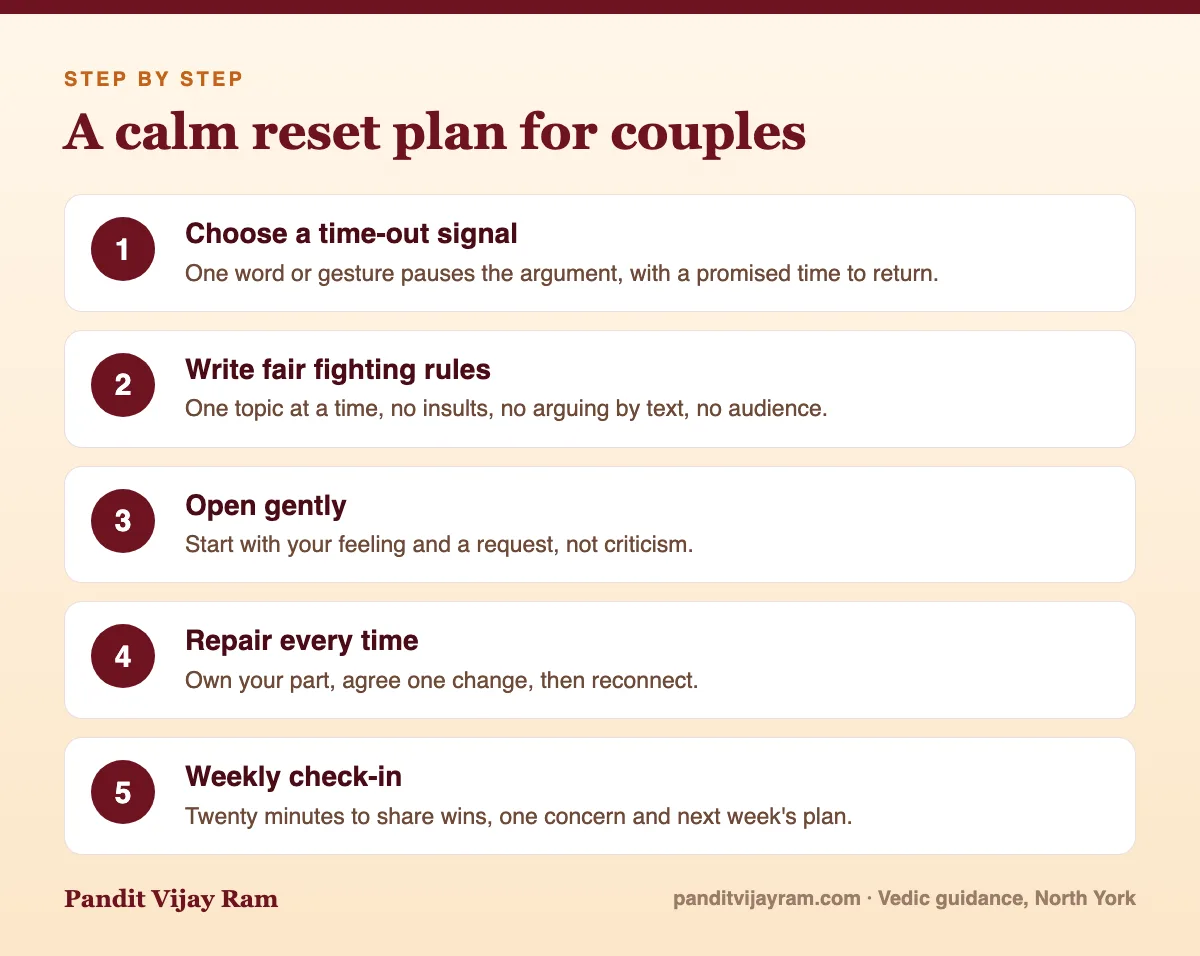
Agree in advance on a word or gesture that means "I need a break". When either of you uses it, stop talking, separate for at least twenty minutes, and do something calming. The person who called the break suggests a time to come back. A time-out is a pause with a return, never a walk-out.
When an argument heats up, the body releases stress hormones and the heart races. Psychologists call this flooding. In that state, nobody listens well. A short break lets the body settle so the conversation can continue productively.
How to set up a time-out that works:
- Choose your signal together on a calm day. It might be a word like "pause", a hand in a T shape, or a phrase such as "I love you, I need a break".
- Either person can call it, and the other agrees to stop, even mid-sentence.
- Separate physically. Go to another room, take a walk around the block, or end the call politely.
- Calm the body, not the argument. Breathe slowly, splash water on your face, listen to a bhajan. Avoid rehearsing your case.
- Return when promised. Usually between twenty minutes and a few hours. If you need longer, message to set a new time.
Time-outs fail when they are used to escape or punish. Walking out without a return time feels like abandonment to the other person and can become the silent treatment. A true time-out always comes with a clear plan to resume.
Some couples also reset the room after a hard conversation. The short practice in clearing energy after an argument uses a lamp and a few minutes of quiet together.
What are fair fighting rules for couples?
Fair fighting rules are agreements that keep arguments respectful: discuss one issue at a time, speak about your own feelings rather than labelling your partner, never insult or threaten, do not argue by text, avoid bringing up the past, and listen fully before replying. Write them down together and keep them visible.
Here is a starter set of rules. Discuss them together and adjust to suit you.
- One topic at a time. If another issue appears, note it for later.
- "I" not "you". Say "I felt left out when plans changed" rather than "You never think about me."
- No name-calling, swearing at each other, mocking or eye-rolling. Contempt does deep damage.
- No threats to break up, to hurt yourself or to tell others private things.
- No fighting by text. If something needs discussing, call or meet. Text only to set a time.
- Leave the past where it is. Avoid "and last year you also..."
- Reflect before replying. Summarise what you heard: "So you're saying you felt dismissed?" This is a simple form of active listening.
- No audience. Do not argue in front of friends or family, or post about it online.
Starting gently matters too. Psychologists call it a soft start-up. Instead of opening with blame, open with your feeling and a request: "I've been feeling a bit disconnected lately. Could we plan a proper evening together this week?" Gentle openings change the whole direction of a conversation.
Print or save the rules where you both can see them. If someone breaks one, the other can point to it calmly rather than escalating.
How do you make up properly after a fight?
Make up by returning to the conversation calmly, each owning your part, apologising for specific words or actions, and agreeing on one small change. Then reconnect physically or emotionally: a hug, a walk, a shared meal. A good repair turns an argument into evidence that the relationship can handle difficulty.
A simple repair conversation has four parts:
- Own your part. "I raised my voice, and I'm sorry." Keep it specific and free of "but".
- Name what you understand now. "I see that you felt ignored when I didn't reply all evening."
- Agree on one change. "If I'm going to be busy, I'll send a quick message."
- Reconnect. A hug, holding hands, cooking together or simply sitting close for a few minutes.
Small repair attempts during an argument also help: a joke that lightens the moment, a touch on the arm, "Can we start again?" Couples who accept these bids for repair recover faster than those who brush them off.
Repair is not the same as one person always apologising to keep the peace. If only one of you ever says sorry, that is an imbalance worth noticing.
Some couples like to close a hard week with a short shared prayer. Light a lamp together and say, "May we speak kindly, listen fully and treat each other with respect." The guide to spiritual cleansing for couples describes a fuller shared routine. A calm conversation through the love problem consultation can also help couples who feel stuck, with prayer for harmony that both partners want.
If a big fight has already led to a breakup, the article on getting back together after a big fight covers that situation.
When are constant arguments a sign of abuse?
Arguments become abuse when one partner uses fear, threats, humiliation, physical force or control to dominate the other. Signs include being afraid to disagree, being checked or tracked, isolation from friends, threats to harm or to share private images, and any physical violence. Fair fighting rules do not fix abuse; safety does.
Two partners who both feel free to speak, disagree and walk away are having conflict. When one feels afraid, small, or unable to leave, it is something else.
Watch for:
- You avoid topics because of how they react, not because you prefer peace.
- They insult you, call you stupid or worthless, or mock you in front of others.
- They read your messages, demand passwords or track where you are.
- They pressure you sexually or threaten to share private photos.
- They push, grab, hit, block doorways or break things.
- They threaten suicide or self-harm to stop you leaving.
If any of these are happening, the reset plan above is not the answer, and couples counselling is not usually recommended while the danger continues. Talk to someone you trust. If you are in immediate danger, call 911. The GTA domestic violence help guide lists confidential services, including support for young people and dating violence. The checklist in signs of a toxic relationship can help you see the pattern more clearly.
Spiritual practice should never be used to persuade someone to stay in an unsafe relationship. Your safety is always the first priority.
The bottom line
Constant arguments with partner often ease once you agree on how to disagree. A time-out with a promised return, a short list of fair fighting rules and gentle openings stop fights from spiralling. Proper repair and a weekly check-in rebuild warmth. Where there is fear, threats or control, the issue is abuse, and safety comes before any reset plan.
Key takeaways
- Agree on rules for arguing while you are calm, not mid-fight.
- A time-out always includes a time to come back.
- Discuss one issue at a time, using "I" statements, never by text.
- Repair by owning your part, agreeing one change and reconnecting.
- Fear, control or violence means abuse; seek safety first.