
Communication Problems in Marriage: Practical Tools

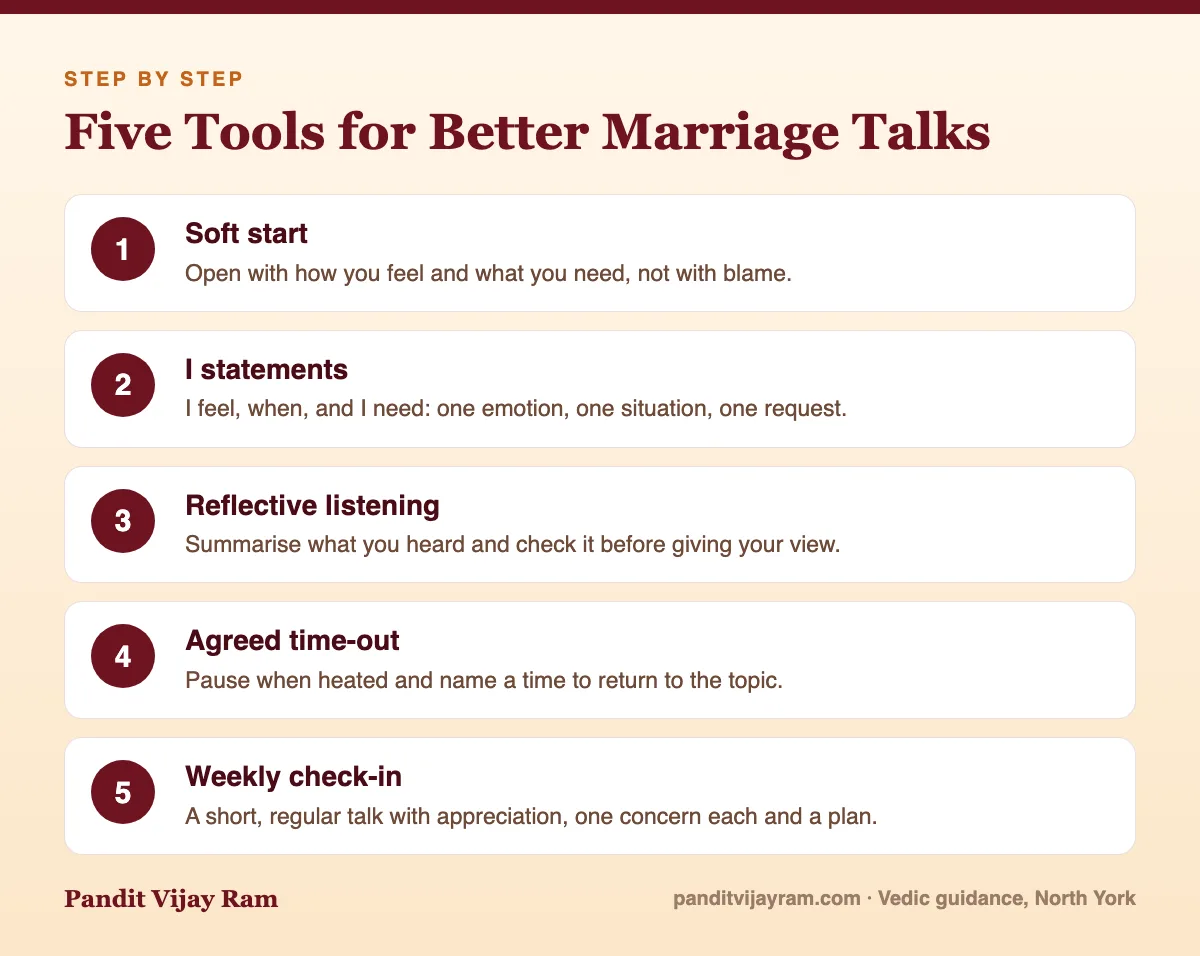
Many couples do not lack love. They lack a way of talking that does not turn into blame, sulking or the same old argument. One spouse raises a concern, the other hears criticism, voices rise, and nothing gets solved. Communication problems in marriage are among the most practical issues couples bring to me in North York, and the good news is that they respond well to practice. This guide is a toolkit rather than a diagnosis. You will learn how to open a difficult topic gently, how to use I statements, how to listen so your spouse feels heard, how to pause before a conversation becomes hurtful, and how to run a short weekly check-in. It also covers when a counsellor is the right next step. In more than forty years of practice I have seen that couples who learn even two of these habits argue less and repair faster, whatever their charts say.
What are the most common communication problems in marriage?
The most common problems are harsh openings, criticism of character instead of behaviour, defensiveness, interrupting, stonewalling and mind-reading. Couples also struggle when they raise issues only during fights, discuss serious topics while exhausted, or let relatives speak for them. Each pattern has a matching skill that can replace it.
Here are the patterns I hear most, paired with what to try instead:
- Harsh start-up (You never help with anything) becomes a soft start: I'm feeling stretched; can we look at the chores together?
- Character attacks (You're so selfish) become comments on one specific action.
- Defensiveness becomes taking responsibility for even a small part of the problem.
- Stonewalling, going silent and leaving, becomes an agreed time-out with a promise to return.
- Mind-reading (I know what you really meant) becomes asking what they meant.
- Talking through relatives becomes speaking to each other first, privately.
Several of these follow research by marriage psychologists, who found that criticism, contempt, defensiveness and stonewalling are especially damaging when they become habits. Contempt, such as mocking or eye-rolling, deserves particular attention because it erodes respect quickly.
If your main issue is that a spouse has withdrawn emotionally rather than that talks go badly, read our separate guide on a spouse becoming distant.

How do I talk to my spouse without it turning into a fight?
Choose a calm time, raise one issue only, start with how you feel and what you need, and keep your voice low. Avoid words like always and never. Ask for a specific change rather than a change in personality, and stop to listen whenever your spouse responds.
A good conversation often depends on its first minute. Try this structure, sometimes called the I statement:
- I feel (one emotion word: worried, lonely, overwhelmed)
- when (the specific situation, described neutrally)
- and I need (a clear, doable request).
For example: I feel lonely when we both scroll our phones after dinner, and I'd like us to sit together for twenty minutes without screens. Compare that with: You only care about your phone. The first invites a solution; the second invites a defence.
Timing matters as much as wording. Avoid raising big issues when either of you is hungry, tired, rushing to work or has just come off a long call with family abroad. Many couples agree that serious topics wait for a set time rather than being sprung on each other.
Not every disagreement is a communication issue. If you argue about the same subjects again and again, our post on why couples fight so much looks at the underlying conflict cycle, and constant arguments with a partner offers a reset plan.
How can couples improve their listening skills?
Reflective listening means repeating back what you heard in your own words, checking it is right, and acknowledging the feeling before replying. It slows conversations down and helps a spouse feel understood. Many couples practise with a simple speaker and listener method, swapping roles after a few minutes.
The speaker and listener method is a structured exercise used by many couples counsellors. It feels awkward at first, which is normal.
- Speaker: talks for two or three minutes about one concern, using I statements, and pauses often.
- Listener: does not argue, fix or explain. They summarise: So you're saying you feel unsupported when my mother visits and plans change without you.
- Check: the speaker says yes, or corrects the summary.
- Acknowledge the feeling: That sounds really frustrating. Agreement is not required, only understanding.
- Swap roles. The listener now becomes the speaker.
Small listening habits help too: put the phone face down, turn toward your spouse, and ask one more question before giving your view. Listening well is not the same as giving in. It simply makes the eventual decision easier, because both people feel their side was taken seriously.
When you feel your heart pounding or your voice rising, that is a signal to slow down or pause rather than push on.
What is a weekly check-in for married couples?
A weekly check-in is a short, scheduled conversation where spouses review the week, share appreciation, raise one concern each and plan ahead. Because issues have a regular place to go, they are less likely to explode during busy moments. Twenty to thirty minutes at a fixed time is usually enough.
A simple agenda keeps the check-in friendly and brief:
- Appreciation first. Each person names two things they valued about the other this week.
- Logistics. Calendars, children's activities, bills, visits from relatives.
- One concern each. Raised with an I statement and heard with reflective listening.
- One agreement. A small, specific change to try before the next check-in.
- Something to look forward to. A walk, a meal out or a temple visit together.
Choose a time that fits your household, such as Sunday evening after the children sleep. Keep it short, and stop if it turns heated, using your agreed time-out. Couples who share a spiritual practice sometimes begin with lighting a diya together, which marks the time as calm and shared. If you miss a week, simply resume the next one.
When money is a recurring concern, the check-in is a good place for it. Our guide to money fights in relationships includes ways to plan shared finances fairly.
When should a couple see a marriage counsellor about communication?
Consider a counsellor when the same argument repeats for months, when one partner shuts down completely, when contempt or shouting has become normal, or when you avoid important topics altogether. Counselling teaches these tools with guidance. If there is fear, threats or control, contact domestic-violence support rather than couples counselling.
Counselling is not a sign of failure. It is a structured place to practise skills with a neutral person present. A trained therapist can spot patterns couples cannot see from inside, and can slow conversations down when they become painful.
Signs it is time to book:
- Conversations regularly end with someone leaving the room or the house.
- You talk about each other more to relatives than to each other.
- Children are noticing and reacting to tension.
- One spouse feels unheard after many honest attempts.
Our guide to finding relationship counselling in Toronto explains how to look for registered professionals. Couples counselling is not suitable where one partner is frightened, controlled or being hurt. In that situation, the GTA domestic violence help guide is the right place to start.
In a marriage problem consultation, I can read both charts for patterns such as Mars influences on speech and temper, and suggest shared prayer for patience. That supports, but never replaces, the practical work described here.
The bottom line
Communication problems in marriage usually come from habits such as harsh openings, defensiveness and stonewalling rather than from a lack of love. I statements, reflective listening and an agreed time-out replace those habits with safer ones. A short weekly check-in gives concerns a regular home, and a counsellor can coach you when patterns feel stuck.
Key takeaways
- Most communication problems are learned habits, and new habits can replace them.
- A gentle start with an I statement changes the tone of a hard talk.
- Reflective listening shows understanding without requiring agreement.
- A twenty-minute weekly check-in stops small issues from building up.
- Fear or control at home calls for safety support, not couples counselling.