
Why Do We Fight So Much? Patterns Couples Get Stuck In

You start talking about the laundry and twenty minutes later you are arguing about whether they ever cared at all. The next week it is the phone, then money, then a comment at dinner. The topics change, yet the fight feels exactly the same. If you have asked yourselves why do we fight so much, you are not alone, and you are not necessarily badly matched. Couples I meet in North York often arrive convinced they disagree about everything. When we slow down and trace a few arguments, we nearly always find one or two patterns repeating, like a song stuck on loop. This guide explains the most common conflict cycles couples get stuck in, the hidden triggers that start them, and why the same fight keeps returning. It includes a simple exercise for mapping your own cycle together, and clear signs that what looks like ordinary fighting is actually control or abuse. In more than forty years of counselling couples, I have learned that once two people can name their pattern, they stop fighting each other and start fighting the pattern together. That shift changes everything.
Why do couples keep having the same fight?
Couples repeat the same fight because the surface topic is not the real issue. Underneath, one or both partners feel unseen, criticised, controlled or alone. Until that deeper need is spoken and met, any topic can trigger it. Relationship researchers also note that many conflicts are ongoing differences in personality or values that are managed rather than solved.
Think of an argument as having two layers. The top layer is the content: dishes, in-laws, screen time. The bottom layer is the emotional message each person hears.
- "You left the dishes again" may be heard as "You don't respect me."
- "You're always on your phone" may mean "I feel lonely next to you."
- "Why didn't you ask me first?" may carry "I don't matter in your decisions."
When couples argue only about the top layer, they solve one dispute and the next one appears, because the bottom layer is untouched.
The psychologist John Gottman found that a large share of couple conflicts are what he called perpetual problems. These come from lasting differences: one person is tidy and the other relaxed; one is close to family and the other more private; one saves and the other spends. Happy couples still have these differences. They simply learn to talk about them with humour and goodwill rather than contempt.
So the goal is not to stop disagreeing. It is to stop the disagreement from turning into the same painful cycle every time.

What is the pursue–withdraw cycle in relationships?
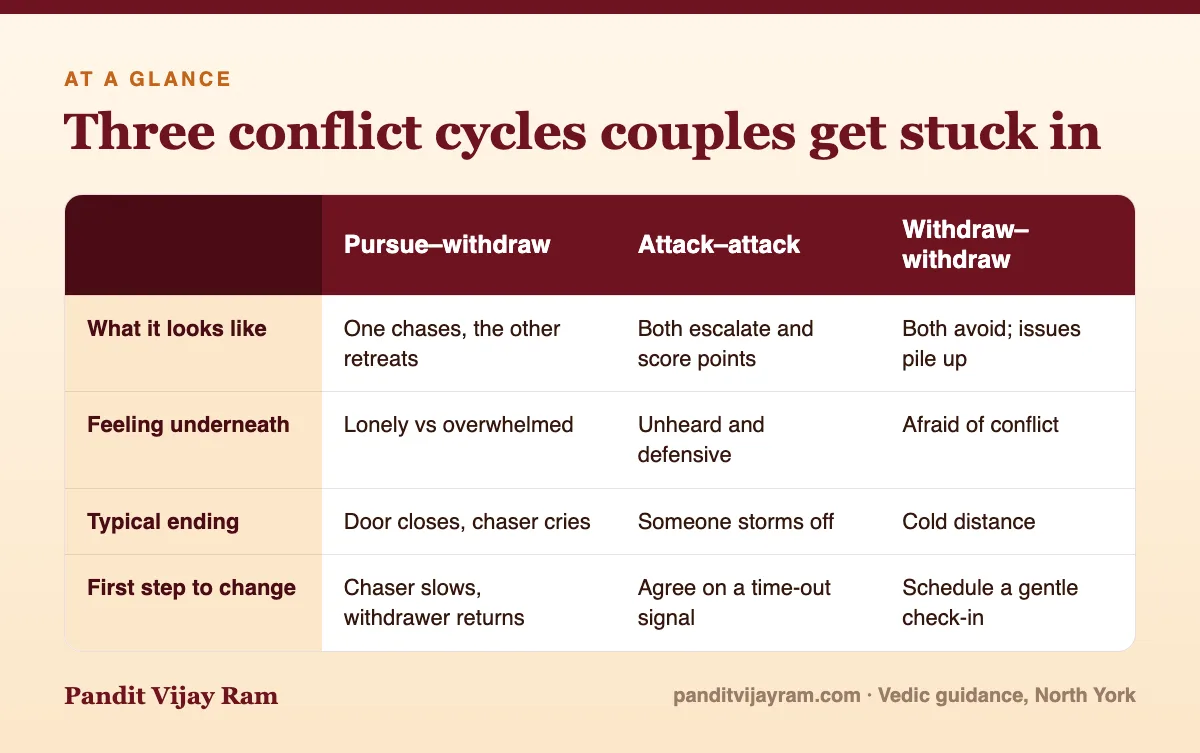
The pursue–withdraw cycle is a pattern where one partner pushes for connection or resolution while the other pulls away to avoid conflict. The more one pursues, the more the other withdraws, and the more they withdraw, the harder the first one pushes. Both are trying to protect the relationship, but in opposite ways.
Researchers sometimes call this the demand–withdraw pattern. It is one of the most common cycles in couples of every culture. Here is how it usually looks:
- The pursuer feels anxious when there is distance. They raise issues, ask questions, follow their partner from room to room, or send many messages. Underneath, they are saying "Please don't leave me alone with this."
- The withdrawer feels overwhelmed by conflict. They go quiet, change the subject, leave the room or say "Fine, whatever." Underneath, they are saying "I'm afraid this will get worse, and I don't know how to fix it."
Each person's move triggers the other's. Neither is the villain. Couples therapists who use emotionally focused therapy describe this as a negative cycle that becomes the real enemy.
Two other cycles are common too:
- Attack–attack: both partners escalate, raising voices and scoring points until someone storms off.
- Withdraw–withdraw: both avoid conflict, so issues pile up silently until the relationship feels cold.
The withdrawer's silence can be confused with the silent treatment. They are different: one is overwhelm, the other is punishment. The guide on the silent treatment explains how to tell them apart.
What triggers constant fighting in a relationship?
Common triggers include tiredness, hunger, work stress, money worries, alcohol, feeling criticised, and old wounds from childhood or past relationships. Family patterns also play a part: people tend to fight the way they saw their parents fight. Life changes such as moving in together, a new job or immigration often raise the temperature.
Many fights begin not with a real disagreement but with a body or mind that is already depleted. A useful check before any difficult talk is to ask whether either of you is hungry, angry, lonely or tired. If so, eat, rest or wait.
Other frequent triggers:
- Stress spillover. A hard day at work or a long commute leaves little patience at home.
- Family scripts. If you grew up in a home where people shouted, you may shout without thinking. If your family went silent, you may withdraw.
- Attachment fears. People who fear abandonment tend to pursue; people who fear being smothered tend to withdraw.
- Big transitions. Moving in together, wedding planning, a new baby, job loss or settling in a new country all add pressure.
- Outside voices. Friends or family commenting on your relationship can stir doubt.
- Alcohol and lack of sleep. Both lower the threshold for anger.
Some couples also look at astrology to understand temperaments, for example a fiery Mars or a sensitive Moon. The guide on husband and wife arguments in astrology covers chart factors. A relationship compatibility reading can show tendencies in both charts, though it never decides who is right. When the whole household is fighting, not just the couple, start instead with constant fights at home.
How can we figure out our fighting pattern?
Choose a calm time and trace one recent argument together, step by step. Note what started it, what each of you did, what you each felt underneath, and how it ended. Repeat with two more fights. Patterns usually appear quickly. Then give your cycle a name, so you can spot it next time.
This exercise works best on a calm day, perhaps over tea, with phones put away. Agree in advance that nobody will defend themselves; you are only describing.
- Pick a recent fight, not the worst one ever.
- The spark: what was said or done first?
- My move: each person describes what they did next. Raised voice? Went quiet? Left the room? Sent long messages?
- My feeling underneath: each person names the softer feeling under the anger. Hurt, scared, ashamed, lonely?
- My fear: what were you afraid would happen if you did not react that way?
- The ending: how did it stop? Did anyone repair it, or did it just fade?
Do this for three different fights. Write the results on one page. You will likely see the same moves and feelings each time.
Then give the cycle a name together, something light like "the chase" or "the storm". Next time it starts, either partner can say "I think the chase is starting" and pause. Naming it turns you from opponents into a team.
For a full step-by-step plan to calm things once you know your pattern, see constant arguments with your partner: a calm reset plan. If the mapping itself turns into a fight, that is a good sign that a couples counsellor would help.
When is fighting a sign of something more serious?
Fighting becomes serious when one partner is afraid of the other, when there is name-calling, threats, pushing or breaking things, or when one person controls money, phone use, friends or movement. That is not a conflict cycle between equals. It is abuse or coercive control, and safety comes before any couples work.
Ordinary conflict, even heated conflict, happens between two people who both feel free to speak. Abuse is different. One person uses fear, humiliation or control to dominate the other.
Warning signs:
- You change what you say because you fear how they will react.
- They threaten to hurt you, themselves, your children or pets.
- There is pushing, grabbing, slapping, blocking doorways or throwing things.
- They check your phone, track your location or decide who you can see.
- Every fight ends with you apologising, even when you did nothing wrong.
In these situations, techniques like naming the cycle or time-outs are not enough and can even be used against you. Couples counselling is often not recommended while abuse is happening. Individual support comes first. The guide on signs of a controlling partner explains coercive control in more detail.
If you are in danger, call 911. For confidential support, the GTA domestic violence help guide lists verified services. No reading, ritual or prayer should ever keep someone in an unsafe relationship.
For couples who feel safe but stuck, a registered couples therapist can help you break the cycle. The guide to finding relationship counselling in Toronto shows how to search.
The bottom line
Why do we fight so much is best answered by looking at the pattern rather than the topic. Most couples are caught in a cycle such as pursue–withdraw, fuelled by unmet needs, stress and old family scripts. Mapping and naming your cycle together turns you into a team against it. Where fear, threats or control appear, the issue is safety, not communication.
Key takeaways
- The surface topic of a fight is rarely the real issue.
- Pursue–withdraw is one of the most common cycles couples get stuck in.
- Tiredness, stress and family scripts often light the spark.
- Mapping three fights together usually reveals your pattern.
- Fear, threats or control mean abuse, not a normal conflict cycle.