
Relationship Anxiety: Signs and Gentle Steps

Your partner says goodnight a little briefly and you lie awake replaying the day. A delayed reply sets off a flood of what-ifs. You ask for reassurance, feel better for an hour, then the worry returns. Relationship anxiety can make a good relationship feel like a test you are always about to fail. Many people who reach out to me in North York describe exactly this, often with some embarrassment, as if they should simply be able to stop. This guide explains what relationship anxiety looks like, why it happens, how to handle the urge for reassurance, which calming practices are worth trying, how to talk with your partner about it, and when to see your family doctor or a therapist. In more than forty years of practice I have learned to treat anxious minds with gentleness first, because pressure rarely quiets fear. You are not broken for feeling this way, and steady help is available.
What are the signs of relationship anxiety?
Signs include frequent worry that your partner will leave, overanalysing texts and tone, seeking constant reassurance, difficulty enjoying calm moments, comparing your relationship with others, and physical symptoms such as a tight chest or poor sleep. The defining feature is that the fear stays high even when nothing concrete has gone wrong.
Relationship anxiety tends to show in thoughts, behaviour and the body:
- Thoughts: Do they really love me? What if I'm with the wrong person? What if they meet someone better?
- Behaviour: rereading messages, asking the same question repeatedly, checking social media, avoiding conflict at all costs, or testing a partner to see how they react.
- Body: racing heart, stomach knots, restless sleep, difficulty concentrating at work after a small disagreement.
- Mood: brief relief after reassurance, followed by renewed doubt.
Some anxiety focuses on the partner's feelings. Some focuses on your own: a nagging doubt about whether you love them enough, which can be just as distressing. Both forms are common.
Relationship anxiety is different from a reasonable concern about genuine problems. If your partner has actually become withdrawn, the post on a partner losing interest covers that situation. If doubts centre on honesty and past hurts, see our guide to where trust issues come from.

Why do I feel so anxious in my relationship?
Relationship anxiety often has several sources at once: a general tendency toward anxiety, an anxious attachment style, past rejection or betrayal, low self-worth, and current stress. Big life events such as moving, engagement, family pressure or a new job can intensify it. Understanding the mix helps you choose the right support.
Contributors I see often include:
- General anxiety. People who worry intensely about health, work or family often find the same worry attaches to love.
- Attachment history. Early experiences of inconsistent care can make closeness feel fragile.
- Past relationships. Being left suddenly or cheated on can leave a lingering alarm.
- High stakes. In many families, a relationship carries pressure about marriage, parents' approval and community reputation, which raises the fear of getting it wrong.
- Uncertainty. Undefined relationships, long distance or unclear future plans give the mind room to spin.
- Body factors. Poor sleep, too much caffeine, alcohol and some health conditions can raise anxiety levels generally.
It helps to remember that anxiety is a protective system working too hard, not proof that something is wrong. Your mind is trying to keep you safe from loss by scanning constantly for danger. The work is to teach it that not every unanswered message is a threat.
How do I stop asking my partner for reassurance all the time?
Reassurance soothes anxiety briefly but teaches the mind to need more of it. Instead, notice the urge, pause, and use a calming skill before deciding whether to ask. Agree with your partner on a reasonable, kind way to handle anxious moments, and gradually reduce how often you seek reassurance.
Reassurance-seeking is like scratching an itch: relief now, more itching later. Many therapists suggest a gradual approach:
- Notice and name it. I'm feeling the urge to ask if they're upset with me.
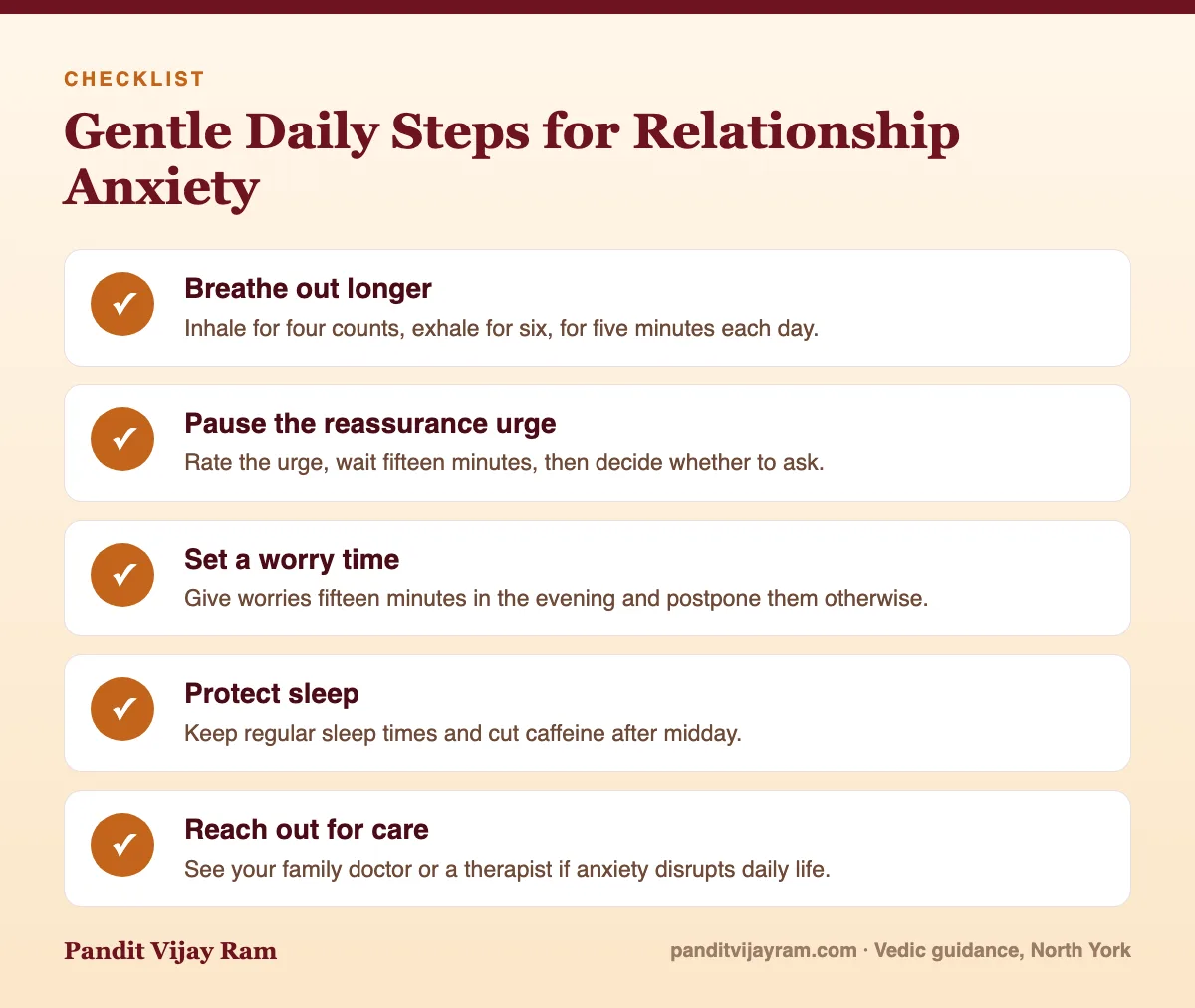
- Rate the urge from one to ten, then wait fifteen minutes.
- Use a calming skill while waiting: slow breathing, a short walk, or writing the worry down.
- Re-rate. Often the urge has dropped enough that you no longer need to ask.
- If you still ask, ask once. Accept the answer rather than repeating the question in new words.
Talk with your partner about this plan so they understand it. They might agree to answer kindly the first time and then gently remind you of your plan if the question repeats. This is not withholding love; it is supporting your recovery.
If your anxiety surges at specific times, such as when your partner is out with friends, prepare in advance with a plan for that evening. Structured planning reduces the sense of helplessness that feeds worry.
What calming practices help with relationship anxiety?
Practices that calm the body help the mind follow. Slow breathing with a longer exhale, regular sleep, daily movement, less caffeine, mindfulness and short devotional routines such as mantra or lamp-lighting are all useful. They work best when practised daily, not only during anxious moments, and alongside professional care where needed.
Try building a few of these into ordinary days:
- Slow breathing. Breathe in for four counts and out for six, for five minutes. A longer exhale tends to settle the nervous system.
- Grounding. Name five things you can see, four you can hear and three you can touch when worry spikes.
- Movement. A brisk walk most days lowers general anxiety for many people.
- Sleep and caffeine. Regular sleep times and less coffee or energy drinks after noon make a noticeable difference.
- Worry time. Give worries a set fifteen minutes each evening; outside that time, note them and postpone.
From the Vedic tradition, gentle practices include chanting a calming mantra such as Om Shanti or the Gayatri mantra slowly with the breath, and sitting before a lit diya in the evening. These are forms of prayer and steadiness, not treatments. A love problem consultation can include a chart reading for Moon and Mercury patterns linked with worry, and simple prayers for your own peace.
For more calming routines that suit families and faith communities, our GTA mental health guide lists culturally responsive services.
When should I see a doctor or therapist for relationship anxiety?
See your family doctor or a therapist when anxiety disrupts sleep, work, eating or friendships, lasts for weeks, causes panic attacks, or makes you feel hopeless. Therapies such as cognitive behavioural therapy are effective for anxiety. If you ever feel unsafe or think about harming yourself, call or text 988 immediately.
A family doctor is a good first step. They can check for physical contributors such as thyroid problems or medication effects, discuss options, and refer you to counselling or psychotherapy. Many workplaces also have an employee assistance programme, which often includes a short course of confidential counselling; check your benefits booklet or ask human resources.
Therapies with good evidence for anxiety include:
- Cognitive behavioural therapy (CBT), which helps you notice anxious thoughts and test them against evidence.
- Acceptance-based approaches, which teach you to make room for uncomfortable feelings without obeying them.
- Attachment-focused or emotionally focused therapy, sometimes as a couple, which addresses the bond itself.
Our guide to relationship counselling in Toronto explains how to find registered professionals.
One important exception: if your anxiety comes from a partner who threatens, monitors or belittles you, the problem is not your nervous system. That is a safety issue. Read our guide to toxic relationship signs and contact support.
The bottom line
Relationship anxiety is persistent worry about love that continues even when the relationship is reasonably secure. Reducing reassurance-seeking gradually, practising daily calming routines and talking openly with your partner all help. When anxiety disrupts sleep, work or mood, your family doctor or a therapist offers effective treatment, with prayer as gentle support alongside.
Key takeaways
- Relationship anxiety is common and treatable, not a personal failing.
- Reassurance brings short relief but feeds the cycle when repeated often.
- Daily calming habits work better than using them only in a crisis.
- A family doctor or therapist is the right step when anxiety disrupts life.
- Anxiety caused by a frightening partner is a safety issue, not a symptom.