
Rahu in the 7th House and Relationships

Few placements cause as much worry in marriage discussions as Rahu in 7th house charts. Relatives hear it mentioned during kundli matching and imagine divorce, a secret affair or a spouse from the other side of the world. Families in North York and across the GTA have brought me horoscopes with that line circled in red. The reality is more interesting and much less frightening. Rahu is a shadow planet of craving, novelty and ambition, and in the 7th house it turns those qualities towards partnership. This guide explains what the placement tends to show, how its sign, dispositor and aspects change the reading, which popular claims are myths, what to expect when Rahu's period runs, and which remedies are sensible. In more than forty years of Vedic practice I have seen Rahu in the 7th in the charts of devoted, long-married couples as often as in troubled ones. It asks for clear eyes in choosing a partner and steady effort once you have chosen. It does not decide your marriage for you, and no honest reader will tell you otherwise.
What does Rahu in the 7th house mean?
Rahu in the 7th house places the planet of desire and the unfamiliar in the house of marriage, partners and open dealings with others. It tends to bring strong interest in relationships, attraction to people from a different background or with an unusual quality, and ambition pursued through partnerships. Ketu sits opposite in the 1st, adding self-detachment.
Rahu and Ketu are not physical bodies but the two points where the Moon's path crosses the Sun's, always exactly opposite. So Rahu in the 7th always means Ketu in the 1st. Read together, the axis describes someone who may feel unsure of their own identity while looking intensely outward, towards partners, for definition.
Common tendencies, depending on the rest of the chart:
- Strong pull towards partnership, sometimes with idealisation early in a relationship.
- A partner who stands out: a different culture, religion, age, profession or temperament from family expectation.
- Partnerships as a route to ambition, including business and public dealings.
- Restlessness if the relationship feels routine, and a need to keep learning together.
The 7th house is also the house of business partners and contracts, so the same restlessness or ambition can show up at work. The opposite placement, with Ketu in the 7th and Rahu in the 1st, reads quite differently; the Ketu in the 7th house guide explains it.
How do sign and dispositor change Rahu in the 7th house?
Rahu has no sign of its own in most schools, so it behaves largely like the lord of the sign it occupies, called its dispositor. A strong, well-placed dispositor steadies Rahu in the 7th; a weak or afflicted one magnifies confusion. Jupiter's aspect softens Rahu, while Saturn or Mars influence can harden it.
When I read this placement, I work through a short checklist:
- The sign. Many readers treat Rahu as exalted in Taurus and debilitated in Scorpio; others prefer Gemini and Sagittarius. Aquarius is often given to Rahu as co-ruler. These disagreements are long-standing, so a reader should name the view they follow.
- The dispositor. Where is the sign's lord, and is it strong? A Rahu in Libra depends heavily on Venus; in Capricorn, on Saturn.
- Conjunctions. Rahu with Venus intensifies attraction; with the Moon, emotional swings; with Saturn, delay and seriousness; with Mars, heat and haste.
- Aspects on Rahu. A Jupiter aspect is one of the most protective factors. Some schools also give Rahu its own 5th, 7th and 9th aspects; others do not use them.
- The 7th lord and Venus. If both are strong, Rahu's restlessness is usually channelled into a lively, unconventional but stable partnership.
- The navamsa. Rahu's position in the D9 confirms or softens what the birth chart shows.
A traditional saying, shanivat Rahu, holds that Rahu acts like Saturn. In the 7th that can mean a serious, slow-building or duty-bound bond rather than a light romance.
Does Rahu in the 7th house mean a foreign spouse or divorce?
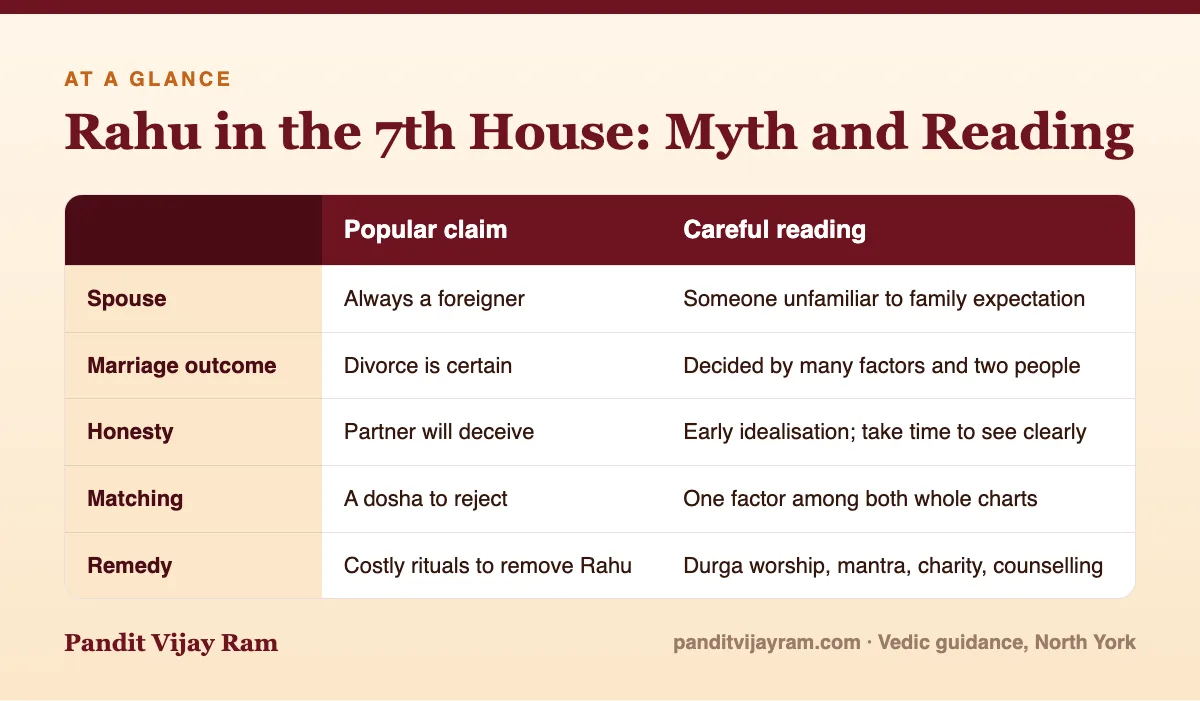
Not necessarily. Rahu in the 7th is linked with partners from a different background, and in diaspora families that sometimes means a different country, culture or community. It does not, on its own, predict divorce, two marriages or an affair. Those claims ignore the rest of the chart and the choices two adults make.
Here are the myths I hear most often, with what a careful reading actually says:
- Myth: a foreign spouse is certain. Reality: the placement suggests someone unfamiliar to your family's expectations. For a Canadian-born child of immigrants, that might simply mean someone outside the community. Foreign links are better judged with the 9th and 12th houses, as the foreign settlement guide explains.
- Myth: it means divorce. Reality: separation is read from many factors together, including the 7th lord, Venus, the navamsa and the dasha. One node does not decide it.
- Myth: inter-caste or inter-faith marriage is fated. Reality: the chart may show openness to difference; the decision belongs to the couple.
- Myth: the spouse will be deceptive. Reality: Rahu can bring idealisation, so slowing down and seeing clearly protects both people. It says nothing certain about a partner's honesty.
During matching, Rahu in the 7th is sometimes treated as a serious flaw. It is better weighed alongside both charts as a whole. The article on kundli matching for love marriage explains why matching offers insight, not a veto.
What happens during Rahu dasha if Rahu is in the 7th house?
Rahu's major period lasts eighteen years in the Vimshottari system, and when Rahu sits in the 7th its period tends to bring relationships and partnerships strongly into focus. That can mean meeting a partner, marrying, starting a business with someone, or questioning an existing bond. Results depend on the dispositor and on the sub-periods within it.
A Rahu period is rarely quiet. It often brings new situations, ambition and a desire for change. With Rahu in the 7th, the change centres on other people.
Some patterns I watch for:
- Rahu–Rahu sub-period: the first stretch of the major period, often the most intense, when new connections or decisions appear quickly.
- Rahu–Venus or Rahu–7th lord sub-periods: commonly linked with romance, engagement or marriage when the chart supports it.
- Rahu–Saturn or Rahu–Mars sub-periods: may test patience and bring friction that needs careful speech.
- Transits of Rahu over the 7th or the ascendant: every eighteen years or so the nodes return to their birth axis, a time many readers associate with re-evaluating relationships.
None of these is a verdict. I encourage people in a Rahu period to slow major commitments slightly, talk openly with a partner about what each wants, and keep family informed where that is healthy. The guide to dasha periods and breakups explains why periods describe pressure, not outcomes. Check a current ephemeris or a Toronto panchang for actual transit timings rather than lists found online.
What are the remedies for Rahu in the 7th house?
Traditional remedies for Rahu in the 7th house include worship of Durga, the Rahu beej mantra on Saturdays, charity of black sesame, blankets or food to those in need, and honest conduct in partnerships. Hessonite, the Rahu stone, is suggested only after a full reading. Practical steps, such as premarital counselling, often help most.
I usually suggest a balanced plan with spiritual and practical parts.
Devotional practice:
- Recite the Durga Chalisa or a short Durga mantra, especially on Saturdays or during Navratri.
- Chant the Rahu beej mantra, Om Bhram Bhreem Bhroum Sah Rahave Namah, one mala of 108, with calm attention.
- Give quietly: black sesame, warm blankets, or a donation to a shelter or food bank.
Practical steps:
- Take time before committing. Rahu's early idealisation fades, and the real person becomes visible after a while.
- Be transparent with a partner about money, family expectations and plans abroad.
- Consider premarital counselling, which helps couples surface differences calmly.
Hessonite, or gomed, can amplify Rahu's restlessness if worn on a guess. It is considered only when Rahu is clearly beneficial for the ascendant, and after a trial. More general node remedies are described in the guide to Rahu and Ketu remedies.
For couples who want to understand how their charts meet, a relationship compatibility reading, done with both partners' agreement, places Rahu in context. Be wary of anyone selling expensive rituals to remove Rahu from your marriage; that is fear-selling.
The bottom line
Rahu in 7th house charts turn the planet of desire and novelty towards partnership, often bringing an unconventional partner and a strong drive to relate. The sign, dispositor, aspects and navamsa decide whether that energy is restless or creative, and schools differ on Rahu's dignities. The popular fears, divorce, deception and a certain foreign spouse, ignore the rest of the chart and the couple's own choices. Steady devotion, honest conduct and practical steps such as counselling are the remedies that make sense.
Key takeaways
- Rahu in the 7th always comes with Ketu in the 1st, so the axis is read together.
- The placement suggests strong desire for partnership and an unconventional partner.
- Rahu acts largely through its dispositor; Jupiter's aspect is one of the best softeners.
- It does not, on its own, predict divorce, an affair or a foreign spouse.
- Durga worship, the Rahu mantra, charity and honest conduct are the core remedies.