
Foreign Settlement in a Kundli: Reading the 12th House

Leaving the place you were born is one of the largest decisions a family makes, and many in the GTA have already made it once. I am often asked, by newcomers in North York and by parents still in India or the Caribbean, whether a kundli shows foreign settlement. Some want to know if a move will last; others wonder why they never feel fully at home in either country. Foreign settlement astrology looks at a cluster of houses and planets that tradition links with distance, travel and life among other cultures. This article explains how the 12th, 9th and 4th houses are read, which combinations people call videsh yoga, and why different schools disagree about them. In more than forty years of practice, I have seen the chart help people reflect on belonging and timing, but I keep a firm line between astrology and immigration law. You will also find a frank section on what no reading can tell you, and on how people already settled here use these ideas to make peace with two homes.
What does foreign settlement astrology look at?
It looks at the 12th house of distant places and separation, the 9th house of long journeys, the 4th house of home and homeland, and Rahu, the node linked with foreign cultures. Astrologers then check which of these the current dasha activates. Together they describe a tendency toward distance, not a fixed destiny.
Every house in a kundli carries several meanings at once. The 12th, for example, covers expenses, sleep, retreat, loss and liberation, as well as faraway lands. A full guide to the twelve houses lists the others. That breadth is why a single placement never tells the whole story.
When reading for settling abroad, astrologers usually follow a sequence:
- Check the lagna and its lord, which describe the person's basic direction in life.
- Read the 4th house and its lord for attachment to home, mother and homeland.
- Read the 9th and 12th houses and their lords for long journeys and life in distant places.
- Note Rahu's house and sign, since Rahu is associated with the unfamiliar and the foreign.
- Look at the Moon, which shows the mind's need for roots or for movement.
- Ask which planets the current dasha and antardasha activate.
The last step matters most. A chart may hold a strong 12th-house theme for decades without a move, because timing in the Vedic system comes from the dasha. Our explainer on the Vimshottari dasha shows how those periods unfold.
One more point is easy to forget. Diaspora readings are not only about leaving. Many people want to understand why they feel unsettled after arriving, and the same houses help frame that conversation.

Which house shows settling abroad: the 12th, 9th or 4th?
All three are read together. The 12th house is the main indicator of living in distant lands, the 9th shows long journeys and fortune found far away, and the 4th shows the pull of home. A strong 12th with a disturbed 4th is the pattern most often linked with long-term settlement.
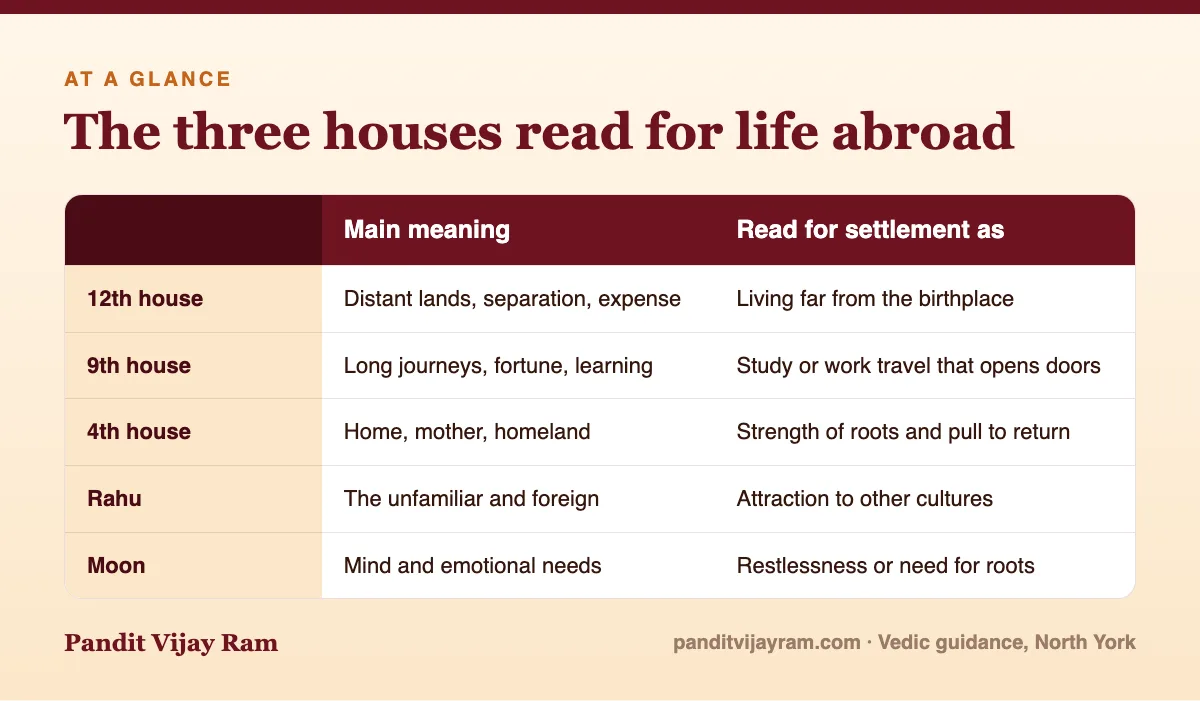
Each house contributes a different piece. A simple way to hold them in mind:
- 12th house: distance and separation. Classical texts tie it to foreign lands, isolation and expenditure. A busy 12th house, or a 12th lord placed in a key house, is the most quoted sign of living away from the birthplace.
- 9th house: long journeys and dharma. It covers pilgrimage, higher learning and fortune. Many people read a strong 9th as study or work travel that opens doors abroad.
- 4th house: home and roots. It represents the homeland, property and mother. When the 4th lord sits in the 12th, or the 4th is under heavy malefic influence, astrologers read it as life away from one's native place.
- 7th house: dealings with others. Some schools add the 7th for foreign trade and business travel.
- 3rd house: short journeys. It is usually read for frequent travel rather than settlement.
Signs matter too. Movable signs, called chara rashis (Aries, Cancer, Libra and Capricorn), are linked with movement, and water signs are sometimes linked with crossing seas. These are associations from tradition, not physical rules.
Different schools give these houses different weight. That disagreement is a good reason to treat any single reading as one view rather than a verdict.
Two homes
Many settled families find the 4th and 12th houses equally active: home is both here and there.
What is videsh yoga in a kundli?
Videsh yoga is a popular name for combinations said to show life or work abroad. Common examples include the 4th lord in the 12th house, the 9th and 12th lords linked together, Rahu in the 12th or 9th, and the lagna lord placed in the 12th. Astrologers define it differently, so lists vary.
There is no single classical yoga called videsh yoga with one agreed definition. The name gathers several combinations that astrologers have linked with distance. Frequently quoted examples include:
- The 12th lord placed in the lagna, 9th or 10th house, or the lagna lord placed in the 12th.
- An exchange or conjunction between the 9th and 12th lords.
- The 4th lord in the 12th, or the 4th house heavily afflicted, suggesting distance from the native place.
- Rahu in the 12th, 9th, 7th or lagna, especially in a movable sign.
- The Moon in the 12th or in a movable sign, read as a restless or adaptable mind.
Some of these combinations are common. Rahu alone sits in the 12th house for about one person in twelve, so it cannot mean everyone will emigrate. Readers who are honest about this will weigh strength, aspects and dasha before saying anything.
I also hear the reverse fear: "My chart has no videsh yoga, so will my move fail?" Plenty of settled, contented people in Toronto have none of these combinations. A chart describes inclination; your choices, skills and the law decide what actually happens.
What can a kundli not tell you about moving abroad?
A kundli cannot predict whether a visa, study permit, work permit or permanent residence will be approved, or when. Those decisions follow immigration law and the documents you submit. Only IRCC, a licensed immigration consultant or an immigration lawyer can advise on your file. Astrology belongs to reflection, not to legal planning.
This boundary is important enough to state plainly. I do not predict visa or immigration outcomes, and I do not give immigration advice. An immigration kundli, however detailed, has no access to your application, your eligibility or the rules an officer must apply.
For anything legal, use official and regulated sources:
- IRCC. Immigration, Refugees and Citizenship Canada publishes the rules, forms and processing information on its own website.
- Licensed consultants. In Canada, paid immigration advice should come from a consultant licensed by the College of Immigration and Citizenship Consultants, or from a lawyer or Quebec notary.
- Lawyers. Complex cases, refusals and appeals need a lawyer.
Be wary of anyone, astrologer or agent, who links a ritual to an approval or asks for money to "speed up" a file. Those are warning signs of fraud. If you are waiting on an application now, our article on spiritual support during visa delays covers patience practices and scam warnings in detail.
What a chart can offer is perspective on readiness. A person in a restless Rahu period may need to slow down and research. Someone in a 4th-house dasha may feel a strong pull to stay close to ageing parents. Naming these feelings helps a family plan honestly.
How do settled families use foreign settlement readings?
Many people already living in Canada use these readings to understand homesickness, decide whether to return, or plan care for parents abroad. The 4th and 12th houses frame feelings about belonging. The reading becomes a conversation about values and timing, supported by community, counselling and practical planning rather than prediction.
Some of the most thoughtful conversations I have about settle abroad astrology happen years after the move. A man who has lived in Scarborough for a long time wonders whether to retire to Punjab. A young woman born here asks why she feels a pull toward Guyana, where her grandparents grew up. A couple debates bringing parents over.
Here the chart is a mirror. A strong 4th house may explain a deep attachment to a family home. An active 12th may describe comfort in distance. Neither answers the practical questions about health care, pensions, taxes or citizenship, which need a financial planner and the relevant government offices.
The emotional side of migration is real. Winter isolation, lost status and long-distance family duties can weigh heavily. Our guide to feeling low after moving to Canada lists community and mental-health resources, and the article on marriage stress after immigration speaks to couples. If low mood lingers, please see your family doctor.
A simple daily lamp, a call home at a fixed time, and a local place of worship help many people feel rooted in both places. When you want a full chart view, the kundli and horoscope service can look at your 4th, 9th and 12th houses together.
The bottom line
Foreign settlement astrology reads the 12th, 9th and 4th houses, together with Rahu and the Moon, as themes of distance, journeys and roots. Videsh yoga combinations vary between schools and are common enough that none can be read as a promise. Immigration decisions belong to IRCC, licensed consultants and lawyers, never to a chart. For families already here, these readings are most useful as a calm way to talk about belonging and timing.
Key takeaways
- The 12th house is the main traditional indicator of life in distant lands.
- The 4th house shows the pull of home and is read alongside the 12th and 9th.
- Videsh yoga has no single definition, and many common placements are included.
- No chart can predict a visa, permit or permanent residence decision.
- Settled families often use these readings to reflect on belonging and returning.