
Ketu in the 7th House: Detachment and Unusual Partnerships

When a family is told that their daughter or son has Ketu in 7th house placement, the reaction is often silence, then worry. Some have heard that it means no marriage, or a spouse who will leave, or a life of renunciation. People in North York and around the GTA have shown me printouts where the placement is described in alarming language, usually followed by an expensive ritual. The truth is calmer. Ketu is the planet of detachment, intuition and what has already been learned, and in the 7th it brings those qualities into partnership. That can make relationships feel distant at times, and it can also produce deeply spiritual, low-drama marriages. This guide explains what the placement tends to show, the myths that surround it, how sign and conjunctions alter it, what Ketu's period can bring, and which remedies are sensible. In more than forty years of practice I have met many contented couples where one partner has Ketu in the 7th. What they share is not luck but awareness: they learned to say what they need instead of quietly withdrawing.
What does Ketu in the 7th house mean?
Ketu in the 7th house brings the south node's detachment and inward focus into marriage and partnership. It is often read as a person who does not cling in relationships, may feel partly unsatisfied or distant, and is drawn to a partner with an unusual, spiritual or independent nature. Rahu in the ascendant opposite adds strong personal ambition.
Where Rahu reaches for the unfamiliar, Ketu lets go of what feels familiar. Many readers say that Ketu marks areas of life already explored in past lives, so in the 7th house a person may approach partnership with a sense of already knowing it, sometimes with less hunger than others expect.
In practice that can look like:
- Self-contained love: affection that is real but quiet, and a dislike of drama or possessiveness.
- An unconventional partner: someone introverted, spiritual, technical, much older or younger, or simply different from the family's picture.
- Moments of distance: times when one partner withdraws, or feels the relationship is not quite enough.
- Strong individual drive: because Rahu sits in the 1st, personal goals can compete with time for the relationship.
The same axis, reversed, is discussed in the guide to Rahu in the 7th house. Comparing the two is a good way to see how sharply the nodes differ: Rahu in the 7th seeks partnership intensely, while Ketu in the 7th can hold it at arm's length.
Some readers also see a past-life or karmic tone in Ketu here, a theme explored with its limits in the article on karmic relationships.

Is Ketu in the 7th house bad for marriage?
Ketu in the 7th is not a bar to marriage. Many people with it marry and stay married. It can bring a less romantic or more detached style, delays, or a feeling of something missing, which needs honest attention. Claims that it denies marriage, guarantees separation or harms a spouse are not supported by careful reading.
These are the fears I am asked about most, with a plain answer to each:
- It means no marriage. No single placement denies marriage. Marriage is judged from the 7th lord, Venus, the navamsa, Jupiter's influence and the dasha sequence.
- The person will become a renunciate. Ketu does bring spiritual interest, but full renunciation needs very specific combinations, and even then free choice decides.
- The spouse will fall ill or leave. This is fear-selling. A placement in your chart is not a sentence on another person's health or behaviour.
- It is the same as Manglik. A traditional saying, kujavat Ketu, holds that Ketu acts like Mars, and a few matchmakers count it in Manglik calculations. Most classical methods do not.
What a careful reader does say is that Ketu in the 7th asks for conscious effort. A partner may sometimes feel shut out, or the person with Ketu may feel restless despite a good relationship. Both are workable with open conversation.
If your marriage is already under strain, the marriage problem guidance Vijay Ram ji offers looks at the whole chart and the practical situation together, rather than blaming one node.
How do sign and conjunctions change Ketu in the 7th house?
Ketu has no sign of its own in most schools, so it gives results through the lord of the sign it occupies and through planets it joins. Many texts treat Ketu as exalted in Scorpio or Sagittarius and weak in Taurus or Gemini, though schools differ. Jupiter's influence tends to spiritualise Ketu; Mars or Saturn sharpen it.
A short guide to the main modifiers I check:
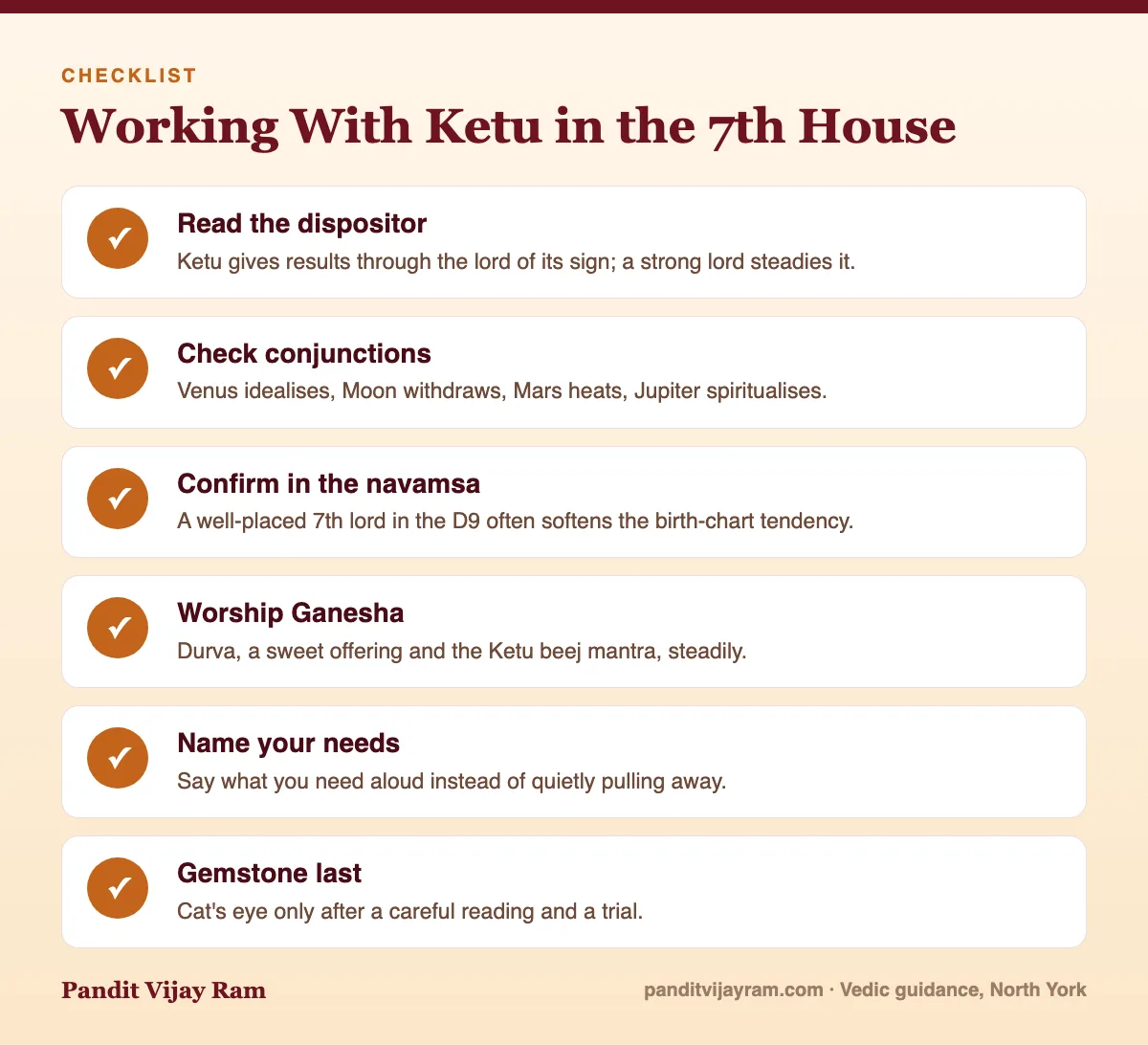
- Sign and dispositor. Ketu in Libra leans on Venus; in Aries, on Mars. A strong dispositor gives Ketu a stable channel.
- Ketu with Venus. Idealistic, unusual or spiritual love; sometimes a feeling that no partner quite matches an inner image.
- Ketu with the Moon. Emotional withdrawal under stress. Learning to name feelings matters here.
- Ketu with Mars. Sudden heat and sharp words; the kujavat Ketu idea is strongest in this combination.
- Ketu with Saturn. Duty-bound, serious or delayed partnership.
- Ketu with or aspected by Jupiter. Often a partner with spiritual depth, or a marriage with a shared practice at its centre.
- The navamsa. If Ketu or the 7th lord is well placed in the D9, the birth-chart tendency is often softened.
The navamsa chart guide explains why the D9 is consulted for marriage. Because schools disagree on Ketu's dignities and on whether it casts aspects of its own, an honest reader should say which tradition they follow. I treat those disagreements as reasons for humility, not for confident verdicts.
What happens in Ketu dasha with Ketu in the 7th house?
Ketu's major period lasts seven years in the Vimshottari system. With Ketu in the 7th, that period often turns attention to relationships through questioning, simplification or a change of priorities. Some people withdraw from a partnership; others find a deeper, quieter bond. The dispositor and the sub-periods decide much of the result.
Ketu's period is short compared with Rahu's eighteen years or Venus's twenty, and it often feels like a pause between chapters. Its sub-periods follow the standard Vimshottari order, beginning with Ketu itself, then Venus, Sun, Moon, Mars, Rahu, Jupiter, Saturn and Mercury; the Vimshottari dasha explainer sets out the full sequence.
Patterns often seen with Ketu in the 7th:
- Ketu–Ketu: a time of inward focus, when relationship goals may feel less pressing.
- Ketu–Venus: romance can arrive suddenly or old feelings resurface; it can also bring sudden endings of bonds that had grown thin.
- Ketu–Moon: emotional sensitivity; a time to talk openly rather than withdraw.
- Ketu–Jupiter: often a gentle, spiritual stretch, good for shared practice.
Transits add another layer. When transiting Ketu crosses the 7th house again, about every eighteen years, people often reconsider what they want from partnership. Check a current ephemeris or a Toronto panchang for actual positions rather than relying on online lists.
None of this is fixed. A detached period can be used well: to simplify, to care for health, and to rebuild a relationship on clearer terms.
What are the remedies for Ketu in the 7th house?
Traditional remedies for Ketu in the 7th house centre on Ganesha worship, the Ketu beej mantra, charity such as blankets or food, and respect for elders and teachers. Cat's eye, Ketu's gemstone, is considered only after a careful reading. Practical habits, such as naming needs aloud and sharing a spiritual practice, often help most.
Ketu is traditionally linked with Ganesha, the remover of obstacles, and many families begin Ketu remedies with him.
Devotional steps:
- Offer durva grass and a modak or sweet to Ganesha on Tuesdays or Saturdays, or on Sankashti Chaturthi.
- Chant the Ketu beej mantra, Om Sraam Sreem Sraum Sah Ketave Namah, one mala of 108, slowly and with attention.
- Give blankets, food or a donation to an animal shelter; feeding stray dogs is a folk custom linked with Ketu in parts of North India.
For a fuller Ganesha observance, the Ganesha puja and havan service can be arranged.
Relationship habits:
- Say what you need in words, especially when you notice yourself pulling away.
- Agree on protected time together each week that personal goals cannot take over.
- Share a short spiritual routine, such as the lamp-and-sankalp practice in spiritual cleansing for couples.
- See a couples counsellor if distance becomes a pattern rather than a phase.
Cat's eye, or lehsunia, is one of the stones I am most cautious about. It is suggested only when Ketu is clearly beneficial for the ascendant, after a trial. Anyone pressuring you to buy it to save your marriage is selling fear.
The bottom line
Ketu in 7th house charts bring detachment, intuition and a less possessive style into partnership, often with an unusual or spiritual partner. The sign, dispositor, conjunctions and navamsa shape the result, and schools differ on Ketu's dignities and aspects. The placement does not deny marriage, doom a spouse or equal Manglik dosha. Ganesha worship, the Ketu mantra, charity and the habit of naming your needs aloud are the remedies most worth keeping.
Key takeaways
- Ketu in the 7th always comes with Rahu in the 1st, so personal drive and detachment in partnership go together.
- The placement suggests a quiet, non-possessive style and an unusual partner.
- It does not deny marriage, harm a spouse or count as Manglik in most classical methods.
- Jupiter's influence tends to spiritualise Ketu; Mars or Saturn sharpen it.
- Ganesha worship, the Ketu mantra, charity and open conversation are the core remedies.