
Pre-Marriage Counselling for South Asian Couples

Wedding planning in South Asian families can take a year of attention: venues, guest lists, outfits, the mehndi, the muhurat. The marriage itself often gets far less preparation. Couples in North York and across the GTA tell me they spent months choosing a caterer and almost no time discussing where they would live or how they would handle money. Premarital counselling fills that gap. This guide explains what it covers, the questions worth asking each other, how to find a registered counsellor in Ontario, and how counselling and kundli matching can work together rather than compete. It is written for love marriages and arranged marriages alike, for couples marrying across cultures, and for families who want to support the couple without taking over. In more than forty years of matching charts, I have found that the couples who come prepared to talk openly before the wedding handle their first hard year with far more grace than those who rely on the score alone.
What is premarital counselling and what does it cover?
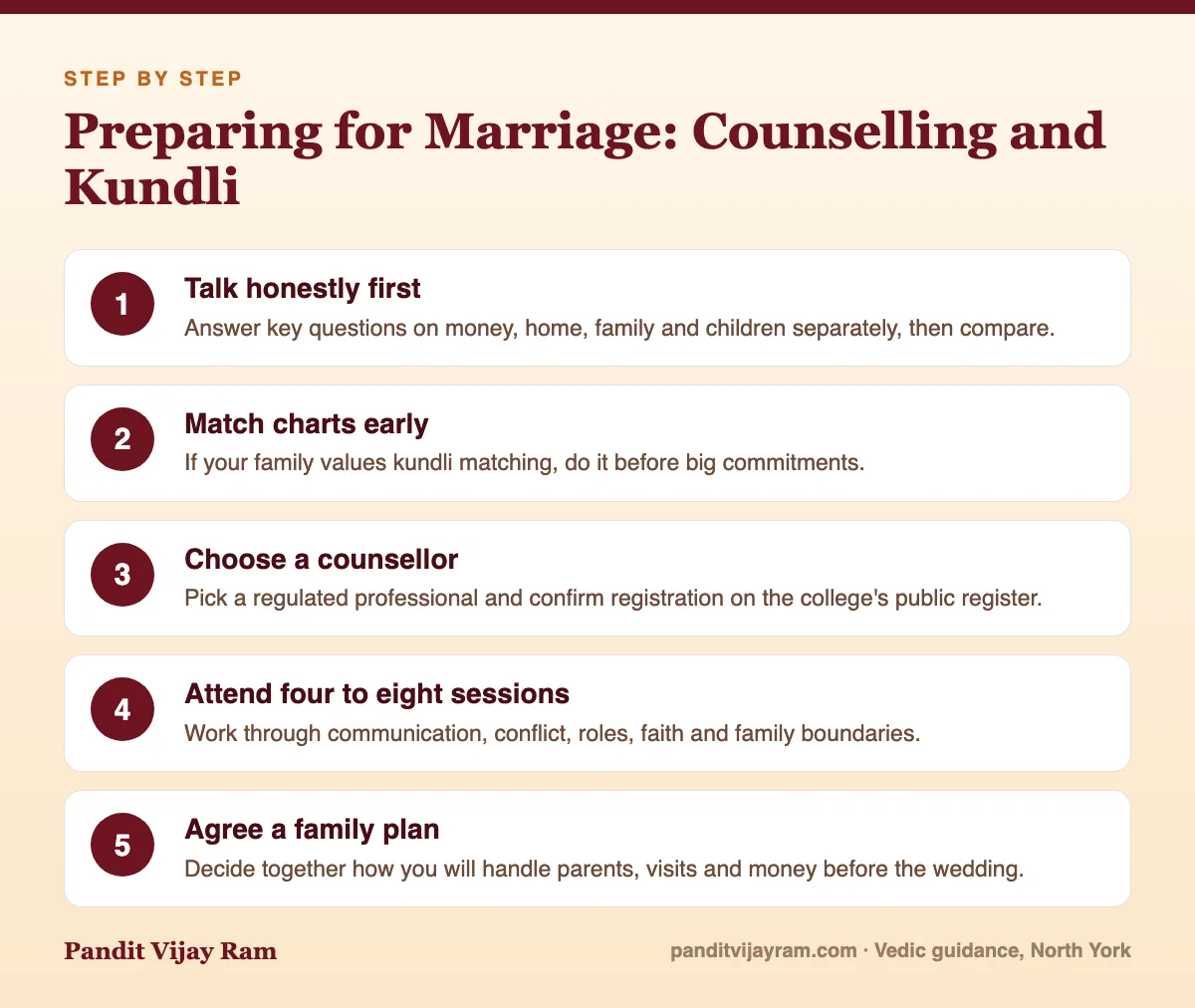
Premarital counselling is a short series of sessions, usually four to eight, in which a trained counsellor helps a couple explore expectations and skills before marriage. Common topics are communication, conflict, money, family boundaries, roles at home, intimacy, children, faith and career plans. The aim is understanding and preparation, not approval or rejection of the match.
Most programmes combine conversation with simple exercises. Some counsellors use a questionnaire that each partner completes separately, then compare the answers in session to find areas of agreement and difference. Faith-based versions, such as Catholic Pre-Cana courses, add teaching about marriage in that tradition.
Typical areas a counsellor will cover:
- Communication. How each of you raises a concern, and what you do when you feel criticised.
- Conflict. Whether one of you pursues and the other withdraws, and how you repair after an argument.
- Money. Joint or separate accounts, debts, spending habits and support for parents.
- Family. How often you will see each set of parents, whether you will live with them, and who makes decisions.
- Roles. Housework, careers and who will slow down if children arrive.
- Intimacy and health. Expectations, any health conditions and family planning.
- Faith and culture. Festivals, rituals, food and how children will be raised.
Good counselling does not tell you whether to marry. It helps you see each other clearly enough to make that choice wisely and to start well.
If you are still deciding whether to commit at all, our guide on a partner who is not ready for marriage may help first.

Why do South Asian couples benefit from pre-marriage counselling?
South Asian marriages often join two extended families, carry strong expectations about roles and parents, and may span countries, cultures or faiths. These pressures are rarely discussed openly before the wedding. Counselling gives the couple a neutral space to agree on boundaries, money and family duties before relatives' assumptions fill the silence.
In many diaspora families, certain things are assumed rather than said. A son is expected to support his parents. A daughter-in-law is expected to adapt. Money is sent home without discussion. These customs can work well when both partners have chosen them. They cause pain when one partner never agreed.
Situations where counselling is especially useful:
- Arranged or semi-arranged matches where the couple has met only a few times.
- Love marriages facing family resistance, where the couple needs a united plan.
- Intercultural or interfaith couples deciding how to blend traditions.
- Transnational marriages, where one partner is moving from India, Pakistan, Sri Lanka, Bangladesh, Guyana or elsewhere and will be far from their own family.
- Couples who grew up with conflict or divorce at home and want to do things differently.
Stigma about counselling is fading, but some elders still see it as admitting a problem. You can frame it as preparation, the way you would learn to drive before buying a car.
If the main hurdle is gaining parents' support for the match, see our guide to convincing parents for a love marriage. For a first meeting in an arranged process, read about the arranged marriage first meeting.
What questions should we ask each other before marriage?
Ask about money, living arrangements, children, careers, faith, family boundaries, health, past relationships and how each of you handles anger and stress. The goal is not perfect agreement but honest answers. Where you differ, discuss whether you can accept or bridge the difference, ideally with a counsellor present for the hardest topics.
Here is a question list many couples use, grouped by theme. Answer separately first, then compare.
- Money: Do we combine our pay? How much debt does each of us carry? Will we send money to parents, and how much is reasonable?
- Home: Where will we live in the first five years? Would either of us move cities or countries for work?
- Family: Will we live with parents? How often will relatives visit or stay? What happens if a parent needs care?
- Children: Do we want them, how many, and roughly when? What if we face fertility problems?
- Work and roles: Who does what at home? Would either of us stop working, and would that be a joint choice?
- Faith: Which festivals and rituals matter? How will children learn about religion?
- Conflict: What do you do when you are angry? What helps you calm down?
- Health and history: Any conditions, medications or past relationships the other should know about?
One answer outweighs all others. If either partner is already afraid of the other's anger, or is being pressured into the marriage, stop and seek help. Forced marriage is a crime in Canada, and the domestic violence help guide for the GTA lists confidential support.
How do I find a premarital counsellor in Ontario?
Look for a regulated professional, such as a registered psychotherapist, registered social worker or psychologist, and confirm their registration on the regulatory college's public register. For psychotherapists, that is the CRPO public register. Ask about experience with premarital work and South Asian families, session format, language and fees before booking.
In Ontario, the title registered psychotherapist is protected. The College of Registered Psychotherapists of Ontario keeps a free online public register where you can search a name and see registration status and any restrictions. Social workers and psychologists have their own colleges with similar registers.
Steps to find a good fit:
- Check your benefits. Many workplace plans and employee assistance programmes cover counselling sessions.
- Search directories, such as the Ontario Association for Marriage and Family Therapy, then confirm the person also appears on a college register.
- Ask about approach. Some use structured inventories; others work more conversationally.
- Ask about culture and language. Experience with joint families, inter-caste or interfaith couples, and your preferred language.
- Book a short first call. Both partners should feel comfortable, not only one.
Faith communities also offer marriage preparation. Churches run Pre-Cana and similar courses, and some temples, gurdwaras and mosques hold workshops. These can complement, but are not the same as, sessions with a regulated therapist.
Our guides to relationship counselling in Toronto and couples therapy in GTA languages explain how to search and what to ask.
Should we do kundli matching as well as counselling?
Many South Asian couples do both, and the two answer different questions. Kundli matching looks at temperament, emotional rhythm and timing through the charts. Counselling looks at real habits, expectations and skills. A good score does not replace honest conversation, and a modest score is no reason to cancel a well-prepared, loving match.
Where families value matching, I suggest doing it early, before emotional and financial commitments grow. The usual Ashtakoota guna milan scores 36 points across eight kootas, and I also look at Mangal dosha, the 7th house, Venus and the navamsa in each chart.
How the two fit together in practice:
- Kundli matching can highlight areas to watch, such as a fiery Mars pairing or very different Moon signs. It names tendencies.
- Counselling turns those tendencies into conversations. If the chart suggests quick tempers, the counsellor helps you practise calming down.
- Neither should be used to pressure a reluctant partner into marriage or to break up a couple who have chosen each other freely.
Some couples worry that a pandit will refuse their match. My role is to explain what the charts show and suggest remedies or care where useful, not to issue a verdict. A low score is explained in our guide to a low guna milan score.
For a full reading of both charts, with time to talk through what it means for your plans, see Vijay Ram ji's relationship compatibility service. Bring your counselling questions too; they often make the reading more useful.
The bottom line
Premarital counselling helps South Asian couples talk about money, family roles, conflict and children before the wedding, rather than discovering differences afterwards. Choose a regulated professional and confirm their registration, for psychotherapists on the CRPO public register. Kundli matching and counselling answer different questions, and using both gives a fuller picture. Above all, the marriage should be freely chosen, and preparation is a gift you give each other.
Key takeaways
- Premarital counselling prepares couples, it does not approve or reject them.
- Money, parents and roles are the topics most often left unspoken.
- Check a psychotherapist's status on the CRPO public register.
- Kundli matching shows tendencies; counselling builds skills.
- Forced marriage is a crime in Canada; help is confidential.