
Karmic Relationships in Vedic Astrology
Some relationships feel older than they are. You meet someone and seem to recognise them; or you keep returning to a person who hurts you and cannot explain why. People often come to me with the phrase karmic relationship, picked up from social media, and want to know whether Vedic astrology agrees. Clients in North York and around the GTA ask it after intense love affairs, difficult marriages and breakups that felt fated. This guide explains what Hindu thought actually says about karma and relationships, the meaning of rinanubandhan, the chart factors astrologers point to, where those claims are classical and where they are modern, and how to work with a bond like this in a healthy way. In more than forty years of practice I have found the idea of karma most helpful when it encourages responsibility and compassion. It becomes harmful when it is used to keep someone in a relationship that frightens or diminishes them. I will be clear about that line throughout, because the word karmic is too often used to excuse things that no tradition asks anyone to endure.
What is a karmic relationship in Vedic thought?
In Hindu thought, every action leaves an impression, a samskara, and the results of past action shape present circumstances, including whom we meet. A karmic relationship is one understood as arising from such past connections. It can be loving or difficult. Its purpose, in this view, is learning and completion, not punishment or endless repetition.
Classical texts do not use the phrase karmic relationship. It is a modern term, popular in Western spiritual writing and now common among South Asian readers too. The underlying idea, though, is old: the Upanishads and the Gita teach that action shapes future experience, and the Puranas are full of bonds carried across lives.
Modern usage tends to mean one of three things:
- An instant, intense recognition that feels like meeting someone already known.
- A repeating pattern, such as the same kind of partner or the same argument, across several relationships.
- A painful bond that is hard to leave, often described as fated or owed.
Only the first two fit comfortably with Vedic ideas. The third needs care, because pain that keeps someone stuck is often explained better by psychology, such as trauma bonding, than by past lives. The article on on-and-off relationships explains why intermittent closeness can feel so binding.
Karma also includes the present. The Gita's emphasis is on right action now, not on decoding the past. Whatever a bond's origin, how you act in it today is the part of karma you actually hold.

What does rinanubandhan mean in relationships?
Rinanubandhan combines rina, debt, and anubandhan, binding. It describes the idea that people come together because of give-and-take left unfinished from past lives, between parents and children, friends, spouses or even strangers. Once the exchange is complete, the bond may loosen naturally. It explains connection without demanding that anyone stay against their wellbeing.
The word is used widely in Marathi, Hindi and Gujarati households, often with a sigh, when someone enters or leaves a life unexpectedly. A grandmother might say it of a neighbour who helped in a crisis, or of a marriage that ended after many years.
The idea carries a gentle wisdom:
- Some bonds are for a season. When the exchange is complete, parting can be seen as completion rather than failure.
- Debts are settled by right conduct. Honesty, kindness and fulfilling genuine duties are how a debt is repaid, not by suffering.
- Both people have accounts. No one is only the creditor or only the debtor.
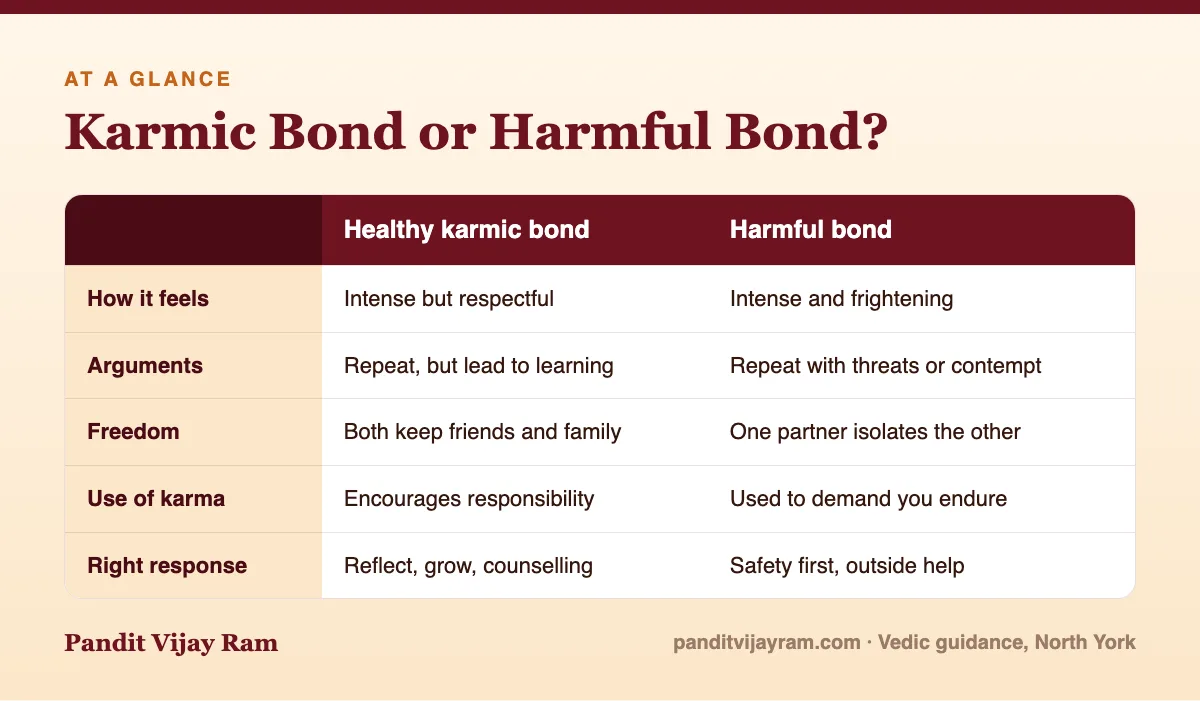
This last point matters. If one partner says you owe them from a past life and must accept mistreatment, they have turned a spiritual idea into a tool of control. That is not rinanubandhan; it is pressure.
In my experience, the concept helps most after a relationship has ended. Seeing the bond as an exchange that has run its course can soften blame and make room for gratitude. It pairs well with the practice described in forgiving an ex, where forgiveness is a release for yourself.
Which chart factors are said to show a karmic bond?
Astrologers most often point to Rahu or Ketu on the 1st–7th axis or joined with Venus, the Moon or the 7th lord; Saturn influencing the 7th; strong 8th or 12th house links; and, between two charts, one person's nodes falling on the other's Moon, Venus or ascendant. Many of these readings are modern rather than classical.
Here is a short guide to the claims, with an honest note on each:
- Rahu–Ketu across the 1st and 7th: widely read as a relationship that carries unfinished business. Ketu is linked with the past and detachment, Rahu with craving and the unfamiliar. See Rahu in the 7th house for the placement itself.
- Nodes joined with Venus or the 7th lord: intense, unusual or sudden attractions.
- Saturn on the 7th house or its lord: duty, delay and serious commitments; often called karmic because Saturn is the planet of consequences.
- 8th and 12th house links: hidden, deep or spiritual bonds, and sometimes loss.
- The 5th and 9th houses: purva punya and dharma, the merit carried from the past, which some readers check for blessed rather than difficult bonds.
- Cross-chart node contacts: popular in modern synastry; these owe a good deal to Western evolutionary astrology.
Classical Parashari texts describe Rahu and Ketu's effects by house and sign, but they do not label relationships as karmic or past-life. Some Jaimini readers also look at the darakaraka, the planet with the lowest degree, explained in the darakaraka guide. A responsible reader presents these as interpretive traditions, not proof that you knew someone before.
Why should karma never be used to excuse harm?
Calling a relationship karmic does not make abuse, control or cruelty acceptable. Hindu ethics places ahimsa, non-harm, at its centre, and no teaching requires anyone to remain where they are hurt or afraid. If a partner threatens, isolates, controls money or uses violence, safety comes first, whatever the chart or past-life story says.
I have heard many versions of the same sentence: it is my karma, so I must bear it. Sometimes a relative says it; sometimes a practitioner does. I disagree, firmly and with respect for the tradition.
Here is why:
- Karma is about choice. Each moment is a new action. Choosing safety is as much a karmic act as choosing to stay.
- Ahimsa applies to you too. Allowing yourself to be harmed is not a spiritual virtue in any mainstream Hindu teaching.
- The other person has karma too. Their harmful actions are theirs to answer for, not yours to absorb.
- Children are watching. A home of fear shapes them, and protecting them is dharma.
Warning signs that a bond has crossed from difficult to dangerous include threats, monitoring your phone, cutting you off from family, controlling money and any physical violence. If you recognise these, the domestic violence help guide for the GTA lists support. In an emergency, call 911.
A reader who tells you to stay in such a relationship because of karma, or sells you a ritual to endure it, is not serving you. Walk away from that advice as well.
How do you heal or complete a karmic relationship?
Healing a karmic bond means doing your part of the exchange well and then letting go of what is not yours. In practice: honest self-reflection about repeating patterns, clear boundaries, forgiveness as a release, counselling where patterns are deep, and steady prayer for your own clarity. Completion does not always mean ending the relationship; sometimes it means changing it.
I suggest clients work in three layers, at their own pace.
Understand the pattern. Write down the last three relationships and what each one felt like at its best and worst. Repeats often become obvious. A counsellor can help with patterns rooted in childhood or past trauma.
Act rightly now. If you are together and both want to continue, work on the specific friction: communication, trust, family pressure. If the relationship has ended, keep your conduct clean: no revenge, no pursuit, no gossip.
Release with devotion. Traditional practices that suit this stage include:
- offering water to the rising sun while naming what you are grateful for in the bond;
- a Monday prayer to Shiva for acceptance, or chanting Om Namah Shivaya;
- writing a letter you do not send, then offering it safely to fire or water as a symbol of completion;
- charity in the other person's name, without telling them.
For couples who want to understand their dynamic together, a relationship compatibility reading with both partners' consent compares the charts and looks at where friction tends to arise. Traditional node remedies, such as Durga or Ganesha worship, are explained in the guide to Rahu and Ketu remedies.
The bottom line
A karmic relationship, in Vedic language, is a bond understood through past action and rinanubandhan, a tie of mutual debt that can loosen when its exchange is complete. Astrologers link such bonds with Rahu, Ketu, Saturn and the 7th, 8th and 12th houses, though many of these readings are modern. The idea is useful when it encourages responsibility, forgiveness and growth. It must never be used to justify harm, and safety always comes before any story of past lives.
Key takeaways
- The phrase karmic relationship is modern; the idea of bonds from past action is old.
- Rinanubandhan means a bond of mutual debt, settled through right conduct, not suffering.
- Rahu–Ketu, Saturn and 8th or 12th house links are the factors most often cited.
- Classical texts do not label relationships as karmic, so treat chart claims as interpretation.
- No teaching requires anyone to stay where they are harmed or afraid.