
Dasha Periods and Breakups: Timing in a Relationship Reading

Many people come to me after a breakup with one question: why now? They have usually read that a certain planetary period ends relationships, and they want to know whether the dasha for love in their chart turned against them. I hear this from clients in North York, across the GTA and on video calls from further away, and the worry underneath is often whether it will happen again. This guide explains how dashas are used for timing in a relationship reading, which periods are traditionally linked with strain, how transits fit in, and why none of it amounts to a verdict about you or your partner. In more than forty years of Vedic practice I have watched the same dasha bring a wedding to one person and a quiet, mutual parting to another. The planet set the stage; the people wrote the scene. You will also find what I suggest doing during a difficult period, and when it is wiser to see a counsellor or your family doctor than to study the chart.
How are dashas used to time love and relationships?
In the Vimshottari system each planet rules a fixed span of years, and sub-periods called antardashas divide each span. For relationships a reader looks at whether the running major and sub-period lords connect with the 7th house, its lord, Venus, or the navamsa. When they do, partnership questions tend to come forward.
The full Vimshottari cycle is 120 years: Ketu 7, Venus 20, Sun 6, Moon 10, Mars 7, Rahu 18, Jupiter 16, Saturn 19 and Mercury 17. Your starting point depends on the nakshatra of your birth Moon, which the Vimshottari dasha explainer covers step by step.
For love, the planets that carry most weight are:
- the lord of the 7th house and any planet sitting in it;
- Venus, the natural significator of partners;
- the lords of the 2nd (family life) and 11th (fulfilment of wishes);
- in traditional readings of women's charts, Jupiter as well.
The major period sets the broad theme for years, while the sub-period decides when it is felt most. An antardasha lasts the major lord's years multiplied by its own, divided by 120; inside a Venus period, the Venus sub-period runs about three years and four months. The guide to antardashas explains why the sub-period often matters more for timing. A reader also notes whether the period lords are strong or weak in the navamsa, since that chart is traditionally consulted for marriage.

Which dasha periods are linked with breakups or separation?
Traditionally, periods of planets linked with the 6th, 8th or 12th houses are read as times of strain in partnership, because the 6th is the 12th from the 7th and so signals loss to the relationship. Afflicted 7th lords, Rahu, Ketu and Saturn periods are also watched. These show pressure, not a certain ending.
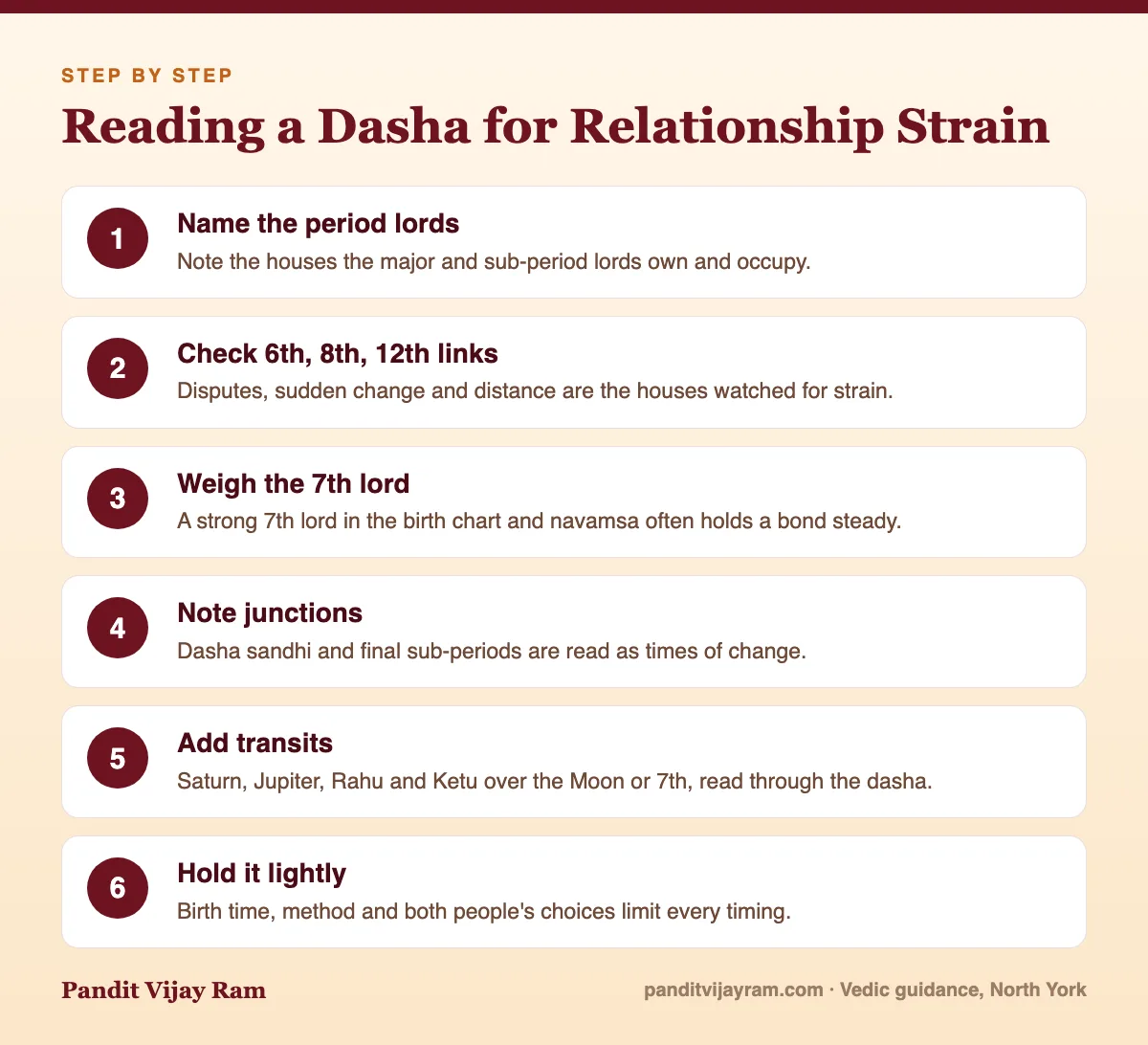
When I check a chart for relationship strain, I work through a short list in order:
- Who rules the current periods? Note the houses each lord owns and occupies.
- Does either lord connect to the 6th, 8th or 12th? The 6th governs disputes, the 8th sudden change and the 12th distance or withdrawal.
- Is the 7th lord weak or afflicted in the birth chart and the navamsa? A strong 7th lord often holds a partnership through a hard period.
- Is it a junction? Many readers treat the last months of one major period and the first of the next, called dasha sandhi, as unsettled.
- Is it the final sub-period of a major period? Some texts call it chhidra, a gap, and read it as a time of closure.
- What does the partner's chart show? One chart describes only one side.
If three or four of these line up, I say the period may bring pressure on the relationship, and I talk about how to meet it. I never say a couple will separate. Many couples pass through exactly these periods and come out closer.
Does a Venus or 7th lord dasha always bring love?
No. A Venus or 7th lord dasha activates relationships, but the results depend on that planet's dignity, house and lordship for your ascendant. A well-placed Venus period often brings romance or marriage. An afflicted one can bring indulgence, attraction to the wrong person or the end of a bond that had already worn thin.
People are often surprised when a relationship ends during the very period they were told was lucky for love. It makes sense once you remember that an activated house shows everything about that area of life, beginnings and endings both.
Consider the ascendant. For Aries, Venus rules the 2nd and 7th, both houses that classical texts call maraka, so its period brings partnership strongly forward but with mixed results. For Capricorn and Aquarius, Venus is a yogakaraka and its period is usually kinder. For Scorpio, Venus rules the 7th and 12th, which can bring a relationship together with distance, travel or expense.
The Venus mahadasha guide covers these variations in detail. The same logic applies to whichever planet rules your 7th house. A strong, unafflicted 7th lord in its own period tends to support commitment; a debilitated or combust one asks for more patience and honest work.
I also look at how Venus relates to Mars, because a heated contact between them can make an active love period passionate and argumentative at once, as the article on Mars and Venus in the kundli describes.
How do transits fit with dashas in a relationship reading?
Transits, or gochar, are read through the dasha rather than on their own. A difficult transit such as Saturn crossing the natal Moon or the 7th house tends to bite hardest when the running period already points to relationship strain. When the dasha is supportive, the same transit is often felt as hard work rather than loss.
The classical principle is simple: the dasha shows what is promised for a period, and transits show when that promise is triggered. A reader checks where slow planets are moving relative to the natal Moon, the 7th house and its lord.
- Saturn moving over the Moon or 7th house tends to bring tests of commitment, responsibility or distance.
- Jupiter aspecting the 7th house or its lord is traditionally read as protective and supportive of commitment.
- Rahu and Ketu crossing the 1st and 7th houses often bring a period of questioning what you want from partnership.
Some modern astrologers add a double transit rule, looking for Saturn and Jupiter to influence the same house together before a major event. It is useful as a guide but is not a classical rule, and schools differ on its weight. Transit positions change constantly, so check a current ephemeris or a Toronto panchang rather than relying on fixed dates found online. The guide to gochar transits sets out the method.
Why is a dasha never a verdict on a relationship?
A dasha describes emphasis and pressure in your own life. It cannot account for your partner's choices, the effort either of you puts in, or ordinary causes such as money stress and family pressure. Birth time errors also shift dasha dates, and different dasha systems can disagree. So a period is read as a tendency only.
I give clients three reasons to hold dasha timing lightly.
First, precision. The dasha balance at birth depends on the Moon's exact degree. An error of an hour in birth time can move sub-period dates by several months, and hospital records are not always exact. A reading built on a guessed time needs humility.
Second, method. Vimshottari is the most widely used system, but traditional astrologers also use Yogini dasha, a 36-year cycle, and Jaimini's Chara dasha, which works from signs. They do not always agree, and honest readers say so.
Third, people. Two adults decide whether a relationship continues. Your former partner has their own chart, their own life and their own right to choose. No period in your chart overrides that, and none should be used to pressure anyone.
A fixed prediction can also become self-fulfilling. If you are told a relationship must end in a certain period, you may stop investing in it. That is why I describe what a period tends to ask of you rather than what it will do to you.
What should you do during a difficult relationship dasha?
During a period linked with relationship strain, slow down major decisions, talk more carefully, and look after sleep, work and health. Prayer or mantra for the period's lord can steady the mind. If you are already apart, use the time to heal rather than to chase. Counselling is often the most useful remedy of all.
A practical plan for a hard period usually includes:
- One steady practice: a short daily mantra for the period's lord, or a lamp lit at the same time each evening. Consistency matters more than length.
- A pause rule: no major relationship decisions made in anger or in the middle of the night.
- Ordinary checks: sleep, drinking, overwork and money stress are often louder than any planet.
- Support: a couples counsellor if you are together, or a counsellor for yourself if you are apart.
If low mood lasts more than a couple of weeks, or sleep and appetite change sharply, please see your family doctor. In a crisis in Canada you can call or text 9-8-8 at any hour.
When you want a fuller look at your own periods, a love problem reading or a complete kundli consultation sets the timing beside the rest of your chart, with an honest note of what it can and cannot show.
The bottom line
A dasha for love shows when relationship themes come forward, through the 7th lord, Venus and the houses linked with strain. Transits act through those periods, and birth time, method and both people's choices all limit what timing can say. The most useful response to a difficult period is steady practice, careful speech and support from a counsellor where needed. Read your dashas as tendencies that ask something of you, never as a verdict.
Key takeaways
- Relationship timing is read from the 7th lord, Venus and planets linked with the 7th house.
- Links with the 6th, 8th or 12th houses suggest strain, not a certain ending.
- A Venus period brings love themes forward, including endings, depending on dignity.
- Transits act through the dasha, so check a current ephemeris, not fixed online dates.
- Birth time errors and different dasha systems make every timing a tendency.