
Rahu and Ketu Afflictions That Feel Like a Curse
Some stretches of life feel strange rather than simply hard. Plans that looked solid dissolve. A restless craving for more pulls you in directions you do not recognise. Or the opposite: interest drains away from things you loved, and a sense of loss settles in for no clear reason. When an astrologer then mentions Rahu or Ketu, the explanation can feel like a sentence handed down. People in North York often come to me after hearing frightening things about these two, and searching rahu ketu remedies late at night has only added to the worry. This guide explains who Rahu and Ketu are in myth and astronomy, why their periods so often feel like a curse, and how a careful chart reading decides whether they are really the cause. It sets out the traditional remedies for each, with mantra, charity and worship, and it is plain about what remedies cannot do. In more than forty years of practice, I have seen Rahu bring remarkable success to many people and Ketu bring deep peace. Neither is an enemy by nature.
Who are Rahu and Ketu in Vedic astrology?
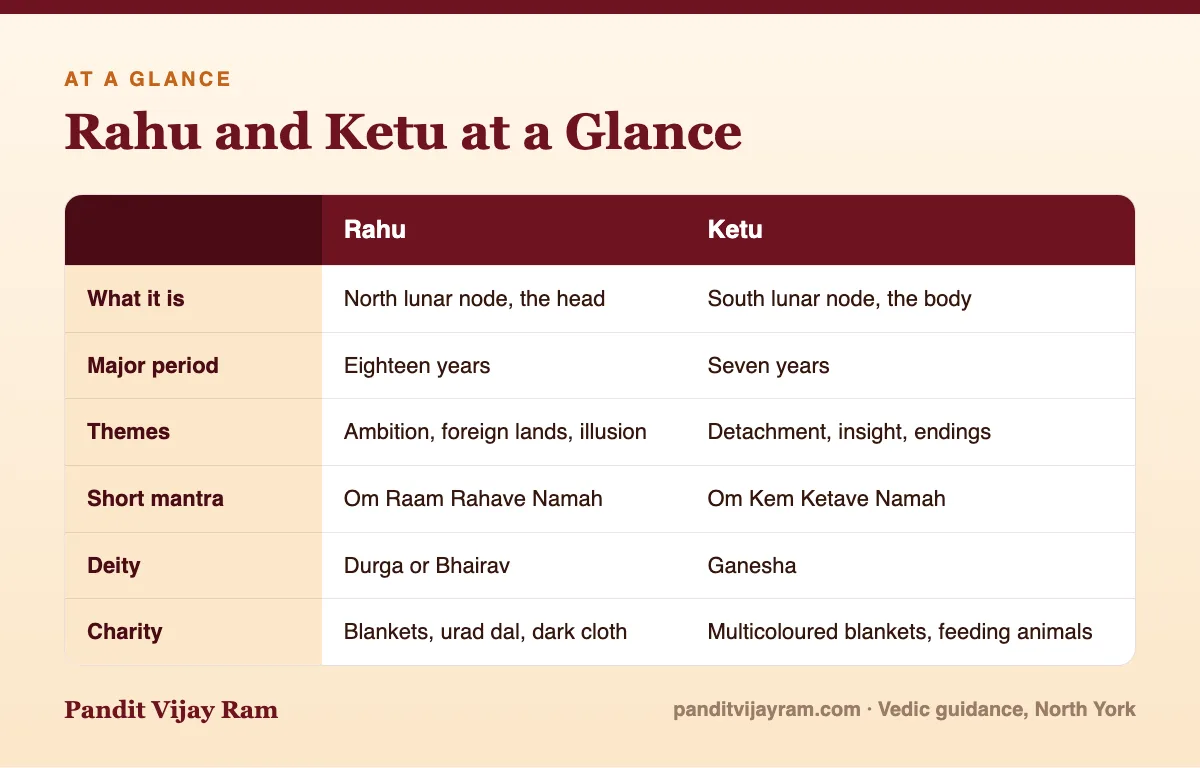
Rahu and Ketu are the north and south lunar nodes, the points where the Moon's orbit crosses the ecliptic. They have no physical body, so they are called chhaya grahas, shadow planets. They always sit exactly opposite each other and move backward through the zodiac, spending about eighteen months in each sign.
The myth comes from the churning of the ocean. As the gods received amrit, the nectar of immortality, the asura Svarbhanu slipped into their line and drank. The Sun and Moon raised the alarm, and Vishnu, in the form of Mohini, severed his head with the Sudarshan chakra. Because he had tasted amrit, both parts lived. The head became Rahu and the body Ketu, and the story says they pursue the Sun and Moon, causing eclipses.
The astronomy matches the story neatly. Eclipses happen only when the Sun and Moon are near the nodes, which ancient Indian astronomers knew well.
Their themes in a chart differ:
- Rahu is the head without a body: appetite, ambition, foreign lands, technology, the unconventional and anything that magnifies. It can bring fame, and also confusion and obsession.
- Ketu is the body without a head: detachment, insight, spiritual search, past skills and sudden endings. It can bring wisdom, and also loss and disorientation.
Both are said to act like the planet that rules the sign they occupy, and like any planet they sit with. That is why the same Rahu can behave very differently in two charts.
Do not confuse either with Rahu kaal, a daily window considered inauspicious for new beginnings. The guide to timing and the best days for cleansing explains that daily period.
Why do Rahu and Ketu periods feel like a curse?
Their periods tend to bring sudden, unexpected change rather than slow, predictable effort and reward. Rahu can create restlessness, illusion and overreach; Ketu can bring loss, withdrawal and confusion about purpose. Because the causes feel invisible and the events feel out of proportion, people naturally reach for the idea of a curse or black magic.
In the Vimshottari dasha system, Rahu's major period lasts eighteen years and Ketu's seven. These are long stretches, and they cover major life stages. A Rahu mahadasha that begins in someone's twenties may include study abroad, migration, career leaps and relationship turmoil all at once.
Common experiences people describe:
- Rahu periods. Sudden opportunity followed by sudden setback, cravings, sleeplessness, suspicion of others, entanglement in risky deals, or an intense attraction that defies reason.
- Ketu periods. Losing interest in work or relationships, unexplained anxiety, injuries, separation from family, or a strong pull toward spirituality.
- Transits. Rahu or Ketu crossing the natal Moon can stir the mind for some months, even outside their dasha.
Here is the honest part. Many of these experiences overlap with ordinary life transitions, stress, anxiety and, sometimes, addiction or depression. A Rahu period does not replace a doctor's assessment of insomnia or panic, and a Ketu period does not explain away clinical low mood.
Where people feel cursed rather than simply challenged, the comparison of black magic, nazar and graha dosh shows how a reading separates a planetary phase from other explanations.
How does an astrologer check for a Rahu or Ketu affliction?
A careful reading looks at the house and sign each node occupies, the planet ruling that sign, any planets joined with them, the dasha currently running and current transits. Terms such as Rahu dosh or Ketu dosh are loose modern labels. A node is only a problem when several of these factors point the same way.
When I examine the nodes in a chart, I work through a short checklist rather than reacting to their placement alone.
- House. Rahu is often productive in the 3rd, 6th, 10th and 11th houses, the houses of effort and growth. Placements in the 1st, 5th, 7th, 8th or 12th need closer attention.
- Sign and ruler. The node takes on the nature of its dispositor. A strong, well-placed ruler softens much of the difficulty.
- Conjunctions. Rahu with the Moon can unsettle the mind. Rahu with Jupiter, called Guru Chandal yoga in popular astrology, can confuse judgement. Ketu with Mars can raise accident-proneness. Each depends on strength and house.
- Dasha and sub-period. A node that is quiet in the chart can become loud during its own period or sub-period.
- Transits. Current movement over the Moon, ascendant or the node's natal position.
- Whole-chart strength. A strong ascendant lord and Moon help a person carry a difficult node well.
Only when several of these line up do I call it a genuine affliction. Even then, I explain what it is likely to affect and what it is not.
When both nodes enclose all other planets, people often hear the words Kaal Sarp. That pattern has its own honest Kaal Sarp explainer. A kundli and horoscope reading covers the whole checklist.
What are the traditional Rahu ketu remedies?
Traditional remedies include mantra japa for each node, worship of Durga or Bhairav for Rahu and Ganesha for Ketu, charity on suitable days, and in some cases a Navagraha or Rahu-Ketu shanti puja. Gemstones such as hessonite for Rahu and cat's eye for Ketu are used cautiously and only after a full chart check.
Remedies are chosen to match the chart, but these are the forms most commonly given:
- Rahu mantra. Om Raam Rahave Namah, or the beej mantra Om Bhraam Bhreem Bhraum Sah Rahave Namah. Remedial manuals traditionally give a full course of eighteen thousand repetitions, usually spread over weeks; many people simply chant one mala of 108 daily.
- Ketu mantra. Om Kem Ketave Namah, or the beej mantra Om Shraam Shreem Shraum Sah Ketave Namah, with a traditional course of seventeen thousand.
- Worship. Durga Saptashati or Durga Chalisa and Bhairav worship for Rahu; Ganesha worship and the Ganapati Atharvashirsha for Ketu. Hanuman worship steadies both.
- Charity. For Rahu, blankets, black or blue cloth and urad dal given to those in need, often on Saturday. For Ketu, multicoloured blankets, sesame and food for stray animals, often on Tuesday or Saturday.
- Conduct. Rahu responds to honesty and avoiding intoxicants and shortcuts; Ketu to steady routine and meditation.
On gemstones, be careful. Hessonite and cat's eye are strong and are widely considered unsuitable for many charts. Wear one only after a full reading and a trial period.
Where a formal ritual is suitable, our Rahu, Ketu and Kaal Sarp puja guidance explains how it is done. The graha shanti guide covers the wider Navagraha approach.
What can Rahu and Ketu remedies not do?
Remedies cannot cancel a dasha, rewrite a birth chart or force a particular outcome. They are meant to steady the mind, encourage better choices and invite grace during a demanding period. Anyone promising that a single puja will end all Rahu problems, or warning of disaster without one, is selling fear.
Honest limits protect you from wasted money and false hope.
- Time still passes. A Rahu mahadasha runs its eighteen years. Remedies change how it is carried, not how long it lasts.
- Practical problems need practical work. Debt, visa issues, legal trouble and job loss require budgets, lawyers, applications and effort alongside prayer.
- Health stays medical. Rahu-type restlessness and Ketu-type withdrawal can be anxiety, depression or substance problems. See your family doctor, and call or text 988 in a crisis.
- Other people stay free. No remedy controls a partner, boss or relative.
Signs of fear-selling to watch for: being told the nodes will destroy your marriage or career, pressure to book expensive rituals at once, multiple gemstones prescribed together, or a practitioner who refuses to show you the chart factors they are reading. The guide to removal scam warning signs lists more.
A balanced plan is modest: a daily mantra, one charitable habit, sensible conduct and good support from people around you. Many people find a Rahu or Ketu period becomes a turning point once fear is removed from it. The evil eye and curses hub links related guides.
The bottom line
Rahu and Ketu are the lunar nodes, and their sudden, confusing periods are often mistaken for a curse. A careful chart check of house, sign, conjunctions, dasha and transits decides whether there is a genuine affliction. Rahu ketu remedies through mantra, worship, charity and honest conduct help a person carry these periods well, while health, money and legal matters still need practical care.
Key takeaways
- Rahu and Ketu are the lunar nodes, always opposite each other.
- Rahu's dasha lasts eighteen years and Ketu's seven, so they shape long chapters.
- Rahu dosh and Ketu dosh are loose labels; a real affliction needs several factors.
- Mantra, worship of Durga, Bhairav or Ganesha, and charity are the core remedies.
- Gemstones for the nodes are strong and need a full chart check first.