
Partner Not Ready for Marriage: Mismatched Timelines

You have been together for years. Your cousins are married, your parents ask at every family gathering, and you feel ready. Your partner says they love you but not yet. When a partner not ready for marriage meets a person who is, both can feel stuck and misunderstood. In North York I often meet people asking when will he marry me or will she ever say yes, hoping a chart can settle the question. A kundli can show periods that favour commitment, but it cannot decide for another person. This guide looks at why people hesitate, how to have a frank talk about timelines, how to handle pressure from families on both sides, what Vedic astrology can add, and how to make a fair decision for yourself. In more than forty years of practice I have seen that clarity, even when painful, brings more peace than years of waiting quietly for an answer that never comes.
Why is my partner not ready for marriage?
Common reasons include financial insecurity, career or study plans, waiting for immigration status, fear shaped by parents' unhappy marriages or a past divorce, family opposition, wanting more time to be sure, and sometimes not wanting to marry this partner. Each reason calls for a different response, so understanding which applies is essential.
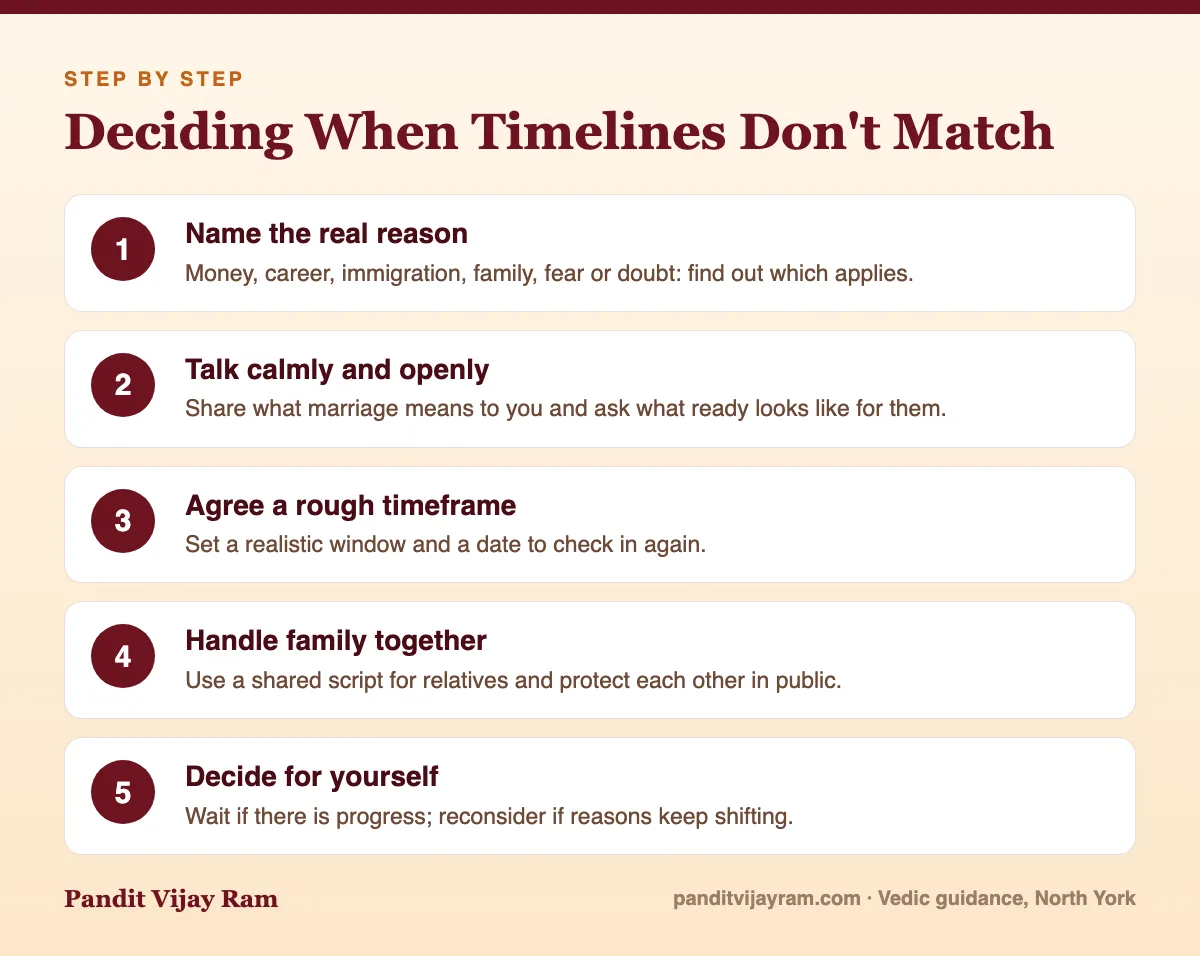
Hesitation usually comes from one or more of these:
- Money. Wanting savings, a stable job or a home first, especially with the cost of weddings and housing in the GTA.
- Career and study. Finishing a degree, a licence exam or a probation period at work.
- Immigration. Waiting for a permit or permanent residence, or unsure which country they will live in.
- Family. Parents who disapprove of caste, religion, culture or a previous marriage, or a sibling who is expected to marry first.
- Fear. Growing up around conflict or divorce, or having been through one themselves.
- Doubt. Uncertainty about the relationship itself, which may be hard for them to admit.
Notice whether the reason is specific and changing, such as finishing a programme next spring, or vague and moving, such as when things settle down. Specific reasons suggest a timeline. Vague ones that shift each time you ask deserve a closer conversation.
If family opposition is the main obstacle, our guide to talking to parents about a love marriage may help both of you prepare.

How do I talk to my partner about marriage without pressuring them?
Choose a calm time, explain what marriage means to you and why, and ask open questions about their hopes and fears. Listen without arguing. Then ask together whether there is a realistic timeframe and what would need to happen first. Clarity is fair to request; an ultimatum in anger rarely works.
A helpful conversation often follows this order:
- Share your own view. I'd like to be married within the next couple of years because I want to start a family and stop hiding from relatives.
- Ask about theirs. What does marriage mean to you? What feels scary or unready about it?
- Look for the real obstacle. Is it money, family, timing, fear or doubt about us?
- Discuss a realistic frame. What would need to be true for you to feel ready? Roughly when might that be?
- Agree on a check-in. Revisit the topic in a few months rather than every week.
Avoid raising it during arguments, after a wedding you both attended, or in front of family. Pressure tends to produce defensive promises rather than honest answers.
Sometimes these talks reveal deeper communication issues. Our post on communication problems in marriage describes I statements and listening skills that work just as well before the wedding.
How should we handle family pressure to get married?
Agree as a couple on what you will tell relatives, so neither partner is blindsided. Give a short, respectful answer and change the subject. Protect each other in front of both families. Family concern is often loving, but the timing of your marriage is a decision for the two of you.
In many South Asian, Caribbean and Latino families, a long relationship without marriage invites questions, and sometimes gossip. Pressure can come from both directions: one family urging a wedding, the other opposing it.
Ways to cope together:
- Make a shared script. Something like we're planning for it and will tell you when we have news.
- Don't blame each other publicly. Saying he won't commit to your mother usually makes things harder.
- Separate family timelines from yours. A sibling's wedding or a grandparent's health may create urgency that you can acknowledge without being ruled by it.
- Talk to one trusted elder. An aunt or uncle who understands both of you can sometimes calm the wider family.
If parents are pressing you to marry someone else, or using threats or control, that is a different situation. Adults have the right to choose whether and whom to marry. Our guides on inter-caste marriage and parents' approval and the GTA domestic violence help guide cover family pressure that crosses into coercion.
Can astrology tell me when my partner will marry me?
Vedic astrology can show periods in your own chart that are traditionally linked with marriage and commitment, such as Venus or seventh-lord dashas, and compatibility between two charts. It cannot predict another person's decision. A reading offers perspective on timing and tendencies, while the real answer comes from your partner.
Astrologers traditionally look at several factors when asked about marriage timing:
- The seventh house and its lord, which describe partnership.
- Venus, a significator of marriage and affection, and Jupiter, traditionally a significator of the husband in a woman's chart.
- Dasha periods of planets connected with the seventh house, which are often read as favourable windows.
- Saturn's influence, which many astrologers associate with delay rather than denial.
Schools of astrology differ in how they weigh these factors, and none can override a person's free choice. Our guide to marriage timing in a kundli explains these methods and their limits in more depth.
In a relationship compatibility consultation, I read both charts for the pressures each partner is carrying and suggest prayer for clarity and harmony that both people want. I do not offer rituals to make someone propose or agree to marry. A marriage entered under pressure, whether human or spiritual, starts on weak ground.
How long should I wait for my partner to be ready for marriage?
There is no correct length of time. Wait while there is a clear reason, real progress and an honest timeframe you both believe in. Reconsider if the reason keeps changing, deadlines pass without discussion, or you feel you are shrinking your own life. Deciding to leave is also a valid choice.
A simple decision rule can help you think clearly:
- Keep waiting if your partner names a specific obstacle, is actively working on it, and talks about the future with you in it.
- Have a serious conversation if the reason is vague, the timeline keeps moving, or you have agreed on a frame that has passed without explanation.
- Consider ending things if your partner says they may never want to marry, if you are hiding the relationship indefinitely, or if waiting is harming your health or other life goals such as having children.
It may help to write down what you need, by roughly when, and why. Then ask yourself whether you are waiting from hope based on evidence or from fear of starting again.
If you decide to part, it does not mean the love was false. It means your timelines could not meet. Our guides to finding closure after a breakup and deciding whether a relationship is worth saving offer support for whichever path you choose.
The bottom line
A partner not ready for marriage may be held back by money, career, immigration, family or fear, or by doubt about the relationship itself. An honest, calm conversation about reasons and a realistic timeframe is the first step, along with a shared plan for family pressure. Astrology can add perspective on timing, but deciding how long you can wait remains your choice.
Key takeaways
- Hesitation about marriage has many causes, and each needs a different response.
- Specific reasons with progress suggest a timeline; vague shifting ones need a talk.
- Agree as a couple on how to answer relatives so neither feels exposed.
- A kundli shows tendencies and periods, not another person's decision.
- Choosing to leave when timelines cannot meet is a valid decision.