
Couples Therapy in the GTA in Punjabi, Hindi, Tamil and Urdu

Some feelings only come out properly in the language you grew up with. A wife may argue in English but cry in Tamil. A husband may only find the right words for shame in Punjabi. If you are looking for couples therapy GTA services that work in your own language, this guide shows you how to search. I meet many couples in North York who gave up on counselling after one session in English, because one partner sat silent while the other did all the talking. You will learn how to use the official CRPO register's language filter, what to ask your workplace program, how community agencies and 211 can help, how to work fairly with an interpreter, and why culture matters as much as vocabulary. We do not name individual therapists here; the aim is to give you a method you can repeat in any city. In more than forty years of practice I have learned that people heal faster when they can speak from the heart without translating first.
How can I find couples therapy in Punjabi, Hindi, Tamil or Urdu?
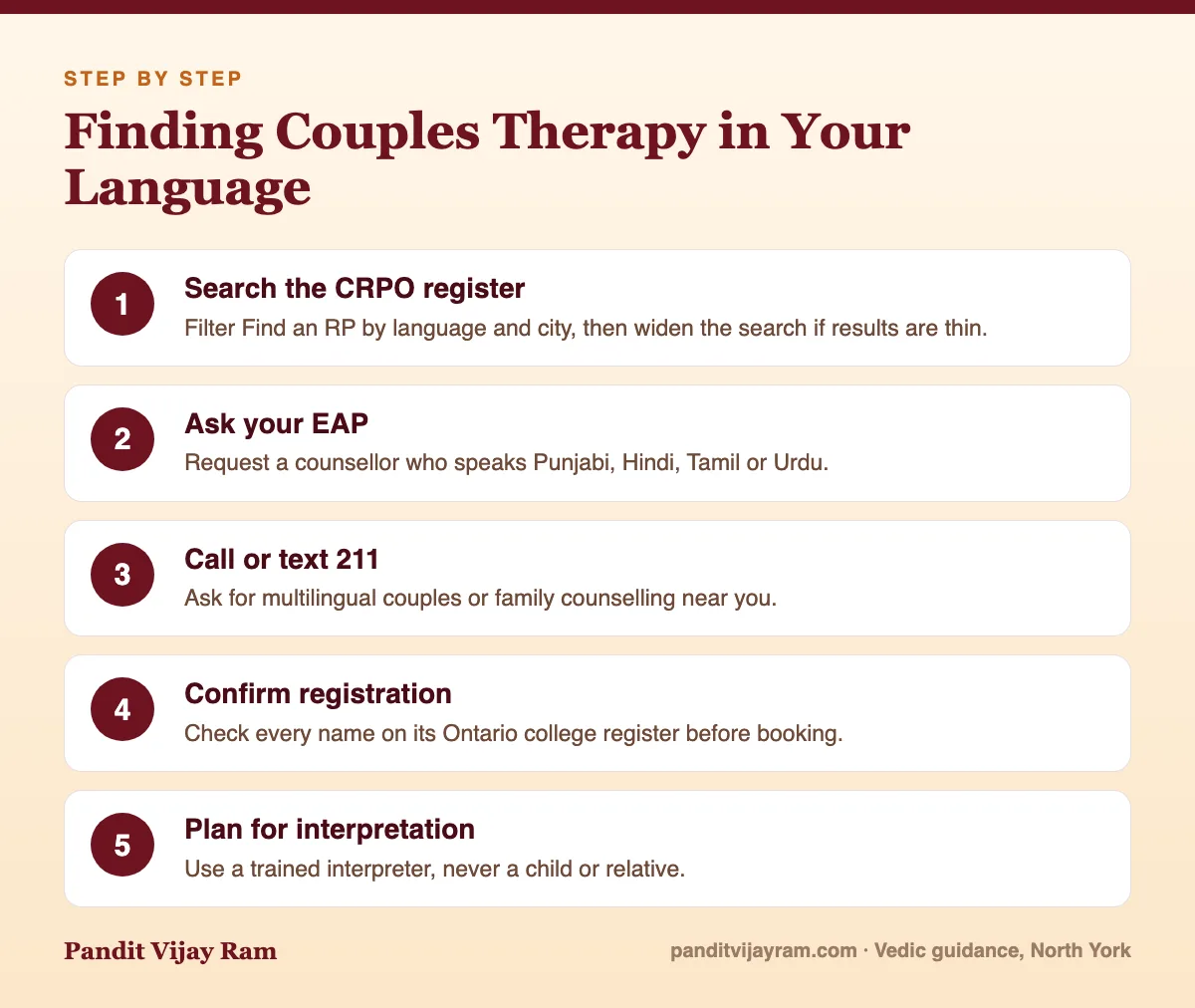
Use four routes together: search the CRPO public register by language and city, ask your employee assistance program for a counsellor who speaks your language, call or text 211 Ontario for community agencies, and ask agencies whether they can provide an interpreter. Then confirm each therapist's registration before booking.
No single list covers everyone, so it helps to search in more than one place.
- Regulator registers. The College of Registered Psychotherapists of Ontario lets you search its Find an RP register by language of care. This is the most direct route.
- Employee assistance programs. If either partner has an EAP through work, call and ask specifically for a counsellor who speaks Punjabi, Hindi, Tamil or Urdu. Many providers keep language information on file.
- 211 Ontario. This helpline links people to community services and is answered in many languages. Ask for couples or family counselling near you.
- Community agencies. Non-profits serving South Asian families often have multilingual staff or can arrange interpretation. Our guide to settlement services in the GTA lists ways to find them.
If you are still deciding what kind of professional to look for, our companion piece on relationship counselling in Toronto explains the regulated professions, fees and benefits in more detail. This post focuses only on language.

How do you search the CRPO register by language?
Open the CRPO website, choose Find an RP, and enter a language plus a city such as Brampton, Mississauga, Scarborough or Toronto. Review each result's practice details. Registrants can choose not to publish their languages, so a short list does not mean no one speaks yours; widen the city or ask CRPO for help.
A step-by-step approach that works well:
- Go to the College of Registered Psychotherapists of Ontario website and open the public register, labelled Find an RP.
- Type the language, for example Punjabi or Tamil, in the language field.
- Add a city if you want in-person sessions. Leave it blank if you are happy with video.
- Open each profile and note the registration status and practice location.
- Look up the practice's own website to see whether couples work is offered.
Some quirks to know. CRPO notes that registrants can opt out of listing their languages, so they will not appear in a language search even if they speak it. Combining many filters can also hide people. If results look thin, search with fewer filters.
Spelling matters too. Try both "Punjabi" and "Panjabi" if one gives few results, and search Hindi and Urdu separately. For social workers and psychologists, check their own college registers by name, then ask the person directly about languages, because not every register shows them.
Can you trust private therapist directories that filter by language?
Private directories are useful for browsing, since many let you filter by language, faith and couples work. They are advertising platforms, though, and listings are written by the therapists themselves. Use them to build a shortlist, then confirm every name on the relevant Ontario college register before sharing personal details or paying.
Commercial directories can show photos, approaches and languages in one place, which saves time. Remember that a listing is a profile the therapist paid for or wrote. It is not a check of their credentials.
A sensible routine:
- Shortlist three or four people who list your language and couples therapy.
- Confirm each one on the CRPO, OCSWSSW or psychologists' college register.
- Send a short email asking whether they offer full sessions in your language, or only greetings and small talk.
- Ask whether they have worked with couples from your community before.
Do not trust anyone who promises guaranteed results, asks for large upfront payments, or claims a spiritual method that will fix your partner. Those are warning signs in therapy as well as in astrology.
If you would like spiritual support alongside counselling, Vijay Ram ji's marriage problem guidance is offered openly as a matter of faith and never as a replacement for therapy.
What if no couples therapist speaks our language?
Ask the therapist or agency whether they work with professional interpreters. A trained interpreter keeps both partners' words accurate and private. Avoid using a child, parent or friend to interpret. You can also choose a bilingual session, with the more fluent partner agreeing not to speak for the other.
Using family members to interpret seems simple, but it causes problems. They may soften hard words, add their own opinions, or later repeat private details. Children should never be put in the middle of their parents' relationship in this way.
Options to ask about:
- Professional interpreters. Some agencies and hospital programmes provide them. Our guide to interpretation services in the GTA explains how to request one.
- Bilingual sessions. The therapist speaks English, and each partner may answer in the language that feels natural, with the interpreter bridging only where needed.
- Individual sessions in your own language. If one partner can find a therapist who speaks their language, individual work can run alongside couples sessions in English.
Whatever you choose, agree a simple rule: the more fluent partner does not answer for the other. Uneven language can quietly become uneven power in the room. It also helps to tell the interpreter, at the start, that you expect every word translated, including the angry ones.
Does culture matter as much as language in couples therapy?
Often it matters more. A therapist who shares your language may not understand your region, caste, faith or family structure, and one from outside your community may understand you well. Ask about experience with joint families, religious practice and two-culture marriages. Privacy matters too; some couples prefer a therapist outside their own social circle.
Language groups are wide. Punjabi is written in Gurmukhi in India and Shahmukhi in Pakistan, and speakers come from Sikh, Hindu and Muslim families. Hindi and Urdu are largely understandable to each other in everyday speech, yet carry different religious and cultural associations. Tamil speakers in the GTA include families from Sri Lanka, India and elsewhere, with different histories.
Useful questions:
- What do you understand about families like ours?
- How do you work when in-laws are part of the conflict?
- Are you comfortable if we mention prayer, fasting or astrology?
Privacy is a real concern in close communities. Some couples worry that a therapist from their temple, gurdwara or mosque may know their relatives. Registered therapists must keep confidentiality, but your comfort matters, so choose freely.
Finally, if either partner is afraid of the other, joint sessions are not safe. See our guide to domestic violence help in the GTA, which lists multilingual helplines. Our broader South Asian mental health guide covers individual support as well.
The bottom line
Couples therapy GTA searches in Punjabi, Hindi, Tamil or Urdu work best when you combine the CRPO language filter, your workplace EAP, 211 and community agencies. Always confirm registration on the college register, and use trained interpreters rather than relatives when no shared language is available. Look for cultural understanding and privacy as well as vocabulary, and put safety first whenever fear is present.
Key takeaways
- The CRPO register can be filtered by language of care and city.
- Some therapists hide their languages, so widen searches if results look thin.
- Ask EAPs and 211 directly for counsellors in your language.
- Use professional interpreters, never children or relatives.
- Cultural understanding and privacy matter as much as shared language.