
Low Guna Milan Score: Should You Still Marry?

The app showed fourteen out of thirty-six in red, and the WhatsApp family group went quiet. For many couples a low guna milan result arrives like a verdict, especially when one set of parents already had doubts. Families in North York, Richmond Hill and across the GTA bring me these printouts regularly, often after a sleepless night. This article explains what the score bands actually mean, why a 16 can be healthier than a 22, which cancellation rules commonly apply, why two websites may give you different numbers, and how to make a calm, practical decision. In more than forty years of practice I have found that the number on the screen is the least informative part of a matching. The breakdown, the cancellations and the two individual charts tell the real story. I will walk you through each, so that you can ask the right questions before anyone makes a decision about your future.
What is considered a low guna milan score?
In popular practice, below 18 out of 36 is considered low and traditionally discouraged. Scores of 18 to 24 are thought acceptable, 25 to 32 good, and above 32 very good. These bands are conventions shared by many astrologers and software tools, not a single rule laid down in one classical text.
The ashtakoota system adds up eight factors: Varna 1, Vashya 2, Tara 3, Yoni 4, Graha Maitri 5, Gana 6, Bhakoot 7 and Nadi 8. Many families learn only the threshold of 18, which is half the total, and treat everything under it as failure.
A more useful picture of the bands:
- Below 18: look closely at which kootas are missing and whether cancellations apply.
- 18 to 24: a workable match in most traditions; the breakdown still matters.
- 25 to 32: a strong emotional fit by this system.
- 33 to 36: rare and well regarded, though a very high score cannot replace a good look at both charts.
South Indian families often use a different method entirely. Tamil and Kerala traditions commonly check ten poruthams rather than 36 gunas, with their own priorities, such as Rajju and Dina. A couple matched under both systems may get a "low" result in one and a perfectly acceptable one in the other.
Neither system looks at the 7th house, Venus or the Navamsa. They compare only the two Moons. That is why I treat any score, high or low, as the opening of the reading. A full relationship compatibility consultation adds the individual chart analysis the number leaves out.

Which kootas matter most when the guna score is low?
Nadi, Bhakoot and Gana together carry 21 of the 36 points and are traditionally treated as the most significant. A low score built from missing Varna, Vashya, Tara and Yoni points is far less concerning than one where Nadi and Bhakoot are both zero. Always ask for the koota-by-koota breakdown, not just the total.
Two examples show why the total misleads.
- Couple A scores 21. They get full points in Varna, Vashya, Tara, Yoni, Graha Maitri and Gana, but zero in both Bhakoot and Nadi. They pass the 18 threshold, yet both of the heaviest doshas are present.
- Couple B scores 16. They get full Nadi (8) and full Bhakoot (7), a single Varna point, and nothing in the other five kootas. They "fail", yet the two factors families worry about most are clear.
Most astrologers I respect would look at Couple A with more care than Couple B.
A practical way to read your breakdown:
- Nadi at zero: check cancellations first; see the detailed guide to Nadi dosha and its remedies.
- Bhakoot at zero: note which sign distance caused it, since some combinations are read more seriously than others; our Bhakoot dosha explainer covers this.
- Gana low: often a temperament difference, workable with awareness.
- Graha Maitri low: different mental styles; communication matters.
- Lighter kootas low: usually minor on their own.
This weighting is why a matching report should always list each koota. If yours shows only a total, ask for the full table.
Can a low guna milan score be cancelled by parihara?
Often, yes. Classical matching rules include cancellations, called dosha parihara or dosha bhanga, under which a dosha is considered not to apply. Common examples are Bhakoot dosha cancelling when both Moon signs share a lord or their lords are friends, and Nadi dosha cancelling in certain same-sign or same-nakshatra cases. These can raise the effective score considerably.
Different texts and regional schools list somewhat different exceptions, so astrologers do not all apply the same set. The ones most widely accepted include:
- Bhakoot: cancelled when the lords of the two Moon signs are the same planet, as with Aries and Scorpio both ruled by Mars, or are natural friends.
- Nadi: cancelled when both Moons are in the same sign but different nakshatras, or in the same nakshatra but different signs. Some schools add the same nakshatra with different padas.
- Gana: many astrologers soften a Gana mismatch when Graha Maitri is strong or the Moon-sign lords are friendly.
When cancellations apply, a careful reader restores the relevant points. A 14 can become a 21 or more once Bhakoot is cancelled, which is why online scores frighten people unnecessarily.
The word parihara is also used for remedies. Where a dosha genuinely remains, traditional responses include Mahamrityunjaya jaap, a Nadi dosha nivaran puja, charity in both partners' names, and prayer to Gauri-Shankar or Vishnu-Lakshmi for a harmonious marriage. These are offered as support and blessing. They are never a reason for anyone to sell you an expensive package in a hurry. The puja and anushthan services page explains how such rites are planned with the family.
Why do different apps show different guna milan scores?
Scores differ because of birth-time errors, the ayanamsa a program uses, whether cancellations are applied, and whether it follows North or South Indian methods. The Moon moves through a nakshatra in about a day, so a birth near a boundary can flip the nakshatra and change several kootas at once.
If two websites disagree, check these points before trusting either:
- Birth time. A hospital record is more reliable than family memory. If one partner's Moon is close to the edge of a nakshatra, a twenty-minute error can change Tara, Yoni, Gana and Nadi together.
- Time zone and place. Births abroad, daylight saving and wrongly chosen cities produce surprising errors. Make sure each chart uses the true place of birth.
- Ayanamsa. Most Indian software uses the Lahiri ayanamsa, but some programs use other values. A small difference can move a Moon near a boundary into a neighbouring nakshatra.
- Cancellations. Many free tools give the raw score and ignore parihara entirely.
- Method. A tool using ten poruthams will not give a score out of 36.
If either partner has no reliable birth time, matching is still possible with reduced precision; our guide to kundli matching without a birth time explains the options. A full kundli reading can also check whether the Moon's position is secure before anyone relies on the score.
Should you still marry with a low guna milan score?
Many couples marry happily with a low raw score, especially after cancellations restore key points and both individual charts support marriage. A low score is a reason to look more carefully, talk honestly and perhaps take up a remedy. It is not, on its own, a reason to end a relationship that is otherwise healthy.
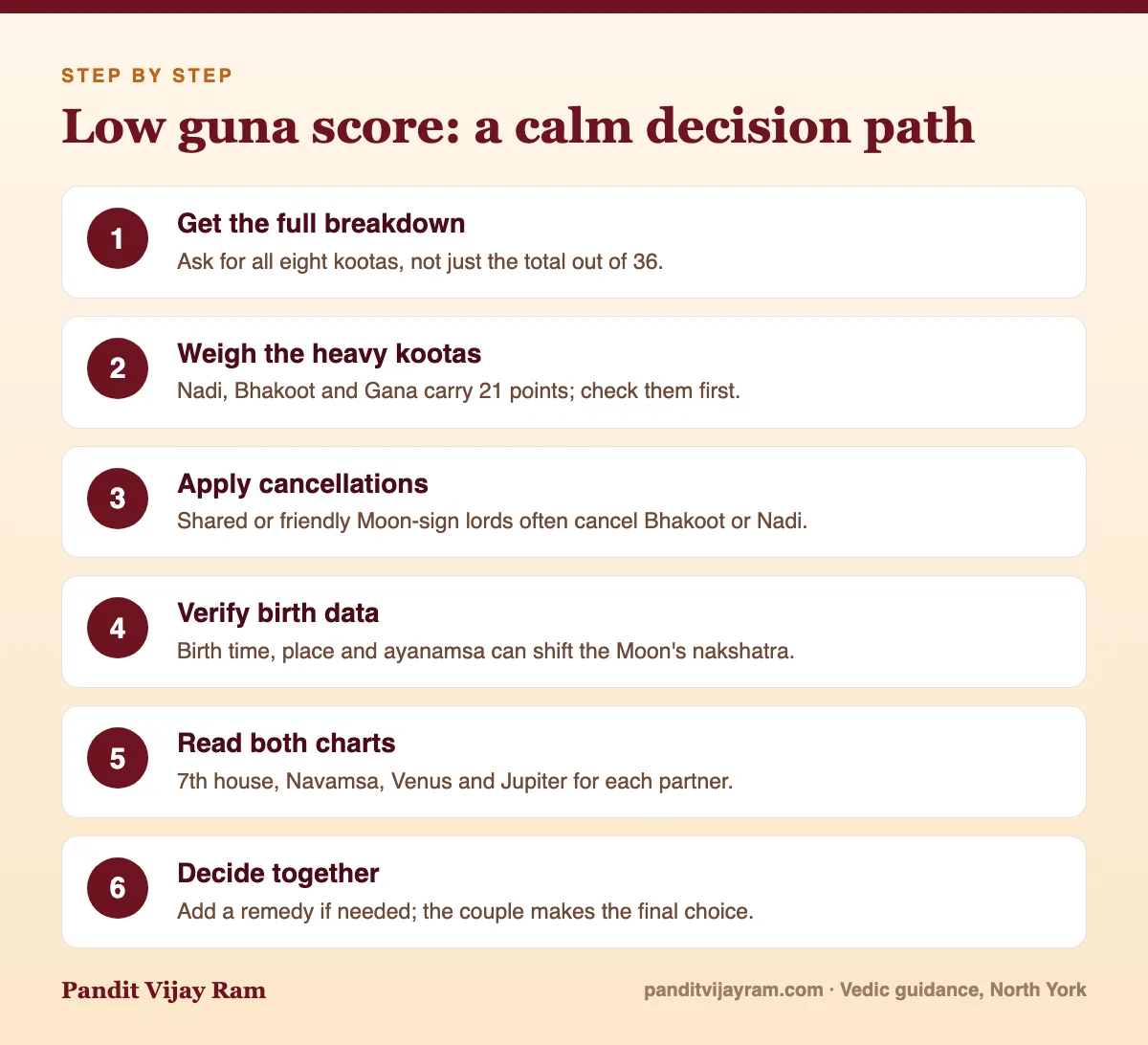
A simple decision path I share with families:
- Get the breakdown and check cancellations. Recalculate the effective score.
- Read both individual charts. Strong 7th houses, a supportive Navamsa and no severe affliction to Venus or Jupiter weigh heavily in favour.
- Check the real relationship. Do you respect each other, handle conflict safely, agree on core values and have at least some family support?
- Consider a remedy if a significant dosha remains, as a shared practice rather than a condition.
- Decide together. The couple, not the chart and not a relative, makes the decision.
There are times when I advise caution. If the chart shows real strain and the couple also describe frequent hurtful fights, or one partner already feels unsure, the score may simply be echoing what they know. Counselling before the wedding is wise then.
There are also times I push back on families. When parents use a low number to force a separation, threaten a child or arrange a hasty alternative match, astrology is being misused. Adults in Canada marry by their own consent. If pressure becomes threats or control, contact police. For more on reading a result when you are already committed, see kundli matching for a love marriage.
The bottom line
A low guna milan score is a prompt to look closer, not a verdict on your marriage. The kootas that are missing matter more than the total, and common cancellations often restore Nadi or Bhakoot points that online tools leave out. Check birth times and methods, read both individual charts, take up a remedy if a real dosha remains, and make the final decision together as a couple.
Key takeaways
- Below 18 is a popular threshold, not a single classical rule.
- Nadi, Bhakoot and Gana carry 21 points and matter most.
- Cancellations often lift a low raw score considerably.
- Birth time, ayanamsa and method can change the number between apps.
- A low score calls for a closer look and a joint decision, not a breakup.