
Marriage Counselling vs Astrology: How They Fit Together
Many South-Asian couples feel pulled between two worlds when a marriage struggles. Parents suggest showing the kundli to a pandit. Friends at work suggest a therapist. You may wonder whether you need one, the other, or both, and whether using one means you do not believe in the other. This guide on marriage counselling vs astrology gives an honest comparison from someone who works on the spiritual side. Couples come to me in North York from across the GTA, and I regularly encourage them to see a counsellor as well. Here you will learn what each approach actually does, what each cannot do, how the two can work together in a sensible order, and the warning signs that astrology is being misused. In more than forty years of practice, I have found that a chart can help a couple understand themselves with more compassion, but it cannot teach them how to listen to each other on a difficult night. That skill is built with practice, and a trained counsellor is the best guide for it.
What is the difference between marriage counselling and astrology?
Marriage counselling is a form of talk therapy delivered by trained, usually regulated professionals who help couples change patterns of communication and conflict. Vedic astrology, Jyotisha, is a traditional spiritual system that reads planetary positions at birth to describe tendencies and periods. One works on behaviour and skills; the other offers meaning and devotion.
The two can look similar from the outside: both involve sitting with someone, talking about your marriage and leaving with suggestions. Underneath, they are quite different.
Marriage counselling is delivered by registered psychotherapists, social workers, psychologists or marriage and family therapists. In Ontario, these professions are regulated by colleges that set training standards and handle complaints. A counsellor assesses the relationship, identifies repeating cycles, teaches specific skills and watches for safety concerns such as abuse or depression.
A Vedic astrology reading looks at both partners' birth charts. The seventh house, Venus, the Moon and the running dashas are traditionally read for partnership. A reading can describe temperaments, likely friction points and periods that may feel heavier. It is often paired with prayer, mantra or puja. Jyotisha is a matter of faith and culture, not a regulated health service.
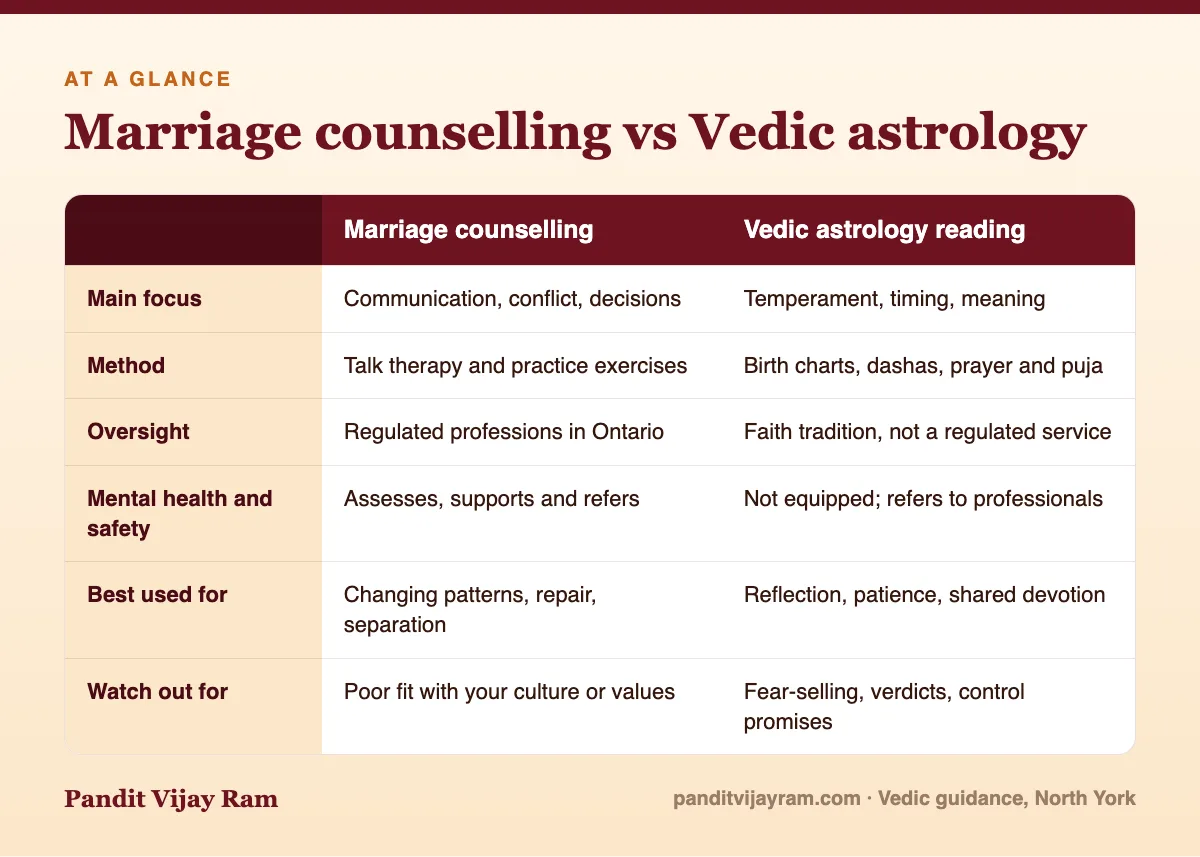
The comparison below summarises the main differences. If you would like to know what a chart-based reading for couples involves, the relationship compatibility reading page explains it plainly.
What can a marriage counsellor do that astrology cannot?
A counsellor can teach and rehearse communication skills, help a couple break a pursue-and-withdraw cycle, recognise depression, anxiety, addiction and trauma, assess safety and refer to medical or legal help. Counsellors are accountable to regulatory bodies. No chart, mantra or ritual can replace these practical and protective functions.
When couples ask me whether they should see a counsellor, my answer is almost always yes. Here is why:
- Skills practice. A counsellor can stop an argument mid-session and help you try again with different words. That kind of coaching changes habits.
- Mental health. Many marriage problems are tangled with depression, anxiety, grief or substance use. A counsellor recognises these and works with your family doctor.
- Safety. Counsellors are trained to recognise coercive control and abuse, and to help a person plan for safety.
- Accountability. If something goes wrong, there is a regulatory college to complain to.
- Neutrality. A good counsellor does not take one family's side, which can be hard to find in a close-knit community.
Couples sometimes worry that a therapist will not understand arranged marriages, joint families or faith. Many in the GTA do, and you are entitled to ask about it before booking. The guide to finding relationship counselling in Toronto explains directories and questions to ask.
For couples who are not yet married, premarital counselling can be a wise addition to kundli matching, covering money, family roles and children before the wedding.
What can a Vedic astrology reading add for a married couple?
A reading can give a couple a shared language for their differences, a sense of meaning during a hard period, and devotional practices that bring calm. For families who trust Jyotisha, it can also open a conversation that elders would otherwise resist. It describes tendencies, not fixed outcomes, and should never replace counselling.
Astrology's value in a marriage is mostly about perspective and peace. Some things couples tell me they find useful:
- Understanding temperament. If one partner has a strong Mars and the other a sensitive Moon, a reading can describe why one speaks sharply and the other withdraws. That can soften judgment on both sides.
- Seeing difficult periods as passing. A Saturn or Rahu dasha is often associated with heavier responsibilities. Knowing a period is demanding can encourage patience rather than despair.
- Devotion as a couple. Shared mantra, a weekly puja or lighting a lamp together gives a calm space that is not about the problems.
- Family bridge. Parents who distrust therapy may accept a pandit's suggestion that the couple see a counsellor too.
What a reading should not do is predict divorce, declare a marriage cursed, or blame one partner's chart for every problem. The guide to divorce yoga in the kundli explains why combinations show tendencies rather than verdicts. A kundli and horoscope reading is best used as reflection that supports practical work, not as a ruling.
How can couples use counselling and astrology together?
Use them in a sensible order: safety first, then a doctor for any health concerns, then a couples counsellor for skills and decisions, with a spiritual reading and prayer as support. When advice conflicts, follow the counsellor on practical and safety matters, and use the reading for personal reflection and devotion.
Combining both works well when each stays in its lane. A simple decision rule many couples find helpful:
- Is anyone unsafe? If yes, call 911 or a domestic-violence service. Neither counselling as a couple nor astrology comes first.
- Is there a health or mood issue? See the family doctor. Low mood, sleep problems or drinking affect a marriage deeply.
- Do you need new ways to talk and resolve conflict? Book a couples counsellor.
- Do you want meaning, calm or a prayer practice? A reading and devotional routine can support you alongside counselling.
- Are you deciding whether to stay or separate? Lean on counselling and, if needed, a family lawyer. A chart can support reflection but should not make that decision for you.
Some couples tell their counsellor about their spiritual practices, and many counsellors welcome that, as faith can be a real source of strength. Equally, I am happy for a couple to tell me what their counsellor has suggested; it often shapes which prayers or routines will help most.
If you are trying to repair a marriage under real strain, the step plan in how to save a marriage from divorce shows how these pieces fit into a weekly routine.
What are the warning signs that astrology is being misused in a marriage?
Be cautious if an astrologer predicts certain divorce, blames all problems on one partner's dosha, discourages counselling or medical help, uses fear to sell expensive rituals, demands more money after each session, or offers to control your spouse's mind. Genuine spiritual guidance respects both partners and encourages professional help.
Astrology is sometimes used to frighten couples rather than support them. Watch for these signs:
- Verdicts. "Your marriage will end" or "Your wife's chart is bad for you" are not responsible statements.
- Blame. Pinning everything on a manglik dosha or a curse can let the real problems, such as criticism, neglect or abuse, go unaddressed.
- Discouraging help. Anyone who tells you not to see a doctor, counsellor or lawyer is putting you at risk.
- Fear and urgency. Warnings that something terrible will happen unless you pay for a ritual today.
- Escalating fees. A small remedy that grows into larger and larger payments.
- Control promises. Offers of vashikaran or rituals to bend a spouse's will. I do not perform these, and they disrespect the other person's freedom.
Before working with any astrologer, it helps to ask clear questions about their approach, what they will and will not do, and how they view counselling. The checklist of questions to ask a love astrologer covers this. If you believe you have been defrauded, report it to the Canadian Anti-Fraud Centre.
The bottom line
Marriage counselling vs astrology is best understood as a partnership with clear roles. Counselling builds skills, supports mental health and protects safety, and it should lead when a marriage is struggling. A Vedic reading and shared prayer can add meaning, patience and calm, provided they never replace professional help or turn into fear and blame.
Key takeaways
- Counselling is a regulated service focused on skills, mental health and safety.
- A Vedic reading offers meaning, temperament insight and devotional support.
- Use them in order: safety, doctor, counsellor, then spiritual support.
- No chart should decide whether you stay married or separate.
- Avoid astrologers who sell fear, discourage therapy or promise control.