
Arranged Marriage First Meeting: Spiritual Preparation and Practical Questions

The first time two families sit down together for a rishta, the room is often full of chai, polite smiles and nerves. The two people at the centre may have only a few minutes alone to decide whether they want a second conversation. Young people in North York and across the GTA often ask me how to prepare for an arranged marriage first meeting without feeling like they are at a job interview. This guide offers a calm plan. It covers how to get ready practically and emotionally, the questions that genuinely help two strangers understand each other, red flags worth noticing early, why your consent and your partner's consent matter above everything, and a short prayer to steady yourself beforehand. In more than forty years of practice I have watched many families through this process, and the couples who do best are the ones who talked honestly from the start, even when it felt awkward. A good first meeting does not decide a marriage. It decides only whether you would like to keep talking, and that is a much lighter thing to carry.
How should you prepare for a first rishta meeting?
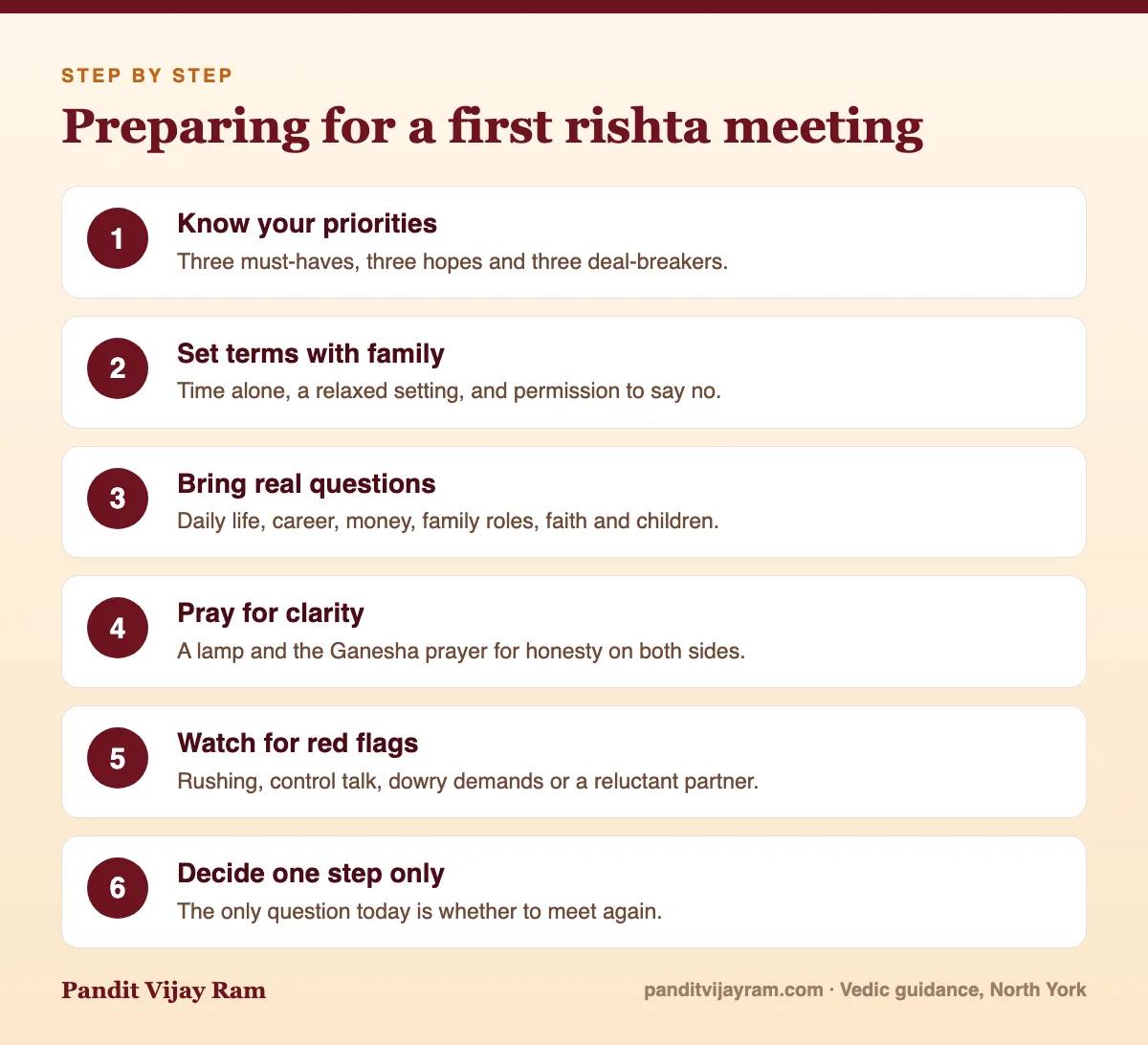
Before the meeting, write down your own non-negotiables, your hopes and your questions. Learn the basics the families have already shared. Agree with your parents on how long you will have alone and that either side may say no. Rest, dress comfortably, and plan to be honest rather than impressive.
Most anxiety comes from not knowing what you want to find out. A little preparation helps:
- Know yourself first. List three things you must have in a partner, three you would love, and three you cannot accept.
- Read the biodata calmly. Education, work, family and location are only a start. Note what you want to ask about.
- Set expectations with your parents. How long will you talk alone? Is a second meeting assumed? Agree that a polite no is acceptable.
- Choose a comfortable setting. Many families now prefer a café, a park or a video call before a formal home visit.
- Keep it short. An hour of real talk is better than a long day of performance.
- Avoid overpreparing answers. Being yourself gives the other person a fair chance to decide.
Many families also compare charts before or after a first meeting. If either of you does not know your birth time, our guide on kundli matching without birth time explains what can still be read. Remember that a chart describes tendencies; your conversation describes the person in front of you.
What questions should you ask at an arranged marriage meeting?
Ask open questions about values, faith, career plans, money, family roles, where you will live, children and how each of you handles conflict. Ask what a normal week looks like for them and what they hope married life will feel like. Listen as much as you speak, and notice how they ask about you.
Group your questions so the conversation flows naturally rather than like a checklist:
- Everyday life. What does a normal weekday and weekend look like? What do you do to relax?
- Work and study. Where do you see your career in a few years? Would you support a partner who wants to study or change jobs?
- Faith and practice. How important is religion day to day? Which festivals and customs matter most to you?
- Family. Do you expect to live with parents? How involved should families be in decisions?
- Money. How do you think about saving, spending and supporting relatives?
- Children. Do you want them, and if so, how would you share caring for them?
- Location. Would you stay in the GTA, move provinces or return to the home country?
- Conflict. When you disagree with someone close, what do you usually do?
Pay attention to how they respond as well as what they say. Do they ask about you in return? Do they listen? Are they respectful about your career and opinions?
If families have strong views that differ from yours, our guide to talking with parents about marriage choices has ideas for respectful conversations at home.
What are red flags in an arranged marriage meeting?
Red flags include pressure to decide quickly, refusal to let you speak alone, dismissiveness about your career or opinions, controlling comments about clothes or friends, evasive answers about work, past relationships or health, demands for dowry or expensive gifts, and any sense that the other person is not there by choice.
A first meeting is short, so it is easy to explain away small signs. Write these down if you notice them:
- Rushing. Families pushing for a yes the same day or week.
- No private talk. Parents refusing to let the two of you speak alone, even briefly.
- Control talk. Comments about what you will be allowed to wear, where you will be allowed to work, or who you may see.
- Dowry or gift demands. Expectations of cash, cars, gold or property, even framed as tradition.
- Evasiveness. Vague answers about job, immigration status, divorce, debts or health.
- Disrespect. Rudeness to staff or parents, mocking your goals, or dismissing your questions.
- Reluctance. The other person seems unhappy, frightened or clearly not there by their own wish.
One red flag does not always end things, but it deserves a direct, polite question at the next conversation. Several together are a strong reason to step back.
Saying no gracefully protects everyone's dignity. If a match ends later, even after an engagement, our guide on what to do when an engagement is broken off offers practical next steps.
How do you make sure an arranged marriage is truly your choice?
An arranged marriage is introduced by families; a forced marriage happens without the free consent of one or both people. You can always say no, or ask for more time. Forcing someone to marry is a crime in Canada. If you feel pressured or threatened, speak to someone you trust, call 211, or call 911 in danger.
Arranged marriage, done well, is families helping two people meet. The final decision belongs to the two of them. A few points that protect consent:
- Time. You may need several conversations before deciding. That is normal and healthy.
- Private space. You should be able to talk alone, by phone or video, before agreeing.
- A real choice. Saying no should not lead to threats, punishment, being sent abroad, or loss of education or work.
- Both people. Ask the other person directly and kindly, "Is this something you want?"
If you feel trapped, you are not alone. Confide in a teacher, counsellor, doctor or friend. Calling 211 can connect you with community agencies that support people facing forced marriage, and police can help if you are in danger or being taken out of the country against your will.
For me, a marriage built without consent cannot be blessed. I will not do rituals to make someone agree to a match, and I encourage families to welcome a no. Our article on praying for marriage without binding anyone explains why the tradition asks for a good partner, not a captured one. When a family wants a chart view as well, a compatibility reading should support the couple's choice, never replace it.
Is there a prayer to say before meeting a prospective partner?
A short Ganesha prayer is the traditional way to begin anything new, asking for obstacles to be removed and the mind to be clear. Light a lamp, recite Vakratunda Mahakaya a few times, and ask simply for honesty and good judgment on both sides. The prayer is for clarity, not a particular outcome.
Before the meeting, a few calm minutes can settle nerves more than any outfit choice. A simple sequence:
- Wash your face and hands, and sit quietly in front of a lamp or image of Ganesha.
- Recite: Vakratunda Mahakaya Suryakoti Samaprabha, Nirvighnam Kuru Me Deva Sarva Karyeshu Sarvada. It asks the Lord to remove obstacles from every undertaking.
- In your own words, pray for honesty, kindness and clear judgment, for yourself and for the other person.
- Take three slow breaths before leaving.
Some young women follow the tradition of Katyayani worship when praying for a good husband, and some families do a small Gauri-Shankar prayer. These are prayers for a suitable partner and a happy home, not for a specific person to say yes.
Our post on spiritual preparation before an important event has a fuller routine, including a short bath and blessing. Practical preparation still matters most: rest, a list of questions, and permission to say no.
The bottom line
An arranged marriage first meeting goes best when you know your priorities, ask honest questions about daily life, family, money and faith, and notice red flags without explaining them away. Consent belongs to the two people, and either can decline without fear. A short Ganesha prayer for clarity and honesty can steady you, while the conversation itself tells you whether to meet again.
Key takeaways
- Know your own must-haves and deal-breakers before the meeting.
- Ask open questions about everyday life, money, family, faith and conflict.
- Rushing, control talk and dowry demands are red flags worth acting on.
- Either person can say no; forced marriage is a crime in Canada.
- Pray for clarity and honesty, not for a specific person's yes.