
One-Sided Love: Spiritual Guidance When Feelings Aren't Returned

Some of the heaviest pain people bring to me is not a breakup at all. It is loving someone who never loved them back in the same way. A classmate, a colleague, a friend of many years, sometimes even a spouse who feels more like a roommate. One sided love can fill every thought and still leave you feeling invisible. Many people in North York and across the GTA ask me whether a mantra or ritual can change the other person's heart. I understand why they ask, and I answer honestly: I will not try to make anyone love you. This guide explains why, and what I offer instead. It covers what unrequited love is, how to recognise when an answer is final, a practical way to move on, and the prayers that help a hurting heart settle. It also explains how this differs from the fixation that can feel impossible to stop. Through more than four decades of guiding people in love, I have found that the most powerful remedy is not changing another person. It is remembering your own worth.
Why does one-sided love hurt so much?
Unrequited love hurts because the mind builds hope and an idealised picture of the other person, while rejection touches deep fears of not being enough. Each small sign of warmth renews the hope, so the pain repeats. Psychologists call the intense, uncertain stage limerence. It is a normal human experience, not a weakness.
When someone describes one-sided love to me, I often hear the same pattern. A kind word, a shared joke or a late-night message lifts them for days. Then silence or a mention of someone else drops them low again. That swing between hope and despair is exhausting.
A few things make it especially strong:
- Idealisation. We fill in what we do not know about the person with our wishes. The one we love becomes partly imagined.
- Intermittent warmth. Occasional kindness from a friend or colleague can feel like encouragement, even when it is simply friendliness.
- Self-worth. Rejection can sound like "you are not lovable," especially for people who already doubt themselves.
- Silence about it. Many people keep this pain secret out of embarrassment, which makes it heavier.
In Vedic thought, the Moon governs the mind and its attachments, and Venus governs love and longing. A strong Venus with an anxious Moon can make love intense and its absence painful. That is temperament, not destiny.
If your feelings have become a fixation you cannot stop, with checking, replaying and sleeplessness, our article on help for unwanted obsession explains that different situation and the support that helps. For guidance on love difficulties more broadly, see the love problem guidance page.
Can a mantra or astrology make someone love you back?
No ethical remedy can make another person love you. Rituals that claim to control someone's feelings, often sold as vashikaran, try to override free will, and I refuse to perform them. Love that is forced is not love. Prayer and astrology can help you understand yourself and heal; they should never target someone else's choice.
Search for one-sided love online and you will quickly find offers to "make someone love you" within days. These offers usually ask for a photo, the person's name and an escalating series of payments. I say clearly: that is not something I do, and not something I believe anyone should do.
My reasons are both ethical and practical:
- Free will matters. In the Vedic view, each person carries their own karma and choices. Trying to bend another person's mind creates a burden on the one who attempts it.
- It would not be real. Even if someone's behaviour changed, you would never know whether they truly chose you.
- It keeps you stuck. Waiting for a ritual to work stretches the pain for months and often drains savings.
- It can become harmful. Focusing on controlling one person can slide into monitoring, pressure or harassment.
Our article on the ethics of love binding spells goes deeper into why binding is refused, and the guide to questions to ask a vashikaran specialist lists the red flags of these offers.
Astrology can still help, in a different way. A reading of your own Venus, Moon and fifth and seventh houses can show how you love, what you need, and when periods favourable for new relationships may come. That turns attention back to your own life, where you do have choices.
How do I know if they will never feel the same way?
The clearest sign is a direct answer: they have said no, said they see you as a friend, or are committed to someone else. Other signs include contact only when you start it, plans that never happen and polite distance. If unsure, ask once, kindly and clearly, then accept the answer without testing it again.
Many people stay in one-sided love for years because they never ask, or because they asked once and decided the answer was not final. A clear question, asked once, often brings painful relief.
Here is a simple decision rule I suggest:
- Look at what they do, not what you hope. Do they start conversations, make plans and follow through? Or does contact depend entirely on you?
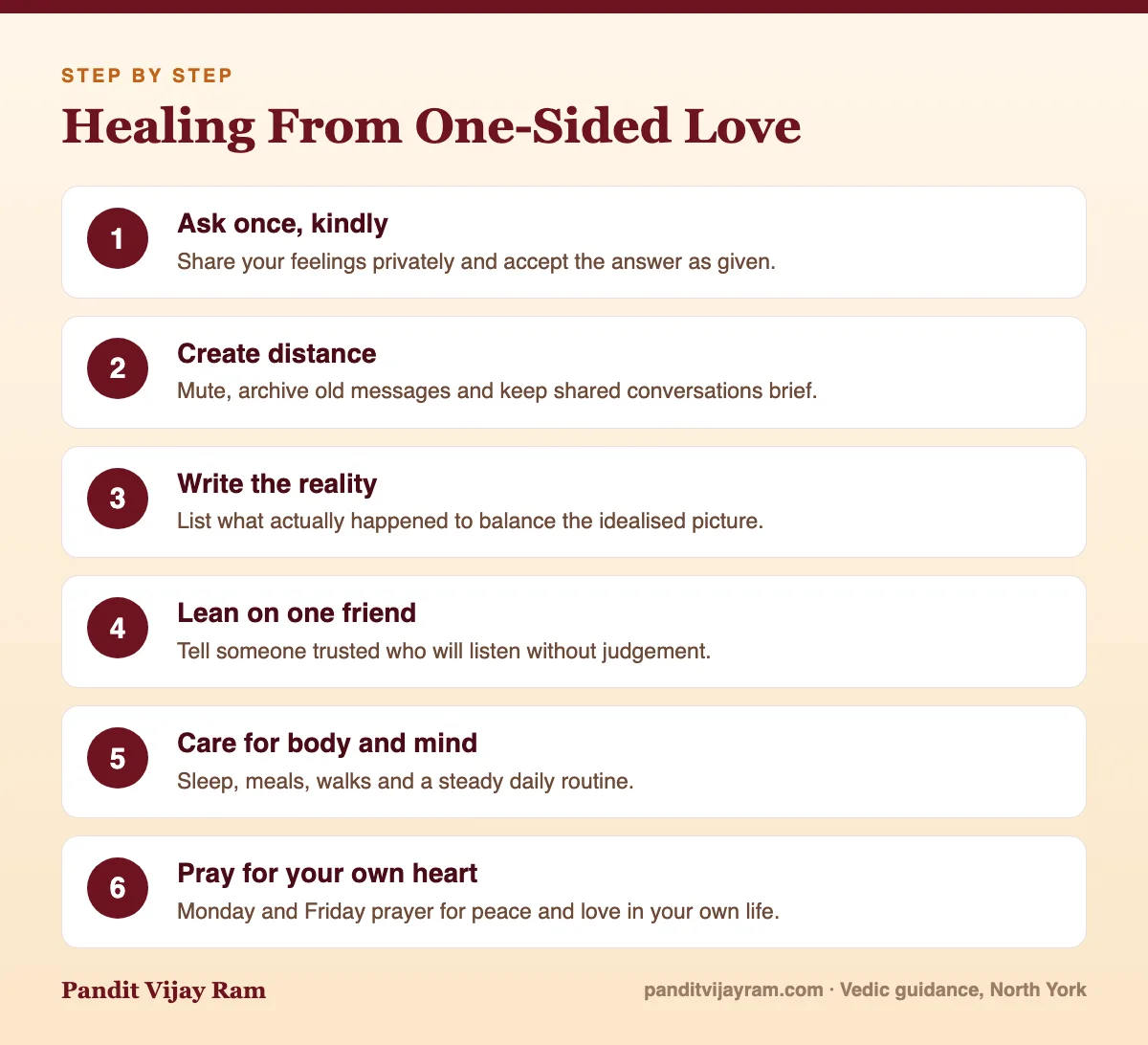
- Ask once, gently. "I've developed feelings for you. I'd like to know honestly whether you feel the same." Choose a private moment and do not pressure.
- Accept the answer as given. "I'm not sure" or "I value our friendship" is usually a kind no. A clear no is final.
- Do not test it repeatedly. Asking again and again, or arranging situations to change their mind, turns your feelings into a burden for them.
- Respect their space. If they ask for distance, give it fully. Following, repeated messages or turning up uninvited can frighten people and may cross into harassment.
If they say yes, wonderful. If they say no, you now have something solid to heal from, rather than a hope that keeps reopening the wound.
When the person is a spouse who no longer seems to return affection, the situation is different. Our guide to what to do when a spouse becomes distant covers that.
How to move on from one-sided love?
Reduce contact and reminders, tell one trusted friend, keep a steady daily routine with sleep and exercise, write down the reality rather than the fantasy, and fill your time with people and goals that are yours. Expect good and bad days. Most people find the intensity eases over weeks to months.
Moving on is less about forgetting and more about letting the feeling lose its grip. Practical steps make a real difference.
- Create distance. Mute or unfollow on social media for a while. You do not need to announce it. If you work or study together, keep conversations friendly and brief.
- Stop rereading. Old messages and photos keep the hope alive. Archive them somewhere out of sight.
- Write the reality. List what actually happened, including the moments you felt ignored. It balances the idealised picture.
- Tell one person. A friend or sibling who will listen without mocking makes the pain lighter.
- Look after the body. Regular sleep, meals, walks and exercise steady mood more than people expect.
- Rebuild self-worth. Spend time on things you are good at, and with people who value you. Being unloved by one person says nothing about your worth.
- Give it time. Many people find the first month hardest. Be patient with yourself.
A release prayer can mark the decision to let go. Our article on clearing ties to a past relationship describes a gentle one that does not target the other person.
If sadness becomes hopelessness, if you cannot sleep or eat for weeks, or if thoughts of self-harm appear, please see your family doctor, and call or text 988 at any hour.
What spiritual practices help heal unrequited love?
Helpful practices include Friday Lakshmi or Venus prayer for love in your own life, Monday prayer for a calmer mind, Kamdev and Rati prayer asking for a loving relationship rather than a particular person, reading the Gita on acting without clinging to results, and charity that turns attention outward. Each focuses on your healing.
Spiritual practice after unrequited love is about loosening attachment and opening the heart again, not about bringing one person closer. I suggest choosing one or two and keeping them simply.
- Monday Moon prayer. The Moon governs the mind. Offering water to Shiva on Mondays and sitting quietly for a few minutes helps an overactive mind settle.
- Friday Venus prayer. Lakshmi worship, white flowers and a short Shukra mantra ask for love and sweetness in your own life, from whoever it may come.
- Kamdev and Rati prayer. Traditionally, this asks for love and attraction to grow in one's own life. Our guide to Kamdev and Rati puja explains how it is done without targeting any individual.
- The Gita on attachment. Chapter two teaches acting without clinging to the fruits of action. Reading verse forty-seven slowly each morning reminds you that you can love without owning the outcome.
- Hanuman Chalisa. For courage on the days when the pain feels larger than you.
- Seva. Serving others at a temple, gurdwara or food bank shifts attention from what you lack to what you can give.
I also advise against practices that keep the person at the centre: repeating their name in prayer, keeping their photo on the altar, or vows tied to their response. These deepen fixation rather than easing it.
People sometimes find hope in seeing that love can come again in time. A reading of your own chart can show supportive periods ahead.
The bottom line
One sided love is painful and common, and it says nothing about your worth. No ethical mantra or ritual can make someone love you, which is why I refuse control work and turn instead to your own healing. Asking once, accepting the answer and creating distance gives the heart something solid to recover from. Steady routines, trusted support and prayer focused on your own peace help the intensity fade, and leave room for love that is freely returned.
Key takeaways
- Unrequited love is a normal human experience, not a weakness.
- No ethical ritual can force another person's feelings.
- Ask once, clearly, and accept the answer as given.
- Distance, routine and trusted support ease the pain over time.
- Pray for love in your own life, not for control of one person.