
Kamdev and Rati Puja: The Traditional Alternative to Binding Spells

When people want love in their lives, they sometimes reach first for the most forceful option they can find online. Yet Hindu tradition has a far older and gentler answer: the worship of Kamadeva and Rati, the divine couple of love and delight. A kamdev puja is a prayer, not a spell. It asks for affection, charm and harmony to grow in your own life, or between you and a willing partner. Clients in North York and the wider GTA are often surprised to learn that this tradition exists, and relieved that it does not ask them to work against anyone. This article introduces who Kamdev and Rati are, what their worship actually requests, a simple home method with the Kamdev Gayatri, why the deity is linked with spring and Vasant Panchami, and what the puja cannot do. In more than forty years of practice, I have found Kamdev worship especially helpful for people who have become hard or fearful after heartbreak. It softens the heart before it changes anything else.
Who are Kamdev and Rati in Hindu mythology?
Kamadeva, or Kamdev, is the Hindu god of love and desire. He carries a bow of sugarcane strung with honeybees and five arrows tipped with flowers, rides a parrot and flies a banner bearing the makara. Rati, his wife, personifies delight and devotion. Together they represent love that is beautiful and mutual.
Kamadeva appears early in Indian thought. A hymn of the Rigveda speaks of kama, desire, as the first seed of mind at creation. In later Puranic stories he becomes a radiant young god whose arrows awaken love in gods and humans alike.
His symbols are full of meaning:
- The sugarcane bow: love is sweet, but the bow can still sting.
- Five flower arrows: usually lotus, ashoka, mango blossom, jasmine and blue lotus, each linked to a stage of falling in love.
- The parrot: speech, charm and playful affection.
- Spring, Vasanta, as his companion: love flourishes in its season.
The most famous story is Kamadahana. Sent to stir Shiva's heart towards Parvati, Kama loosed an arrow while Shiva meditated. Shiva opened his third eye and burnt Kama to ash. Rati's grief was so great that Shiva later promised Kama would live on without a body, as Ananga, present in every loving heart, and later be reborn as Pradyumna, son of Krishna.
The story teaches that desire must serve something higher than itself. Our guide on Gauri-Shankar prayer for marriage follows the same narrative from Parvati's side.
What does a kamdev puja ask for?
A Kamdev puja asks for love, attraction, sweetness and harmony to bless the worshipper's own life. Single people pray for charm and a good partner; couples pray for renewed affection and understanding. It does not ask for any particular person to be captured, which is why it sits on the ethical side of love practice.
The intention, or sankalpa, is what makes Kamdev worship a prayer rather than a binding. Typical ethical intentions include:
- "Let my heart become warm and open again after hurt."
- "Bless me with charm, confidence and the right partner."
- "Renew affection and playfulness between my spouse and me."
- "Help us understand each other's needs with kindness."
What it should not ask:
- That a named ex return against their wishes.
- That someone leave their partner for you.
- That a person become unable to think of anyone else.
Those requests turn love's deity into a tool of control. Even in the stories, Kama's arrows are not weapons of possession. When he tried to force a moment on Shiva, the result was his own burning. The tradition's own warning is built into its best-known tale.
For a clear line between the two kinds of request, see love binding versus attraction rituals. Vijay Ram ji's vashikaran and attraction guidance uses Kamdev worship in exactly this sense: for attraction and harmony in your own life, and between willing partners.
How do you perform Kamdev puja at home?
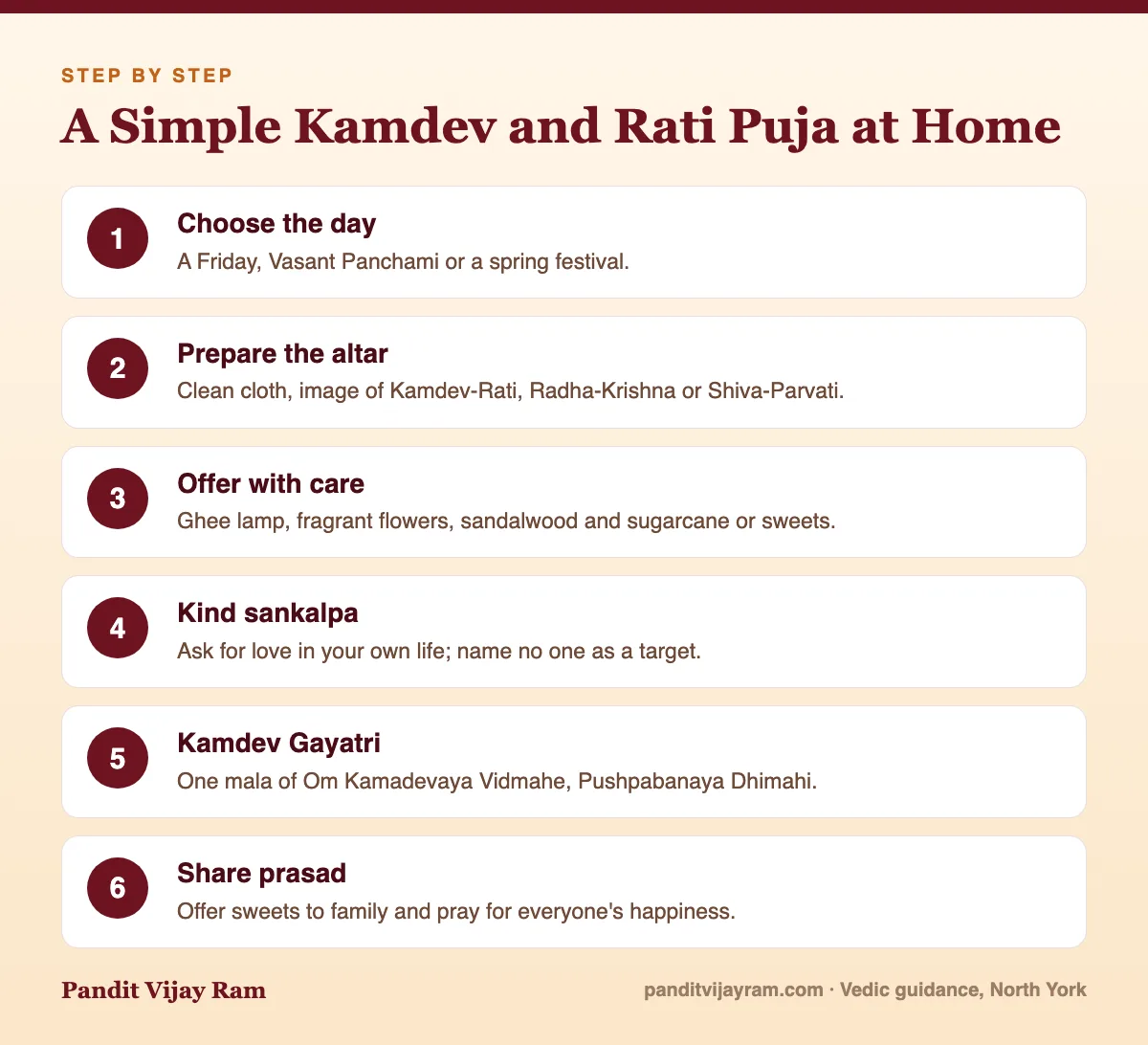
Choose a Friday or a spring festival, clean a small altar, place an image of Kamdev and Rati or of Radha-Krishna, offer flowers, sweets and a ghee lamp, state a kind sankalpa and chant the Kamdev Gayatri. End by praying for the happiness of everyone you love. Keep it simple and sincere.
A short home method many families follow:
- Choose the day. Fridays, ruled by Venus, suit love prayer. Vasant Panchami and the days around Holi are traditional for Kamdev.
- Prepare the space. Bathe, wear clean bright clothes and set a yellow or pink cloth on a small table.
- Place the image. Images of Kamdev and Rati are less common; many people use Radha-Krishna or Shiva-Parvati instead, since both couples are linked to Kama's story.
- Offer. A ghee lamp, incense, fragrant flowers such as jasmine or roses, a little sugarcane or sweets, and sandalwood paste.
- State the sankalpa. In your own words, ask for love and harmony in your own life, without naming anyone as a target.
- Chant. The Kamdev Gayatri: Om Kamadevaya Vidmahe, Pushpabanaya Dhimahi, Tanno Ananga Prachodayat. One mala of 108 is plenty.
- Close. Offer the sweets as prasad, share them with family, and pray for everyone's happiness.
Couples can perform this together, which makes the consent explicit and turns the puja into a shared moment. For a larger ceremony with havan, Vijay Ram ji can arrange a Kamdev-Rati puja through the puja and anushthan service. If you would like to pair this with chart-based Friday practice, the article on Venus remedies for love explains how.
Why is Kamdev linked to Vasant Panchami?
Vasant Panchami marks the start of spring, the season that is Kamdev's companion in the myths. Many communities remember Kama and Rati on this day alongside Saraswati worship, and in some regions spring festivals around Holi recall Kama's burning and return. The timing honours love as a natural, seasonal blossoming.
In classical poetry, Vasanta, the personified spring, travels with Kama and prepares the world for him with blossoms, bird song and gentle breezes. It makes sense that the first day of spring became associated with love.
Across India, the day carries layered meanings:
- Many households worship Saraswati, goddess of learning, and wear yellow for the mustard fields.
- Some temples and families add prayers to Kama and Rati, asking for love and marital happiness.
- Older Sanskrit literature describes a spring festival in honour of Kama, celebrated with music and flowers.
- In parts of South India, observances near Holi recall Kamadahana, the burning of Kama, and Rati's prayer for his return.
For families in Canada, Vasant Panchami often falls in the depths of winter, when spring feels far away. That contrast can be meaningful. Lighting a lamp for Kamdev in the cold months is a quiet act of hope that warmth will return, in the season and in the heart.
Families with students may already observe the day for Saraswati. Our article on Saraswati remedies for students covers that side of the festival, and a short Kamdev prayer can follow the same morning puja.
Can Kamdev puja bring back a specific person?
No honest priest can promise that. Kamdev puja can soften your heart, renew warmth in a willing relationship and help you meet love with more openness. Whether a particular person returns is their own decision. Using the puja to pull someone back against their wishes misreads the tradition entirely.
People sometimes arrive hoping that Kamdev is the gentler route to the same goal a binding promised. It is not. The puja's power, in the traditional view, lies in what it does to the worshipper: making them more loving, more attractive in spirit and more patient.
What people often notice after a period of Kamdev worship:
- Bitterness after a breakup begins to ease.
- They feel more like themselves, and more willing to meet new people.
- In existing marriages, small gestures of affection return.
- They are able to wish a former partner well.
If you are still hoping for a particular person's return, combine prayer with honest reflection and, where both are willing, conversation. If they have said no, respect it. Our guide to whether love back spells work explains what usually decides reconciliation.
If longing has turned into constant thoughts you cannot control, or you feel tempted to follow or keep contacting someone, please speak to your family doctor or a counsellor. Love's deity is a blessing for open hearts, not a remedy for distress that needs care. Vijay Ram ji's love and marriage guidance brings these strands together with a kundli reading and practical advice.
The bottom line
Kamdev puja honours Kamadeva and Rati, the divine couple of love and delight, and asks for warmth, charm and harmony in your own life or a willing relationship. It can be done simply at home with flowers, a lamp, a kind sankalpa and the Kamdev Gayatri, especially on Fridays or around Vasant Panchami. It is the traditional alternative to binding spells precisely because it seeks blessing rather than control, and it sits comfortably alongside counselling when longing becomes distress.
Key takeaways
- Kamdev and Rati are the Hindu deities of love and delight.
- Their puja asks for love in your own life, never for a captive.
- Kamadahana shows that forced desire burns the one who forces it.
- Fridays, Vasant Panchami and spring are traditional times.
- No puja can decide another person's return; respect their choice.