
Mohini and Sammohan Mantras: Attraction, Charisma and Ethics

Some people search for a mohini mantra because they want to be noticed. Others have been told they lack charm, or have lost confidence after a hard few years. The adverts make it sound simple: chant this, and anyone you choose will be drawn to you. I hear a quieter version of this wish from people in North York every week, often from those who feel invisible at work or in the marriage market. This article looks at what Mohini actually means in the Puranic stories, what the word sammohan describes, why both have been turned into sales labels, and where the ethical line sits. Then we turn to the more useful part: how Vedic tradition understands attraction, and what you can genuinely do to strengthen it through Shukra, through steady habits and through the way you treat people. In more than forty years of practice, the most attractive people I have met were not the ones chanting at others. They were the ones at ease in their own skin.
Who is Mohini in Hindu mythology?
Mohini is the only female avatar of Vishnu. In the churning of the ocean, the Samudra Manthan, she appears to take the nectar of immortality from the asuras and serve it to the devas. In another story she outwits the demon Bhasmasura. Her enchantment always serves the restoration of balance, never personal possession.
The name comes from the Sanskrit moha, delusion or bewilderment, and means 'the enchantress'. Her stories appear in the Mahabharata and several Puranas.
The best-known episodes:
- The churning of the ocean. Devas and asuras together churn the cosmic ocean for amrita, the nectar of immortality. When the asuras seize it, Vishnu appears as Mohini. Captivated, they let her distribute it, and she gives it to the devas.
- Bhasmasura. A demon is granted the power to burn anyone to ash by touching their head, and turns on Shiva himself. Mohini invites him to dance and mirror her movements, until he places his hand on his own head.
- In South Indian traditions, Mohini's union with Shiva is linked to the birth of Ayyappa, also called Hariharaputra.
Look at what the enchantment achieves. It stops a destructive force and returns the world to order. Mohini is not a love goddess handing out power over partners. She is Vishnu acting to protect.
There is also Mohini Ekadashi, a fast in the month of Vaishakha associated with this form. Families observing it pray for clarity and freedom from delusion, the opposite of what most online 'mohini' pages promise. For the general Hindu view of love prayer, our article on Kamdev and Rati puja is a good companion read.
What does sammohan mean?
Sammohan, from sam plus moha, means complete enchantment or bewilderment. In classical lists it is the name of one of Kamadeva's five flower arrows, the one that infatuates. In modern Hindi it is also used for hypnosis. Online, the word is marketed as mass attraction, a meaning the tradition did not treat as a goal.
The prefix sam intensifies, so sammohan is total moha, a state where judgement is clouded. That is worth pausing on. In Hindu philosophy moha is one of the inner enemies, alongside desire, anger, greed, pride and envy. The Bhagavad Gita opens with Arjuna caught in it.
Kamadeva's five arrows are traditionally named for the stages of infatuation, with lists such as:
- Unmadana — maddening, unsettling the mind.
- Tapana — burning, the ache of longing.
- Shoshana — withering, losing appetite and sleep.
- Stambhana — paralysing, unable to act.
- Sammohana — complete infatuation.
Read as a list, these describe a crush that has become unhealthy. Poets used them to explain lovesickness, not to recommend it.
So a 'sammohan mantra' sold to make crowds or one person fall under your spell is asking to impose a state the tradition considered a kind of suffering. That is why Vijay Ram ji treats these requests as a starting point for conversation, not a service. You can read his approach on the attraction and vashikaran guidance page, and the root ideas in what vashikaran means in Sanskrit.
Is it ethical to use an attraction mantra on someone?
Using a chant to make a particular person desire you, without their knowledge, aims to override their judgement and is not ethical in Hindu teaching or common decency. Praying to become more radiant, kind and confident in yourself is entirely different. The question to ask is whether your practice changes you or targets someone else.
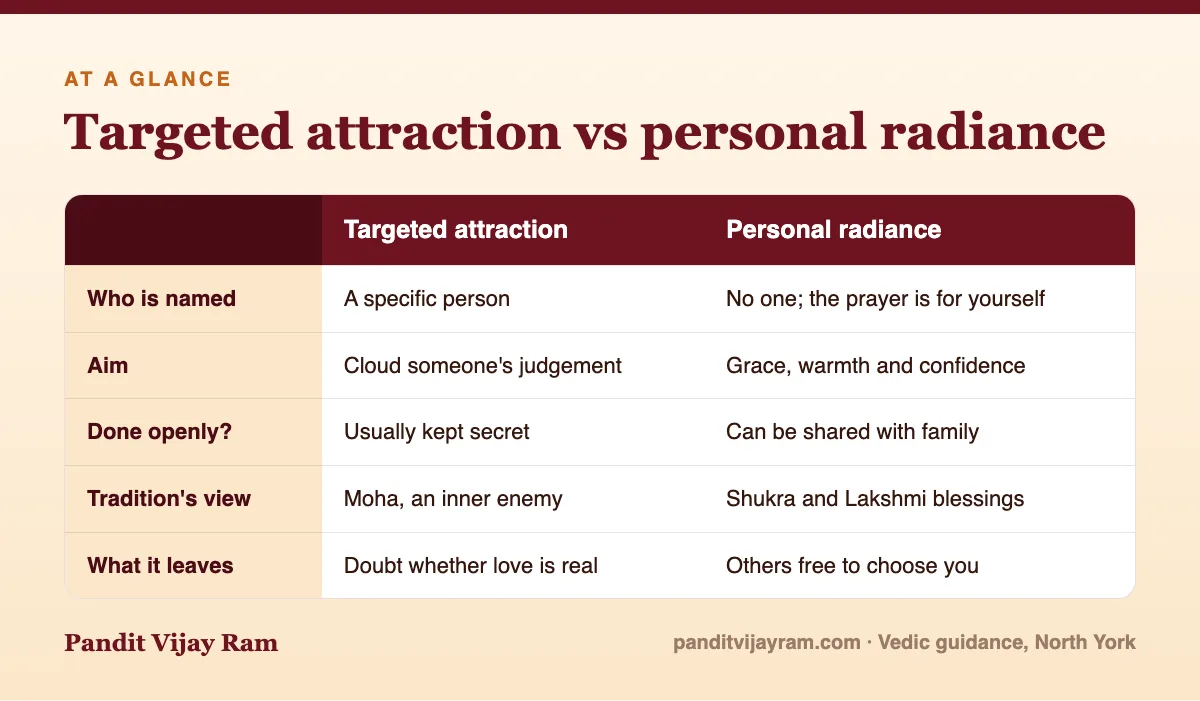
The ethical line is the same one that runs through every love practice: consent. A useful way to think about it is a simple comparison.
- Targeted attraction: names a person, seeks to cloud their judgement, works best in secret, and treats their 'yes' as something to be produced.
- Personal radiance: names no one, asks for grace and confidence in yourself, can be done openly, and leaves every other person free to respond as they wish.
The first creates the very moha the tradition warns about. Even if it seemed to succeed, you would never know whether the other person truly chose you, which is a lonely way to be loved.
The second is old and respectable. Hindu households have long prayed to Lakshmi for grace, to Shukra for beauty and harmony, and to Kamadeva and Rati for sweetness in married life.
If the person you want has already said no, the kindest course is to accept it, however painful. Our guide on one-sided love deals with that situation directly, and love binding versus attraction rituals sets out the difference in a table.
How can you increase attraction and charisma the Vedic way?
Vedic tradition links attraction with Shukra, the planet Venus, and with a calm, warm presence. Practical steps include strengthening Venus through Friday prayer and charity, caring for appearance and surroundings, speaking kindly, and building self-respect. Charisma grows from steadiness and genuine interest in other people, not from any chant aimed at them.
A sensible plan works on three levels at once.
1. Shukra, the planet of grace.
- On Fridays, chant Om Shum Shukraya Namah for one mala, or the Lakshmi stotra your family uses.
- Wear clean, light-coloured clothes and add a little fragrance.
- Give something sweet or white, such as rice, milk or a meal, to someone in need.
- Gemstones such as diamond or white sapphire should only be considered after a chart reading, never because a website says so.
2. Presence and care.
- Sleep, movement and simple grooming do more for how people respond to you than any ritual.
- A tidy, pleasant room changes your own mood, which others notice.
- Practise listening: ask one real question and wait for the whole answer.
3. Character.
- Keep small promises. Reliability is deeply attractive.
- Speak well of people who are not in the room.
- Notice where shame or old rejection makes you shrink, and work on it, with a counsellor if needed.
For chart-specific timing and Venus placement, see Venus and 7th house remedies, or book a reading through the kundli and horoscope service.
What can a mohini mantra not do?
No chant can make a specific person love you, keep a partner from leaving, or replace the slow work of trust. It cannot fix low mood, social anxiety or loneliness that needs real support. Devotional practice can steady you and soften your presence. Everything beyond that depends on choices, time and other people's free will.
Honest limits are part of honest guidance, so here they are plainly.
- It cannot choose for someone else. Another person's feelings belong to them.
- It cannot speed up trust. Attraction may spark quickly; a relationship still takes months of showing up.
- It cannot treat illness. Persistent low mood, panic in social settings or loss of appetite are reasons to see your family doctor.
- It cannot undo harm. If someone has been hurt by your actions, repair needs an apology and changed behaviour.
What devotional practice can do is real but quieter. It can lower the frantic edge that pushes people away. It can remind you of your own worth. It can give your week a calm rhythm that makes you easier to be around.
If you have been paying for 'mohini' or 'sammohan' rituals that keep needing another fee, stop and look at our guide on why online mantra lists mislead. And if you feel desperate or unsafe, call or text 9-8-8 at any hour.
The bottom line
The mohini mantra takes its name from Vishnu's enchanting form, whose charm in the myths always served balance rather than possession. Sammohan describes total infatuation, a state the tradition linked with suffering, so imposing it on another person crosses an ethical line. Genuine attraction in Vedic thought grows through Shukra, through care for yourself and your surroundings, and through good character. Pray to become more radiant, and leave others free to respond.
Key takeaways
- Mohini is Vishnu's female form; her enchantment restored balance.
- Sammohan means total infatuation, one of Kamadeva's five arrows.
- Targeting a person with an attraction chant overrides their judgement.
- Shukra prayer, grooming, kindness and reliability build real charm.
- No chant can choose for someone else or replace trust.