
Vashikaran Specialist Claims: Questions to Ask Before You Pay

People rarely search for a vashikaran specialist on a good day. Usually someone has left, a family has said no, or a marriage feels like it is slipping. In that state, an advertisement that promises results in days can sound like rescue. I meet people in North York and hear from others across Canada who paid first and asked questions later, and by then the money and the hope were both gone. This guide is a consumer checklist. It explains what these advertisers usually claim, the specific questions to ask before any money changes hands, the warning signs that point to a scam, why I refuse to perform rituals that try to control another person, and what to do if you have already paid. In more than forty years of practice I have seen the word vashikaran stretched to cover almost anything for sale. The questions here are fair to ask of anyone, including me. A practitioner with nothing to hide will answer them calmly and will never mind you taking a few days to think.
What does a vashikaran specialist claim to do?
Advertisers usually claim they can make an ex return, make a partner obey, change parents' minds about a marriage, end an affair or win someone who is not interested. Those claims describe control over another person. In older tantric texts the term had a narrower technical sense, and its online use has drifted far from that.
The Sanskrit root vash relates to bringing something under one's influence. In tantric literature, vashikaran appears as one of a group of ritual aims, and it was never meant as a casual service for hire. Our article on the meaning of vashikaran in Sanskrit traces how the word changed.
Online, the claims tend to fall into a few familiar types:
- Return claims. "Your ex will come back and beg."
- Obedience claims. "Your husband or wife will do whatever you say."
- Family claims. "Your parents will agree to your love marriage."
- Rival claims. "The other woman or man will leave."
- Speed claims. Results in hours or days.
Notice what all of these have in common: another person's will is treated as an obstacle to be removed. That is the ethical problem, before the question of whether any of it works. Many also come with copied mantras that sound authoritative; our guide on why online vashikaran mantras mislead explains why those are unreliable.
The site does have a vashikaran service page, and it explains the narrow, consent-respecting way Vijay Ram ji uses that word.
What questions should I ask a vashikaran specialist before paying?
Ask what exactly will be done and by whom, the total cost in writing before anything starts, what payment methods are accepted, whether there are any further charges, what happens if nothing changes, and whether they promise a result. Honest answers are specific and calm. Vague, pressured or shifting answers are your cue to stop.
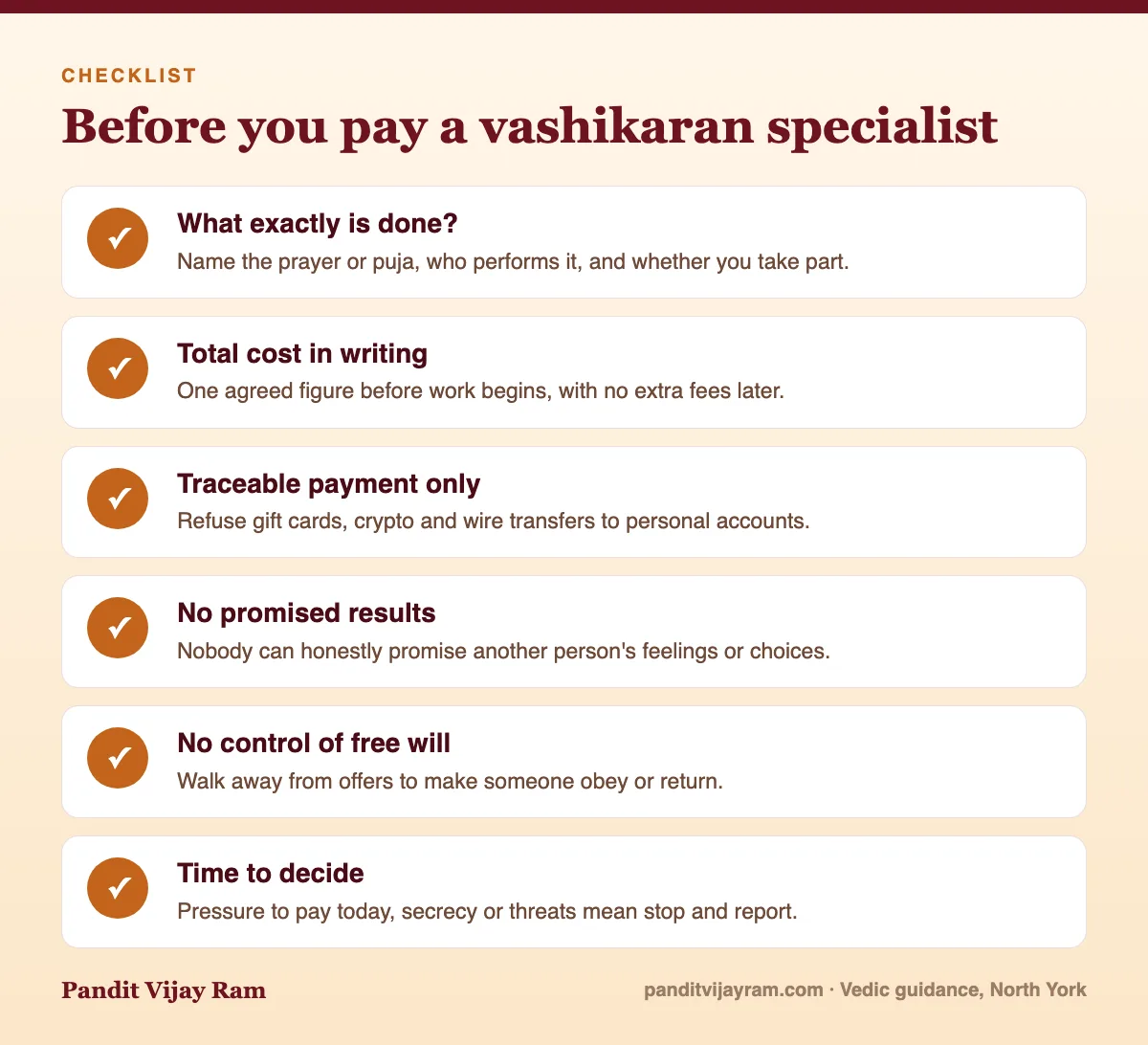
Before sending any money, ask these questions and write down the answers:
- "What exactly will you do?" Which prayer, puja or practice, how long it takes, and whether you take part.
- "Who performs it, and where?" A real person with a verifiable presence, not an anonymous number abroad.
- "What is the total cost, in writing?" One figure, agreed before work begins.
- "Could there be extra charges later?" The honest answer is no, or a clear explanation of when and why.
- "How do I pay?" Traceable methods with receipts. Refuse gift cards, cryptocurrency and wire transfers to personal accounts.
- "Do you promise a result?" Anyone who says yes is telling you something untrue.
- "Does this affect another person's free will?" A responsible practitioner says no, and explains what the practice does instead.
- "Can I take a few days to decide?" The only acceptable answer is yes.
Pay attention to how the questions are received. Irritation, flattery or a sudden "special discount if you pay today" all tell you more than the answers do.
A broader version of this approach, written for black magic removal, appears in our guide to choosing a black magic removal specialist. The same instincts apply here.
What are the red flags of a vashikaran scam?
The biggest red flags are promised results, deadlines, demands for secrecy, payment by gift card, crypto or wire transfer, new fees for newly discovered obstacles, requests for intimate photos, and threats that stopping will bring harm. Grand titles, copied reviews and no verifiable address or identity add to the risk.
Scams in this area follow a pattern that becomes obvious once you have seen it. Watch for:
- Titles that do the selling. Long strings of grand titles, invented awards and claims of fame instead of a clear description of the work.
- Results on a timer. "Results in three days, certain" or any fixed deadline for someone else's feelings.
- Obstacles on demand. After the first payment, a rival, a curse or a planet is suddenly found, and it costs more to remove.
- Unusual payment routes. Gift cards, crypto, money transfer apps to individuals, or a relative's account.
- Isolation. Instructions to tell nobody, including your partner, family or bank.
- Intimate requests. Photos, videos or personal items "for the ritual". These can be used for blackmail.
- Fear as leverage. Warnings that your loved one will be harmed, or the ritual will reverse onto you, if you stop paying.
One red flag is enough to pause. Two or more together should end contact. If you would like to see how these scripts show up specifically in love spell advertising, our article on fake love spell casters online walks through real-world patterns, such as planted comments and recovery offers.
Why does Vijay Ram ji refuse vashikaran that controls another person?
Because every person has the right to choose whom to love and how to live, and a ritual aimed at overriding that choice is a form of coercion. In the Vedic view such acts also carry heavy karmic consequences for the one who commissions them. He offers prayer for your own peace and relationship harmony instead.
When someone asks me to make a person love them, I understand the pain behind the request. I also explain why I will not do it.
- Consent. Love that is forced is not love. A relationship built on overriding someone's will is closer to control than to marriage.
- Karma. The tradition teaches that trying to bind another person's mind creates a debt that returns to the one who sought it.
- Safety. Requests to control a partner sometimes come from situations where the other person is trying to leave for good reasons. Supporting control could put someone in danger.
- Honesty. I cannot promise that any ritual will change another person's heart, so I will not take money as if I could.
What I offer instead is work on what is genuinely yours: your own peace, clarity and conduct, prayer for harmony between two willing people, kundli insight about timing, and encouragement towards counselling and honest conversation. If the person has made their choice, I help you heal and move forward with dignity.
For those struggling with love that is not returned, our guide to one-sided love and spiritual guidance offers a kinder path than any control ritual.
What should I do if I already paid a vashikaran specialist?
Stop sending money, even for a final step. Save every message, receipt and number. Call your bank or card issuer quickly to ask about stopping or disputing payments. Report the fraud to the Canadian Anti-Fraud Centre and local police, and ignore anyone who later offers to recover your money for a fee.
Shame keeps many people silent, and silence helps the scammer. You did nothing foolish; you were in pain and someone used it. Practical steps, in order:
- End contact. Block the numbers and accounts once you have saved evidence. Do not argue or threaten them back.
- Gather records. Screenshots of chats, ads, websites, payment confirmations and any names or numbers used.
- Call your bank. Card payments can sometimes be disputed; transfers may be traceable if you act quickly.
- Report it. The Canadian Anti-Fraud Centre collects reports, and local police can open a file. Your report may protect the next person.
- Report the platform accounts. Flag the ads and profiles where you first found them.
- Watch for a second wave. "Recovery agents" who contact you offering to retrieve your money for a fee are usually connected to the original scam.
If intimate images were shared and you are being threatened, do not pay. Stop responding, keep the evidence and contact police. If the threats make you feel unsafe or hopeless, call or text 988 to talk with someone at any hour.
Afterwards, give yourself time to recover emotionally as well as financially. A calm conversation with a trusted friend, counsellor or genuine spiritual guide can help you rebuild trust in your own judgment.
The bottom line
Before paying any vashikaran specialist, ask what will be done, who does it, the full cost in writing and how payment works, and never accept a promise about another person's feelings. Promised results, rising fees, secrecy, unusual payment methods, intimate requests and threats are signs of a scam. Vijay Ram ji refuses control work out of respect for free will and offers prayer for your own peace instead, and if you have already paid, the Canadian Anti-Fraud Centre, your bank and police are the right next steps.
Key takeaways
- Ask exactly what will be done, by whom, and the total cost in writing before paying.
- Refuse gift cards, cryptocurrency and wire transfers to individuals.
- New obstacles after each payment are a classic sign of fraud.
- No ethical practitioner offers to override another person's free will.
- Report losses to your bank, the Canadian Anti-Fraud Centre and police.