
Cord Cutting: How to Clear Energetic Ties to a Past Relationship

Cord cutting is a phrase many people find online after a relationship ends and they still cannot stop thinking about the other person. You may check their profile at midnight, replay old conversations or feel that part of you stayed behind. Clients in North York, Etobicoke and Vaughan sometimes describe it as a rope tied around the chest. This article explains what cord cutting means, how the idea fits with older Vedic teaching on attachment, and a gentle release practice you can do at home over several weeks. It also explains what cord cutting is not. It is not a way to make someone return, forget you, or suffer. In more than forty years of practice I have seen that the people who heal best after a break-up are those who stop trying to manage the other person and turn their attention to their own steadiness. Prayer, routine and honest support from friends and counsellors all help. The goal is that your memories stay, but they stop pulling you off balance.
What does cord cutting mean spiritually?
Spiritually, cord cutting means consciously releasing the invisible pull between you and someone you were close to, so that thoughts of them no longer drain your energy. The term comes from modern energy healing. Vedic teaching describes the same need through vairagya, moha and the karmic bond called rinanubandhan.
The image of a cord is a modern one, popular in energy-healing circles. It pictures a line of attention running between two people that can stay active long after they part. You do not need to accept the image literally to recognise the experience it describes.
Vedic thought offers older words for the same ground:
- Moha is clinging attachment, the kind that clouds judgement and keeps the mind returning to what it cannot hold.
- Vairagya is the opposite quality, a calm letting go that does not require hatred or coldness.
- Rinanubandhan describes a bond created by karmic give and take. When the account between two people is settled, the bond naturally loosens.
The Bhagavad Gita repeatedly asks the reader to act without clinging to the fruits of action. Applied to a relationship, that means you can wish someone well, keep the lessons, and still stop arranging your life around their response.
So in a Vedic setting, cord cutting is not a technique to sever someone with a spiritual knife. It is a period of prayer and discipline in which you take back your attention. It suits endings that are already decided. If you still hope to repair the relationship, a different conversation, about communication and love problem guidance, may fit better.

How do you cut cords with an ex using Vedic practice?
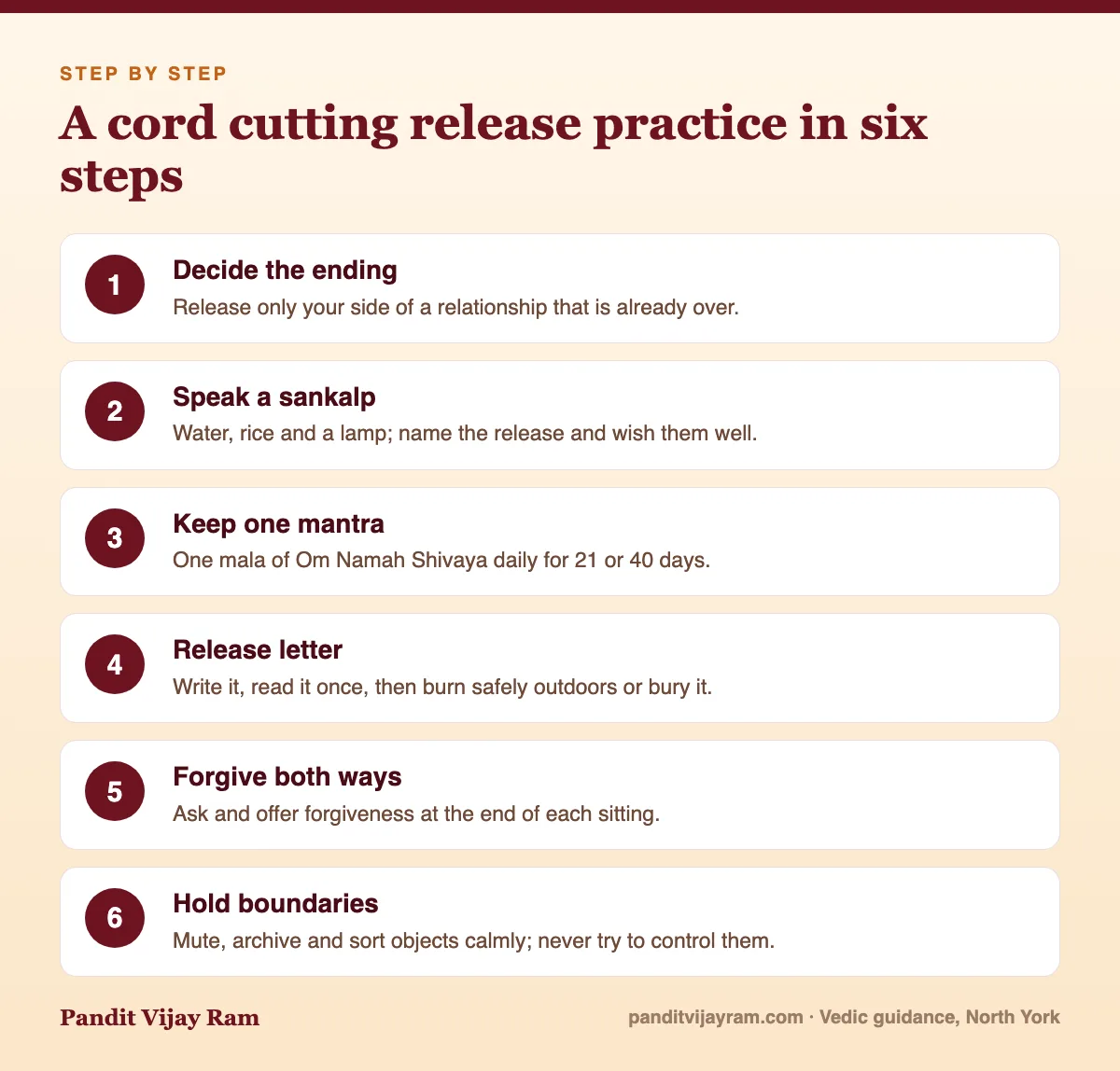
Begin with a sankalp stating that you release your own attachment and wish the other person well. Then keep a daily lamp and a short mantra such as Om Namah Shivaya for twenty-one or forty days, write and burn or bury a release letter, and return or donate charged objects. Add firm digital boundaries.
The structure matters more than any single step. A release practice usually has four parts.
- Sankalp. Sit before a lamp, hold a little water and rice in the right palm, and say your intention in your own language. For example: I release my attachment to this person. I take back my peace. I wish them health and their own path. Then let the water fall onto a plate.
- Daily mantra. Shiva is honoured as the one who dissolves what no longer serves, so many people use Om Namah Shivaya, one mala of 108 a day. Others prefer the Gayatri Mantra. Choose one and keep it steady for twenty-one or forty days.
- Release letter. Write everything you did not get to say. Read it once, aloud if you can. Then tear it and offer it into a small fire in a safe outdoor spot, or bury it in a garden pot with soil.
- Forgiveness prayer. At the end of each session, ask forgiveness for any harm you caused and offer forgiveness for harm you received. You do not have to feel it fully yet.
During this period, keep the practical side going too: mute or archive their social media, delete chat threads you keep rereading, and tell close friends you are doing this so they can support you. The ritual and the boundary work strengthen each other. The guide to no contact and spiritual remedies expands on that pairing.
Can cord cutting make someone forget you or stop loving you?
No. Cord cutting is about your own attachment, not the other person's mind. No ethical Vedic practice reaches in to change another person's feelings or memories. If someone is contacting you against your wishes, use clear boundaries, block them and, where there is harassment or fear, contact the police.
People sometimes arrive hoping that cord cutting will work on the other side: that the ex will stop calling, lose interest, or feel the pain they caused. That wish is understandable, but it changes the practice into an attempt at control.
Vijay Ram ji does not perform rituals designed to override another person's free will, in either direction. Binding someone to you and cutting someone off from you are the same kind of act when the target is their mind rather than your own. In the karmic view, trying to steer another person's heart creates a new knot rather than untying the old one.
What you can do:
- Release your own pull, as described above.
- State your boundary once, clearly, if contact continues.
- Block numbers and accounts if the boundary is ignored.
- Keep a record of messages if they become threatening.
- Call the police if you feel unsafe, are being followed, or someone appears where you live or work. Call 911 in an emergency.
If you suspect that someone has tried to bind or influence you, the article on breaking a love binding begins with ordinary explanations and protective practice. Your safety always comes before any spiritual step.
How long does it take to let go of an ex energetically?
Most people notice a little more space within a few weeks of steady practice, but deep attachment often loosens over months. A twenty-one or forty-day cycle gives structure, not a deadline. Healing is uneven; a hard day after progress is normal and does not mean the practice failed.
Grief after a relationship has its own rhythm. The length of the relationship, whether there are children, how it ended and what support you have all change the timeline. A spiritual practice gives the grief a container. It does not erase it on a schedule.
Signs that release is happening tend to be modest:
- You go longer between checking their profile.
- Memories still come, but you can put them down sooner.
- You start planning something that has nothing to do with them.
- Your sleep and appetite steady.
- You can hear their name without your body reacting.
Signs that you need more than ritual:
- You cannot work, eat or sleep for weeks.
- You feel hopeless about the future.
- You are drinking more or using other substances to cope.
- Thoughts of harming yourself appear.
In those cases, please see your family doctor or a counsellor. If you are in crisis, call or text 9-8-8 at any hour. Persistent, intrusive fixation can also be a sign of an anxiety condition or limerence, which counsellors understand well. The article on help for unwanted obsession covers that ground.
What should I do with gifts, photos and jewellery from a past relationship?
Sort them calmly rather than in anger. Return items of real value if appropriate, donate clothes and ordinary gifts, store photos you may want later in one closed box or folder, and cleanse jewellery you keep with salt water or ganga jal. There is no need to destroy everything.
Objects carry memory. For some people, seeing a bracelet or a hoodie every morning reopens the wound. For others, throwing everything out in a rush leads to regret. A middle path works for most.
- Engagement rings and family heirlooms: where appropriate, return them, or settle the matter through the agreements you made. Legal questions belong with a lawyer.
- Clothes and everyday gifts: wash and donate. Giving in a spirit of release is itself a quiet offering.
- Photos and letters: place them in one box or one archived folder. Decide later, when you are calmer, what to keep.
- Jewellery you keep: rinse in clean water with a pinch of rock salt or a few drops of ganga jal, dry it, and offer it before the lamp with a short prayer before wearing it again. Check the metal first; salt can harm some finishes and stones.
- Bedroom items: change and wash the bedsheets, and move furniture slightly if it helps the room feel new.
For more on cleansing objects safely, see the guide to clearing jewellery, gifts and objects. For the immediate days after a painful split, the short reset after a break-up is the place to start, with cord cutting as the longer work that follows. More release and protection practices are gathered in the cleansing and protection hub.
The bottom line
Cord cutting is a release practice that loosens your own attachment to a past relationship. In Vedic terms it rests on vairagya, a clear sankalp, steady mantra and forgiveness, alongside practical boundaries. It never reaches into the other person's mind, and safety always comes before ritual. Give the process time, and bring in a doctor or counsellor when grief becomes too heavy.
Key takeaways
- Cord cutting works on your attachment, never on the other person's will.
- Vairagya, moha and rinanubandhan are the Vedic words behind the idea.
- A sankalp, daily mantra and release letter give the practice structure.
- Digital and practical boundaries make the ritual effective in daily life.
- Harassment calls for police; deep despair calls for a doctor or 9-8-8.