
When a Spouse Becomes Distant: Spiritual and Practical Steps

Few things feel lonelier than lying beside someone who seems a thousand kilometres away. Maybe the conversations have shrunk to logistics, or your partner comes home and goes straight to the phone. When people in North York tell me they are finding their spouse distant, they usually expect me to look for a planet or a spell. I begin somewhere else. This guide walks through the ordinary reasons partners withdraw, how to tell whether depression or a health problem may be involved, a step-by-step way to reach out without pushing, when couples counselling makes sense, and how a shared spiritual practice can rebuild closeness without trying to control anyone. In more than forty years of practice I have found that distance is often a symptom of something the distant partner cannot yet put into words. Patience, curiosity and a little structure tend to do more than pleading or accusation. It also helps to remember that you cannot do all the repair alone, and that your own wellbeing matters while you wait.
Why does a spouse suddenly become distant?
Most emotional distance comes from stress, exhaustion, work pressure, money worries, depression, illness, grief or resentment that has not been spoken. Sometimes it follows a new baby, a move or a loss. Less often, it signals an outside relationship. The change usually has a cause the distant partner has not yet named, even to themselves.
Withdrawal is a common way of coping. Some people, especially those raised not to show feelings, go quiet when they are overwhelmed. Others pull back because they feel criticised and expect any conversation to become a fight.
Questions worth asking yourself before assuming the worst:
- Has anything changed recently? A new job, a layoff, an illness in the family, a move, a death.
- How is their sleep and energy? Late nights, early waking or constant tiredness point to stress or health.
- Are there unspoken hurts? An argument that never really ended, or a feeling of being unappreciated.
- Is the distance everywhere or only at home? If they are withdrawn with friends too, think about mood.
- Has anything become secret? New passwords, unexplained absences or hidden spending may suggest something more.
If you have evidence of an affair, that is a different conversation; our guide on the first weeks after discovering an affair is written for that situation. For newcomer families, distance often begins with the strain described in our post on marriage problems after immigration.

Could my distant spouse be depressed?
Possibly. Depression often looks like withdrawal, irritability, loss of interest in family or sex, poor sleep and tiredness rather than obvious sadness, particularly in men. If your partner has seemed this way for two weeks or more, gently encourage a visit to the family doctor. Physical conditions can cause similar changes.
Many partners hear "depression" and imagine someone crying all day. In reality it often shows as numbness. The person still goes to work but has nothing left at home. Signs to notice:
- Loss of interest in things they used to enjoy, including children or hobbies.
- Changes in sleep, appetite or weight.
- Irritability, short temper or more drinking.
- Saying they feel useless, trapped or like a burden.
- Pulling away from friends as well as from you.
A doctor can also check for physical causes, such as thyroid problems, chronic pain, side effects from medication or sleep disorders, which can drain anyone's warmth and energy.
How to raise it: choose a quiet moment, speak about what you have noticed with care ("you seem tired all the time and I'm worried") and offer to book or attend the appointment together. Avoid labels in the first conversation.
If your partner ever mentions not wanting to live, take it seriously. Call or text 988, the Suicide Crisis Helpline, at any hour, or call 911 if there is immediate danger. Our article on negative energy or depression explains why medical care comes first even when families suspect a spiritual cause.
How do I reconnect with a distant husband or wife?
Start small and steady rather than with one big talk. Lower criticism, offer daily moments of warmth that ask nothing back, and invite conversation with open questions at calm times. Ask what would help instead of guessing. Reconnection usually takes weeks of consistent small gestures before a partner feels safe enough to open up.
When someone feels distant, the instinct is to chase. Repeated questions such as "what's wrong with you?" often push them further away. A gentler approach works better.
Small daily habits that rebuild connection:
- A real greeting. Stop what you are doing for thirty seconds when they come home.
- One kind word a day. Thank them for something specific.
- Shared tasks. Cooking or walking together creates easy, side-by-side time to talk.
- Phone-free meals. Even one per day.
- Low-pressure touch. A hand on the shoulder, without expecting more.
Then, once the atmosphere is calmer, try one open conversation. Use "I" statements: "I miss us. I'd like to understand what's been hard for you." Listen without defending yourself. If they say little, thank them and try again later.
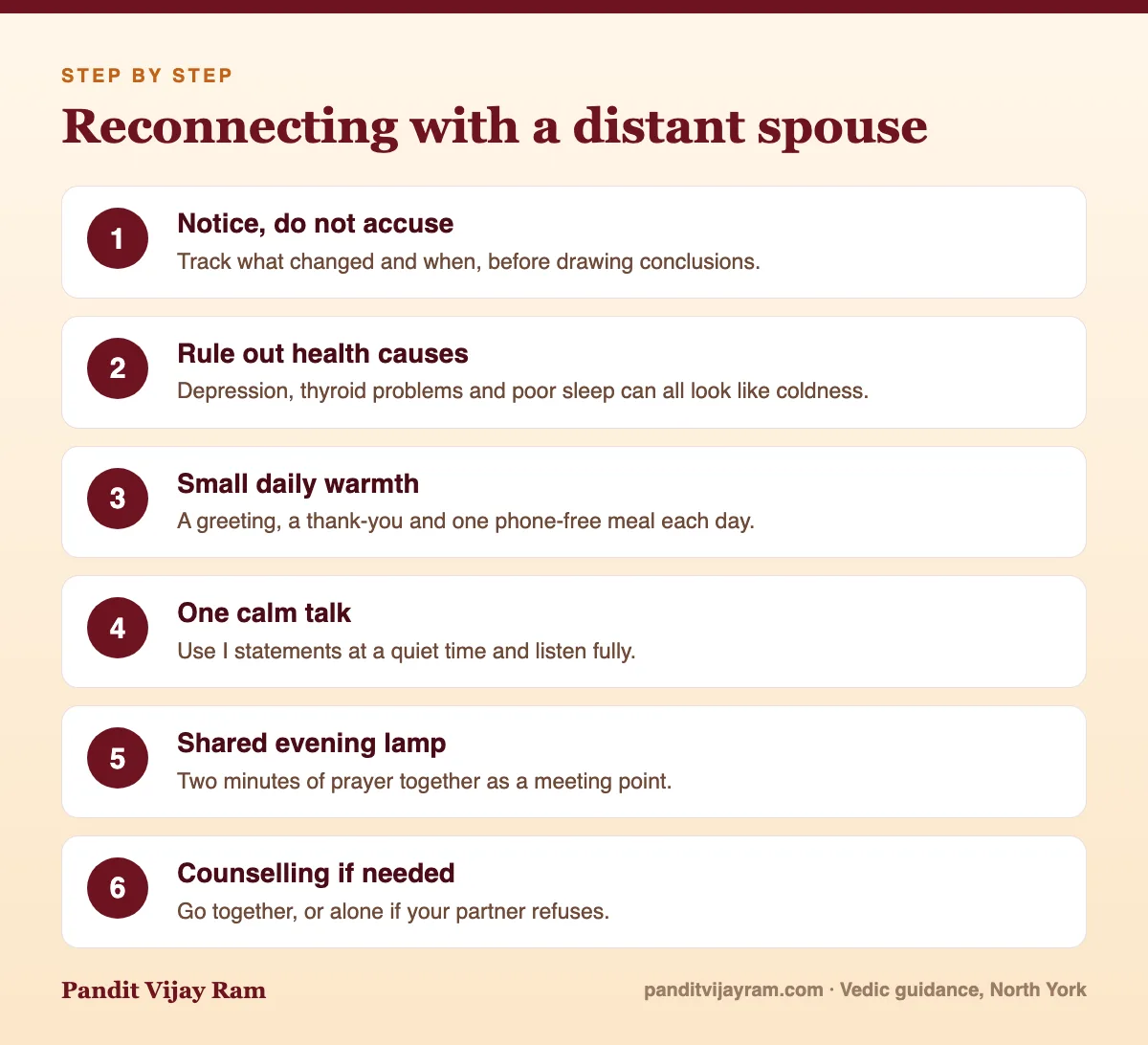
Look after yourself through this. Keep your own friendships, rest and routines. Reconnection depends on both people, and you cannot force the other person's heart. The step-by-step routine below gives these ideas an order you can follow.
When should a couple see a marriage counsellor?
Consider counselling when distance has lasted several months, when every attempt to talk ends in a fight or silence, or when a specific event such as an affair, a loss or a move is still hurting. A counsellor offers a neutral space where the quieter partner often finds it easier to speak.
Couples often wait too long, treating counselling as a last resort. It works best earlier, before resentment hardens. Signs it is time:
- Conversations repeat the same argument without progress.
- One or both of you feel lonely in the marriage most of the time.
- Intimacy has stopped and neither knows how to restart it.
- You are considering separation but are unsure.
Ways to find a counsellor in Canada include asking your family doctor, checking a workplace employee assistance program, contacting community family service agencies or calling 211. Some agencies offer counsellors who understand South-Asian, Caribbean or Latino family expectations, which can make it easier to speak openly.
If your partner refuses, go alone. Individual counselling can help you understand your part, set limits and decide what you need.
One caution: if the distance is part of a pattern of control, threats or fear, joint counselling may not be safe. Speak to a domestic violence service first. In a marriage problem consultation, Vijay Ram ji asks about safety and counselling before talking about charts or remedies.
Can a shared spiritual practice bring a distant couple closer?
It can help, when both partners are willing. A short daily ritual done together, such as lighting a lamp, a few minutes of prayer or a weekly temple visit, creates a calm meeting point that is not about problems. It should invite closeness, never pressure one partner or attempt to control their feelings.
Couples who share a spiritual practice often say it gives them a few minutes each day when they are on the same side. It works because it is gentle and asks nothing difficult. Ideas I suggest:
- Evening lamp together. One person lights it and the other rings the bell. Two minutes is enough.
- A shared mantra. Om Namah Shivaya or a simple prayer for the family, recited together.
- Monday or Friday worship. Shiva-Parvati or Lakshmi-Narayan are traditionally worshipped for marital harmony.
- A joint sankalp. Once a month, say together what you hope for as a couple.
Our guide to spiritual cleansing for couples describes a fuller home routine.
If your partner does not want to join, practise alone without making it a test. Pray for their wellbeing and your own patience. I do not offer rituals designed to make a spouse love, obey or return against their wishes; distance must be bridged by two people choosing each other. Where trust has been broken, our post on rebuilding trust after cheating covers the longer road of repair.
The bottom line
When a spouse is distant, the cause is usually stress, exhaustion, depression, illness or unspoken hurt, so begin with curiosity and a doctor's visit rather than accusation. Rebuild connection with small daily gestures and one calm conversation at a time. Bring in a counsellor if distance lasts, and use a gentle shared ritual to create closeness without pressure.
Key takeaways
- Emotional distance usually has an ordinary cause the distant partner has not yet named.
- Depression and physical illness often look like withdrawal, so a doctor's visit matters.
- Small daily warmth works better than one big confrontation.
- Counselling helps most when started early; go alone if your partner refuses.
- A shared ritual invites closeness but should never be used to control a partner.