
Negative Energy From a Specific Person: Jealousy, Envy and Ill-Wishing

You leave a family dinner and feel flat for two days. A colleague praises you with a smile that never reaches the eyes. A cousin asks a little too often about your salary. When people search for help with negative energy from someone, this is usually the picture: a specific person, a pattern of envy, and a tiredness that seems to follow contact. I work with families in North York and across the GTA who describe exactly this, and the first thing I say is that the feeling deserves to be taken seriously without turning it into fear. This guide explains what tradition says about envy and ill-wishing, which ordinary explanations to rule out, how to set boundaries that actually hold, and which protective practices are gentle enough to keep up daily. In more than forty years of practice I have found that the people who settle fastest are the ones who change the contact pattern first and add prayer second. You will also read why I never offer anything that harms or binds the person you suspect.
Can you really absorb negative energy from someone who is jealous of you?
Many traditions say yes. Vedic texts describe drishti dosha, the effect of an envious gaze, and the Mediterranean and Middle East speak of the evil eye. Psychology offers a parallel: repeated contact with hostile or competitive people raises stress and drains attention. Both views point to the same remedy: less exposure and a steadier inner state.
In Hindu households the idea is old and ordinary. Grandmothers say nazar lag gayi when a praised child suddenly stops eating, or when a new business has a bad first month after everyone admired it. The belief is that envy, even unspoken, carries weight. Sikh, Muslim and Caribbean families have their own versions, and the shared thread is that admiration mixed with resentment can unsettle the person admired.
I take a balanced view. Some of what people call absorbed energy is the body reacting to tension. If you brace yourself before every phone call with a sister-in-law, your shoulders, sleep and digestion will tell the story whether or not anything spiritual is involved. That does not make the experience imaginary. It means the first layer of protection is behavioural.
Where tradition adds something is in the steadiness it offers. A daily lamp, a short prayer and a protective thread give the mind a ritual boundary to stand behind. Our page on removing nazar at home covers the household customs in detail, and the evil eye and nazar service explains when a reading adds clarity.
What I do not accept is the leap from "I feel drained around her" to "she has done black magic on me". Envy is common. Deliberate occult harm is rare. Keeping those two ideas separate protects both your peace and your family relationships.
What are the signs someone is sending you negative energy?
People commonly report fatigue after meeting one person, small setbacks after sharing good news with them, irritability at home following their visits, and a sense of being watched or compared. None of these proves ill-wishing. They are prompts to look at the pattern honestly, starting with stress, sleep and the relationship itself.
When someone tells me a relative is "sending" them bad energy, I first ask them to keep a simple two-week note. Write down each contact, in person or online, and how you felt that evening and the next morning. Patterns are more useful than single bad days.
Here is how I sort what people bring back:
- Linked to contact: heaviness, headache or low mood that reliably follows time with one person. This points to the relationship first and nazar second.
- Linked to disclosure: plans that wobble after you announce them. Tradition says keep new ventures quiet until they are steady; common sense agrees.
- Linked to comparison: you feel worse after scrolling their social media. That is a boundary issue with an easy fix: mute.
- Not linked at all: constant exhaustion regardless of contact. That needs a check with your family doctor before any spiritual work.
If the heaviness is general rather than person-specific, the broader guide to how a practitioner assesses negative energy is the better starting point. Anyone wondering whether the low mood is something clinical should read negative energy or depression before anything else.
How do you protect yourself from jealous relatives without a family fight?
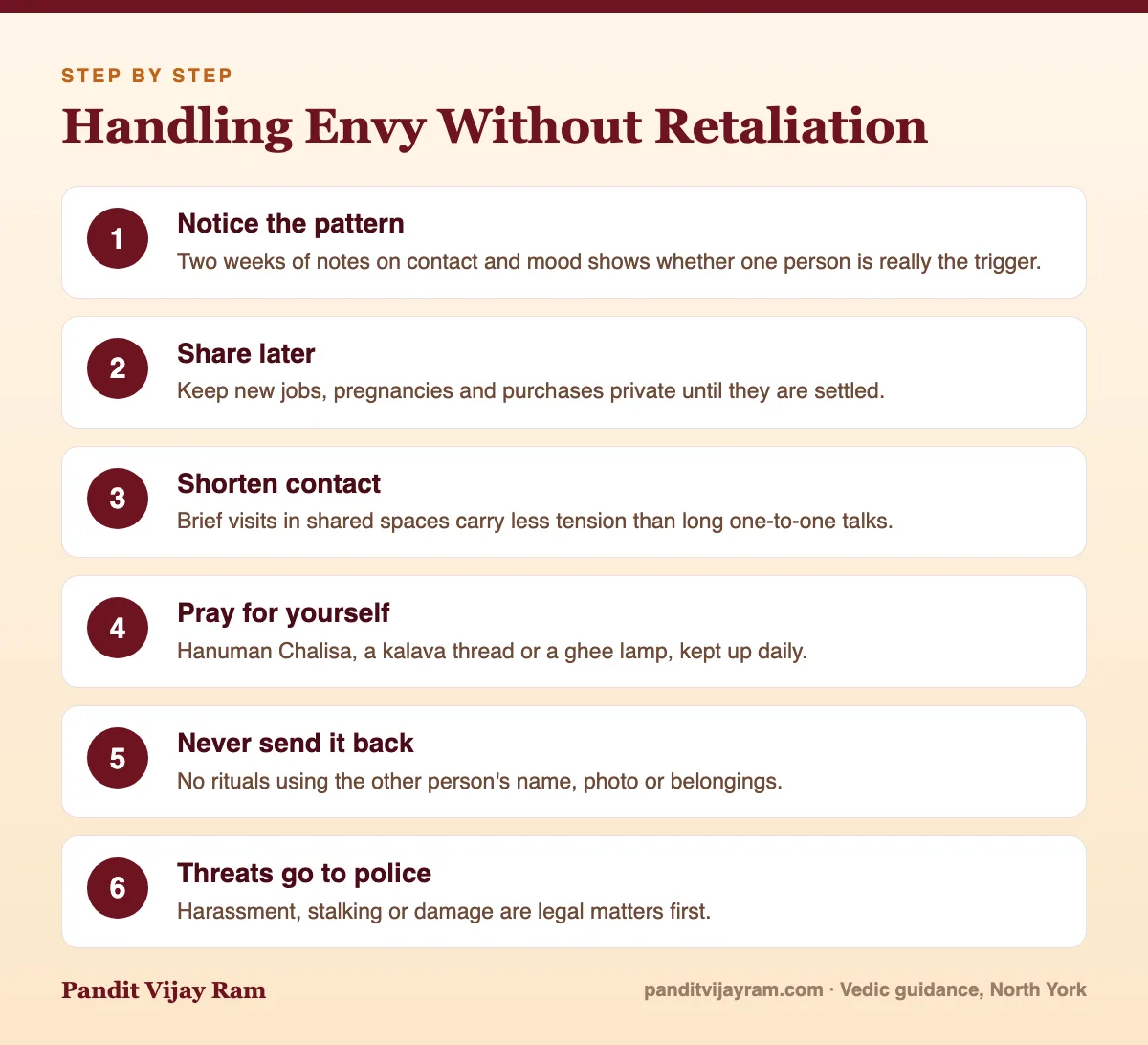
Reduce what the envious person can see and comment on, keep visits shorter and in shared spaces, and stop defending your choices to them. Protection without confrontation means changing your own exposure rather than accusing anyone. Spiritual practice then sits on top of those boundaries, not in place of them.
Relatives are the hardest case because you cannot simply walk away. Weddings, festivals and family WhatsApp groups keep you in contact. I suggest a decision rule that keeps peace and protects you:
- Share less, sooner. Pregnancy, job offers, house purchases and engagements can wait until they are settled. This is the oldest nazar remedy there is.
- Keep meetings short and public. A two-hour visit in a busy living room carries less tension than a long one-to-one.
- Answer without detail. "It's going well, thank you" ends most probing questions.
- Do not retaliate in words or ritual. Tradition is clear that sending harm back keeps you tied to the conflict.
- Talk to one ally. A spouse or sibling who understands can redirect conversations at gatherings.
If the envy has turned into open hostility, interference in your marriage or threats, it has moved beyond energy. Families in that position often benefit from mediation or counselling, and the family problem guidance page describes how a reading can help everyone see the pressures at play. Our post on suspecting black magic by a relative covers the harder version of this situation without accusations.
Which Vedic practices protect against envy and ill-wishing?
Common protective practices include reciting the Hanuman Chalisa morning or evening, wearing a red kalava thread tied with prayer, keeping a ghee lamp at the home shrine, and the old nazar utarna with salt or dry red chillies on a Tuesday or Saturday. They are offered for your own steadiness, not aimed at anyone.
I recommend choosing two or three practices and keeping them up rather than collecting many. Steady and small works better than intense and occasional.
- Hanuman Chalisa: forty verses, about ten minutes. Hanuman is invoked as Sankat Mochan, the remover of troubles, and households across the diaspora recite it on Tuesdays and Saturdays for courage and protection.
- Kalava or mauli: a red-and-yellow cotton thread tied on the right wrist for men and the left for married women, usually after a short puja. The detail of when to replace it is in our kalava thread guide.
- Nazar utarna: a family member circles a fist of rock salt or seven dry red chillies around the head seven times, then dissolves the salt in running water or burns the chillies safely outdoors or on the stove.
- Om Namah Shivaya or the Gayatri Mantra: eleven or twenty-one repetitions on a mala before leaving home.
Notice what is missing from that list. There are no rituals using the other person's photo, name or belongings. I do not perform those, because protection that reaches out to affect someone else is no longer protection. Anyone offering to "return" envy to its sender is offering conflict with a ritual label.
When is ill-wishing a sign to get outside help instead?
Seek outside help when envy becomes harassment, threats, stalking, damage to property, or interference with your job or children. Those are matters for police, workplace HR or a lawyer. If the worry itself is keeping you awake, anxious or low for weeks, speak with your family doctor before or alongside any spiritual work.
Most cases I hear are mild: a jealous aunt, a competitive friend, a coworker who takes credit. A few are not mild at all, and spiritual language can hide real danger if we are not careful.
Please treat these as non-spiritual problems first:
- Repeated unwanted messages, following you, or turning up at your home or work. In Canada, criminal harassment is an offence; call local police, or 9-1-1 if you feel unsafe.
- Threats to you, your partner or your children, including threats wrapped in religious words.
- Damage to your car, home or belongings.
- Spreading false information to your employer or community.
Equally, if you notice that thinking about this person fills most of your day, or you feel hopeless, talk to your family doctor. If you are in crisis, Canada's 9-8-8 Suicide Crisis Helpline is open around the clock by call or text.
Spiritual support still has a place. A negative energy removal consultation can include a kundli check for periods such as Sade Sati or a difficult Rahu dasha, which many families associate with heightened conflict. That reading is context, not a verdict on anyone. You can find the wider set of protective guides on the cleansing and protection hub.
The bottom line
Negative energy from someone envious is a real experience, but it is best handled with boundaries before ritual. Rule out stress, sleep and the relationship itself, then add one or two steady protective practices such as the Hanuman Chalisa or a kalava thread. Never answer envy with retaliation, and treat harassment or threats as matters for police rather than prayer.
Key takeaways
- Envy is common; deliberate occult harm is rare.
- Share good news later and keep tense visits short.
- Choose two or three protective practices and keep them daily.
- Protection is for yourself and never targets the other person.
- Harassment, threats or stalking go to police first.