
Enemies at Work or in the Community: Protection Without Retaliation

A colleague takes credit for your work and whispers to the manager. A community member spreads stories about your family at every function. You feel watched, undermined and tired of being on guard. People in North York and throughout the GTA often come to me asking for protection from enemies, sometimes naming a person, sometimes only sensing hostility. I take that fear seriously, whatever its source. This guide explains how to tell a true adversary from a misunderstanding, which practical protections at work and in the community matter most, when the police or a lawyer should be involved, and what Vedic tradition says about shatru badha, the obstruction caused by opponents. It also explains clearly why I do not perform rituals to harm, bind or punish anyone. Over four decades I have seen that the person who stays calm, keeps good records and prays for steadiness usually outlasts the person attacking them.
How do I know if someone is my enemy at work?
Look for patterns rather than single incidents: repeated exclusion from meetings, credit taken for your work, false reports to managers, rumours, or sabotage of tasks. Write down dates and facts. Sometimes the cause is competition, misunderstanding or a manager's poor communication rather than personal hostility, so check your assumptions with a trusted colleague.
Workplaces and communities are full of friction, and not all friction means enmity. Before I suggest any remedy, I help clients sort what is happening into three groups:
- Misunderstanding. A curt email, a missed invitation, a manager who praised someone else. Often resolved with a direct, polite conversation.
- Competition. A colleague who wants the same promotion and behaves selfishly but not maliciously. Manage it with visibility of your work and clear boundaries.
- Hostility. Repeated, targeted behaviour: lies, sabotage, harassment or threats. This needs documentation and formal steps.
In the third case, start a private log today. Note the date, what happened, who was present and any messages or emails. Store copies outside work systems if company policy allows. This record will matter far more than anything you feel.
Be gentle with yourself in the process. Constant vigilance is exhausting, and anxiety can make neutral events feel hostile. If sleep or mood are suffering, your family doctor can help.
When the problem is someone accusing you of something you did not do, the guide to facing a false accusation sets out documentation and support steps. Our enemy and court case guidance explains how I work with people under this kind of pressure.

What practical steps protect you from workplace enemies?
Document every incident, keep communication in writing, stay professional, and raise the problem through your manager or HR using your employer's harassment or respectful-workplace policy. Seek advice from a union, an employment lawyer or a human rights body if discrimination is involved. Report threats or violence to police. Protect your own reputation through consistent, visible good work.
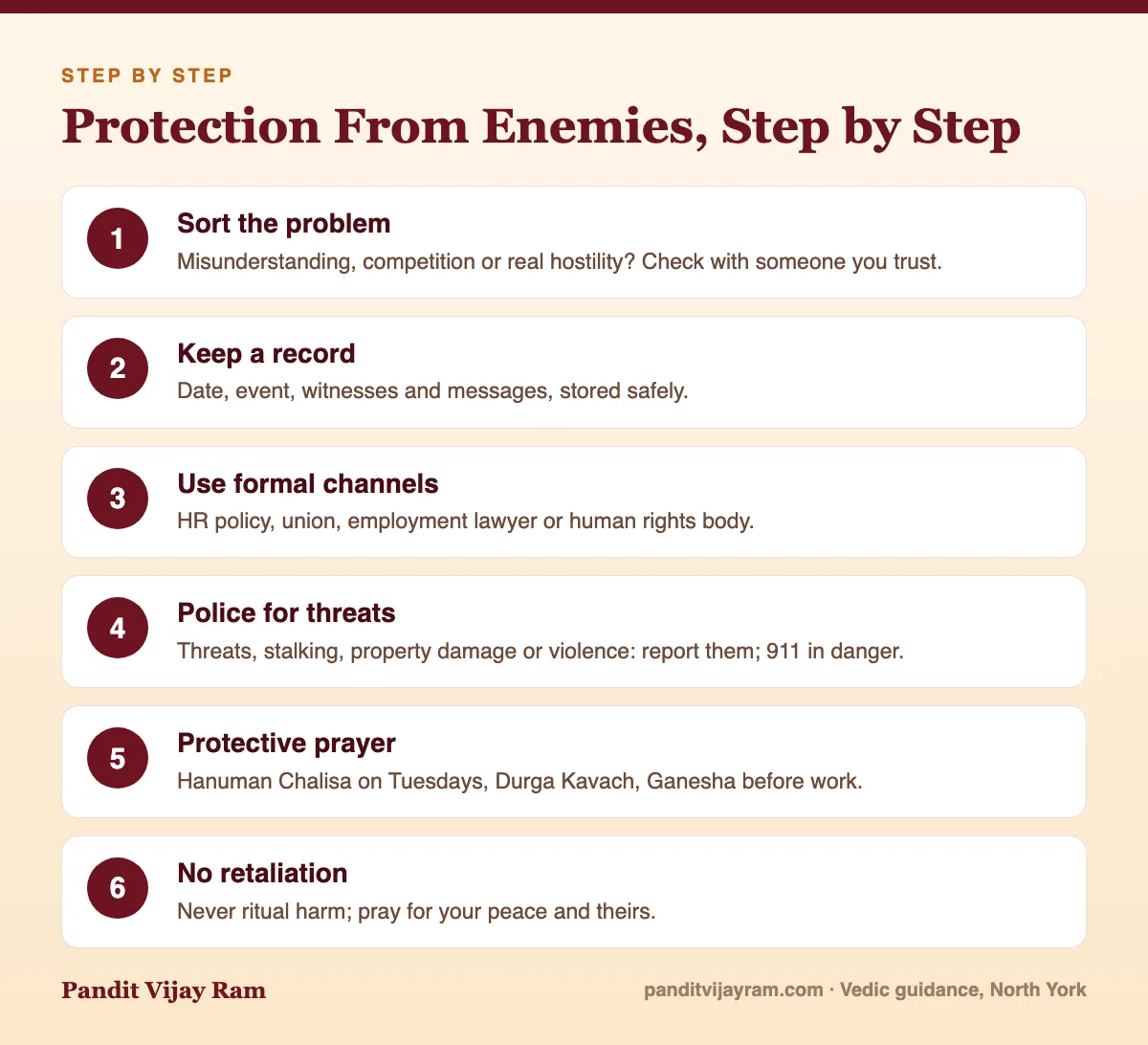
Practical protection works. It is slower and less dramatic than a ritual, but it creates a record that institutions must respond to. Steps I encourage:
- Keep everything in writing. After a verbal conversation, send a short email: "Just confirming what we agreed today."
- Use the policy. In Ontario, most employers must have a workplace harassment policy and a process for complaints. Ask HR for a copy.
- Get advice. A union representative, an employment lawyer or a legal clinic can explain your rights. If you are treated badly because of race, religion, gender or another protected ground, a human rights body may be relevant.
- Stay above it. Do not gossip back or retaliate. It weakens your position.
- Build allies. Good relationships with other colleagues make rumours less effective.
- Make your work visible. Share progress updates with your manager regularly.
In community settings, such as temple committees, associations or neighbours, the same principles apply. Use the organisation's rules, keep records, and seek mediation where it is offered. Neighbour quarrels have their own steps, covered in neighbour disputes in the GTA.
If anyone threatens you, follows you, damages property or harasses you online in a frightening way, contact police. In immediate danger, call 911.
What is shatru badha in Vedic astrology?
Shatru badha means obstruction or trouble from enemies. In Vedic astrology the sixth house governs open opponents, rivals, litigation and competition, and the seventh describes declared adversaries in some contexts. Mars and Saturn are linked with conflict. A difficult dasha involving these factors may coincide with hostility, but it shows a season to manage, not a fixed fate.
Shatru means enemy and badha means obstruction. The term appears in astrological and ritual literature to describe periods when opponents seem stronger or more active.
When I look at a chart for enemy problems, I consider:
- The sixth house and its lord. Enemies, competition, service and daily struggle. Interestingly, malefic planets in the sixth are often read as giving the strength to overcome opponents.
- The twelfth house. Hidden opponents and losses in some interpretations.
- Mars and Saturn. Aggression, rivalry and delay.
- Rahu. Confusion, deception and sudden hostility.
- The current dasha. A period of the sixth lord may bring conflicts to the surface.
I share these with care. The sixth house is also the house of service and effort, and many successful people have strong sixth-house placements because they thrive in competition. A chart can help you see that a difficult season is temporary and choose patience and preparation.
A chart never tells me who your enemy is, and I will not name anyone from it. That would be guesswork dressed as insight, and it could damage innocent relationships.
For a fuller explanation of why destruction-focused remedies are refused, see shatru nashak remedies and their limits.
Which prayers give protection from enemies?
Hanuman Chalisa and Hanuman Ashtak are widely used for courage and protection from hostility, especially on Tuesdays and Saturdays. Durga Kavach and the Durga Saptashati invoke the Mother's protective strength. Ganesha prayer removes obstacles. These prayers are recited to steady and shield yourself, not to weaken or harm the other person.
Protective prayer in the Vedic tradition is about strengthening your own spirit. You ask for courage, clear thinking and the grace to stay fair, so that hostility has less hold on you.
A simple weekly protective routine:
- Tuesday and Saturday mornings: Hanuman Chalisa, once or more, before a lamp. Offer red flowers or sindoor if that is your family's custom.
- Daily before work: three repetitions of Om Gam Ganapataye Namah for clear passage through obstacles.
- Fridays or during Navratri: Durga Kavach, the protective armour hymn from the Saptashati tradition.
- Each evening: a brief prayer for your own peace and, if you can manage it, for the person troubling you to find peace too.
That last step surprises people. Praying for an adversary is not weakness. It loosens resentment's grip on you, and it reflects the tradition's view that hatred binds the hater.
For a deeper practice, the post on the Durga Saptashati path explains how families organise a full recitation. The Hanuman puja and havan page describes a formal anushthan for protection and strength.
Keep prayers short enough to sustain. A single sincere Chalisa every Tuesday is better than a long vow you abandon in a fortnight.
Why should you never send harm back to an enemy?
Rituals to harm, bind or punish another person go against dharma, invite karmic consequences in the tradition's own terms, escalate conflict, and keep you tied to the person you resent. They also distract from practical steps that actually protect you. True protection makes you steadier and safer; it does not make anyone else suffer.
I am often asked to "finish" an enemy, "turn back" what they did, or make them lose their job. I decline every time, and I explain why.
- Dharma. The tradition distinguishes protection from aggression. Hanuman protects Rama's cause; he is not a weapon for personal revenge.
- Karma. In the tradition's own understanding, wishing harm on another creates consequences for the one who wishes it.
- Escalation. Retaliation, spiritual or otherwise, tends to provoke more hostility, not less.
- Attachment. Focusing on harming someone keeps them at the centre of your life. Protection lets you move on.
- Uncertainty. You might be wrong about who is behind your trouble. Harm aimed at an innocent person would be a grave wrong.
People who sell "enemy destruction" rituals often charge heavily and play on fear. Treat any such offer as a warning sign.
What I offer instead is protection: a kavach, steady prayer, chart insight about timing and, most importantly, encouragement to use the practical channels that institutions provide. The article on return-to-sender spells goes further into why retaliation is refused.
Calm, documented, principled conduct is the best protection there is. Prayer helps you keep it up.
The bottom line
Protection from enemies begins with practical shields: a written record, HR policies, legal or union advice, and police for any threat. Shatru badha in the chart describes a season of opposition to be managed with patience, never a reason to name or harm someone. Hanuman, Durga and Ganesha prayers strengthen courage and calm. Sending harm back is refused because it escalates conflict and binds you to the person you resent.
Key takeaways
- Separate misunderstanding and competition from real hostility before acting.
- Document incidents and use HR, union, lawyer or human rights channels.
- Report threats, stalking or violence to police; call 911 in danger.
- Hanuman and Durga prayers are for your courage and safety.
- No ritual to harm, bind or punish anyone is ever offered.