
Pranayama for Energetic Cleansing: Breathwork in Vedic Practice
Some people finish a long week feeling heavy in a way that sleep does not lift. Their thoughts race, the chest feels tight, and they wonder whether something unseen has settled on them. Pranayama for energy cleansing is often the first practice I suggest, because the breath is always with you and costs nothing. Here in North York, people are surprised that a cleansing can start with five quiet minutes on a cushion rather than a ritual kit. This guide explains what the old teachers meant by prana and the nadis, then walks you through nadi shodhana and bhramari step by step. It also covers kapalbhati honestly, including the people who should not attempt it, and how breathwork sits beside mantra and lamp practice. In more than forty years of Vedic practice, I have learned that a calm, slow exhale often settles a person faster than any elaborate remedy. You will also learn the signs that point away from energy work entirely and towards a family doctor, because dizziness, panic or breathlessness deserve medical attention first.
What is pranayama and how does it cleanse your energy?
Pranayama combines prana, the vital force, with ayama, meaning extension or restraint. Yogic texts describe the breath as the visible handle of prana. Slowing and balancing it is said to clear the nadis, the subtle channels, so a scattered or heavy feeling gives way to steadiness and clearer attention.
The classical picture names three main channels. Ida runs on the left and is linked with the moon, cooling and rest. Pingala runs on the right and is linked with the sun, heat and effort. Sushumna is the central channel, and teachers say it opens when the two sides are balanced. When people describe themselves as stuck or clouded, the traditional reading is that prana is moving unevenly between these channels.
Breath practice is therefore a form of prana shuddhi, purification of the life force. It does not wash anything away in a physical sense. It changes the pace of the nervous system, quietens the mind, and makes prayer or mantra easier to sustain. That is why many cleansing routines begin with a few rounds of breathing before the lamp is lit.
Breathwork belongs to a wider family of methods. Fire, water, sound and smoke are the others, and our overview of spiritual body cleansing explains how they differ from medical ideas of detox. If you want the whole map of practices, start at the cleansing and protection hub.
One honest point matters here. Pranayama is a discipline, not a quick fix. A single session can feel calming, but the deeper settling the yogis describe comes from steady daily practice over weeks, done gently and without strain.
How do you do nadi shodhana alternate nostril breathing step by step?
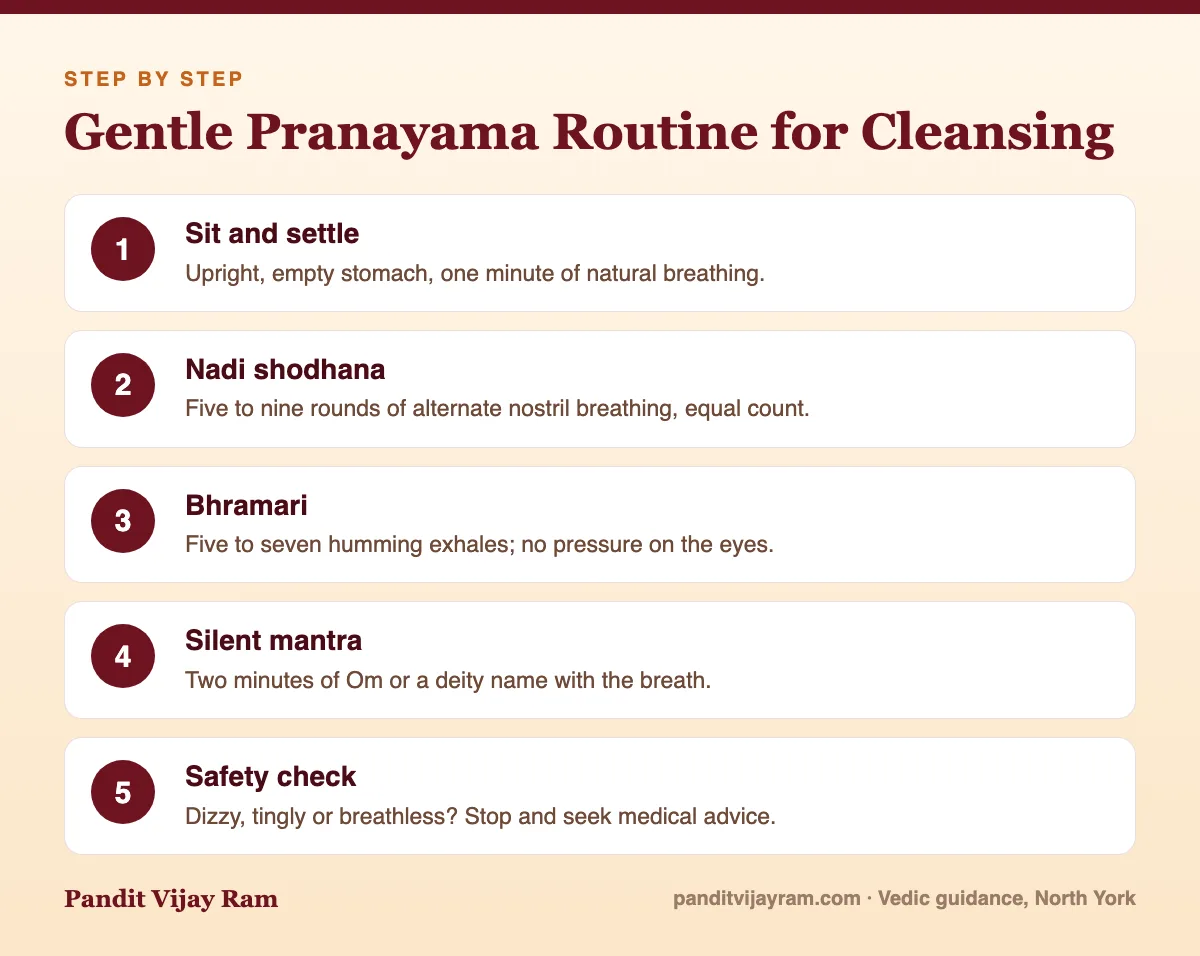
Nadi shodhana means channel cleaning. You close one nostril at a time with the right hand, breathing in through one side and out through the other. A beginner does five to nine rounds without holding the breath, keeping every inhale and exhale smooth, silent and comfortable rather than deep or forced.
Sit on a chair or cushion with your spine upright and shoulders soft. Many families face east or north, but comfort matters more than direction. Practise on an empty or light stomach.
- Form the hand position. Fold the index and middle fingers of the right hand into the palm. The thumb will close the right nostril and the ring finger the left. This is often called Vishnu mudra.
- Empty the lungs. Breathe out gently through both nostrils.
- Inhale left. Close the right nostril with the thumb and breathe in slowly through the left.
- Exhale right. Close the left with the ring finger, release the thumb, and breathe out through the right.
- Inhale right, exhale left. Breathe in through the right, switch, and breathe out through the left. That completes one round.
- Find a count. Begin with an equal count, perhaps four in and four out. After a few weeks, some teachers lengthen the exhale to six or eight.
- Finish quietly. Lower the hand, breathe normally through both nostrils, and sit for a minute before standing.
Breath retention, called kumbhaka, appears in advanced texts. I advise people not to add it from a video. Learn it in person from a qualified yoga teacher, and skip it entirely if you have heart, lung or blood pressure concerns.
If either nostril is blocked by a cold or allergy, do not force air through it. Practise bhramari instead until the passage clears.
What does bhramari humming bee breath do for the mind?
Bhramari is named after the black bee because you make a low humming sound as you breathe out. The vibration and the long exhale tend to quieten mental chatter. Traditionally it is used before meditation or mantra, and many people find it the gentlest breath practice for an anxious, crowded mind.
Sit comfortably and close your eyes. Breathe in through the nose without strain. Keep the lips lightly closed and the teeth slightly apart. As you breathe out, hum a steady mmm sound, like a bee, until the breath runs out naturally. Let the next inhale come on its own.
Some teachers add shanmukhi mudra, the six-gate seal. The thumbs press the small flap at the front of each ear, the index fingers rest lightly above the eyes, and the remaining fingers rest beside the nose and lips. Use only light pressure. Never press on the eyeballs.
Start with five to seven rounds. You may notice the sound feels loudest inside the skull, and the face and jaw soften. That inward focus is why bhramari is often paired with the closing prayers of a home cleansing, or used at night before the short routine in our guide to clearing energy before sleep.
Bhramari is quiet enough for an apartment or a shared room, which makes it practical for students and night-shift workers. It also suits people who cannot use incense or camphor because of asthma, smoke alarms or building rules.
Stop if you feel ear discomfort or pressure. People with an ear infection should rest from the practice until it has healed and their doctor is comfortable with it.
Is kapalbhati safe, and who should not do it?
Kapalbhati uses short, forceful exhales driven by the belly, with passive inhales. It is a cleansing kriya rather than gentle pranayama. People who are pregnant, have high blood pressure, heart disease, hernia, recent surgery, epilepsy or a history of panic should avoid it unless their doctor clearly approves.
Kapalbhati means skull shining. In hatha yoga it is listed among the shatkarmas, the six cleansing actions, which tells you it was meant to be learned under a teacher. Online it is often shown at high speed for many minutes. That version is where most problems start.
Avoid kapalbhati, or ask your doctor first, if any of these apply:
- Pregnancy, or the weeks after giving birth.
- High or poorly controlled blood pressure, heart disease, or a pacemaker.
- Hernia, recent abdominal or eye surgery, or glaucoma.
- Epilepsy or a history of seizures.
- Panic attacks, as fast breathing can trigger them.
- Menstruation, which many traditional teachers treat as a rest time for forceful kriyas.
If you are cleared to practise, keep it modest. Begin with a short set of perhaps twenty soft pumps, rest with normal breathing, and do no more than two or three sets. Stop at once if you feel dizzy, tingly, faint or short of breath. Those are signs of over-breathing, not of energy leaving you.
I mention this plainly because some people arrive believing a headache after kapalbhati was a sign that negativity was coming out. It was simply too much effort too fast. The safer path is nadi shodhana and bhramari, which give the same calm with far less risk.
When is breathwork not enough, and when should you see a doctor?
Breathwork supports calm, but it does not treat illness. If you have chest pain, ongoing breathlessness, fainting, frequent panic, or low mood lasting weeks, see your family doctor first. If you feel unsafe or have thoughts of self-harm, call or text 9-8-8, Canada's Suicide Crisis Helpline, at any hour.
Ordinary causes come first. Poor sleep, long screen hours, caffeine, dehydration, anaemia, thyroid changes and money stress can all create the heavy, foggy feeling people call negative energy. A doctor can check several of these with a simple visit. That step is not a lack of faith; it is good sense.
A simple decision rule helps:
- Feels a little better after a week of gentle practice: keep going, and add a lamp or short mantra if you like.
- No change after several weeks: look again at sleep, diet, work and relationships, and speak with your doctor.
- Symptoms worsen during practice: stop the breathing exercise and get medical advice.
- Physical causes are ruled out and the heaviness stays: a spiritual consultation may help you look at the chart and the home.
When people come to me for aura cleansing, I often begin by asking how they breathe, sleep and eat, before any ritual is planned. Breath practice then becomes part of their daily protection rather than a replacement for care. For people facing health worries alongside spiritual ones, the health and wellbeing guidance page explains how prayer can support, never replace, treatment.
A good yoga teacher, a doctor and a spiritual guide can work side by side. Each sees a different part of the picture.
The bottom line
Pranayama for energy cleansing works best as a gentle, daily discipline rather than a dramatic fix. Nadi shodhana and bhramari suit most people and can be learned safely at home. Kapalbhati and breath retention need caution and, for many, a doctor's approval first. Keep ordinary causes and medical care in view, and let the breath support your prayer and protection.
Key takeaways
- Pranayama steadies prana by slowing and balancing the breath.
- Nadi shodhana and bhramari are the gentlest starting practices.
- Kapalbhati is a forceful kriya and is unsuitable during pregnancy or with blood pressure or heart concerns.
- Dizziness or tingling means stop, not that negativity is leaving.
- Ongoing breathlessness, panic or low mood needs a family doctor first.