
Money Fights in Relationships: Budgets, Families and Fairness

One partner wants to save for a house. The other sends part of every pay cheque to parents in Punjab, Georgetown or Manila. Credit card statements arrive and the arguments start again. Money fights couples bring to me in North York are rarely about the numbers alone. They are about loyalty, security, respect and the families who shaped each partner's habits. For many immigrant households, the pull between building a life in Canada and supporting relatives abroad adds a layer that standard budgeting advice ignores. This guide looks at why couples argue about money, how remittances and family obligations can be discussed fairly, the main ways to structure joint and separate finances, how to hold a calm money talk, and when money conflict becomes control. In more than forty years of practice I have seen that couples who make a plan together fight less, even when money is tight. A shared plan turns blame into teamwork.
Why do couples fight about money so much?
Couples fight about money because it carries values and emotions: security, freedom, generosity, status and family loyalty. Partners often grew up with different habits, one saving carefully and the other spending freely. Stress from debt, job loss or high living costs turns those differences into conflict when there is no shared plan.
Underneath most money fights lie a few common sources:
- Different money stories. One partner grew up with scarcity and feels safe only with savings; the other grew up comfortable or chaotic and sees money as something to enjoy now.
- Unspoken expectations. Who pays for what, who manages the accounts, and how much spending needs discussion were never agreed.
- Family obligations. Support for parents and siblings, wedding contributions and festival gifts can be large and unpredictable.
- Income gaps. When one partner earns much more, fairness becomes a sensitive question.
- Secrecy. Hidden debt, a secret account or unexplained spending damages trust faster than the money itself.
- Stress. Housing costs in the GTA, job changes and inflation leave less room for error.
If debt is already causing anxiety or sleepless nights, start with our guide to debt and money stress remedies, which covers budgeting and non-profit credit counselling first. If money is one of many repeated arguments, why couples fight so much looks at the wider conflict cycle.

How do couples handle sending money home to family?
Treat family support as a planned budget line, not a private habit. Agree together on a monthly or yearly amount, discuss emergencies openly, and include both partners' families fairly. Transparency matters more than the exact amount. Hidden transfers, even with good intentions, usually cause more conflict than the money itself.
Sending money to relatives abroad is common in diaspora households and often deeply tied to duty and gratitude. It can also strain a marriage when one partner feels it happens without their say. Steps that help:
- Talk about expectations early. Before or soon after marriage, discuss who in each family may need support and why.
- Set a planned amount. Decide a regular figure that fits your budget, and review it a few times a year.
- Agree an emergency rule. For example, any unplanned transfer above an agreed amount is discussed first, except in a true crisis.
- Be fair to both families. If one side receives regular help, consider how the other side's needs or occasions are honoured.
- Use regulated transfer services and keep records. Be wary of relatives being pressured by scammers posing as officials.
- Say no kindly when needed. A joint answer, such as we've already sent this month's support, protects both partners.
Generosity to parents is a value worth honouring. It works best when it is shared, planned and visible to both partners. For settled couples facing these pressures, our guide to marriage problems for Indian couples in Canada covers related family expectations.
Should married couples have a joint account or separate finances?
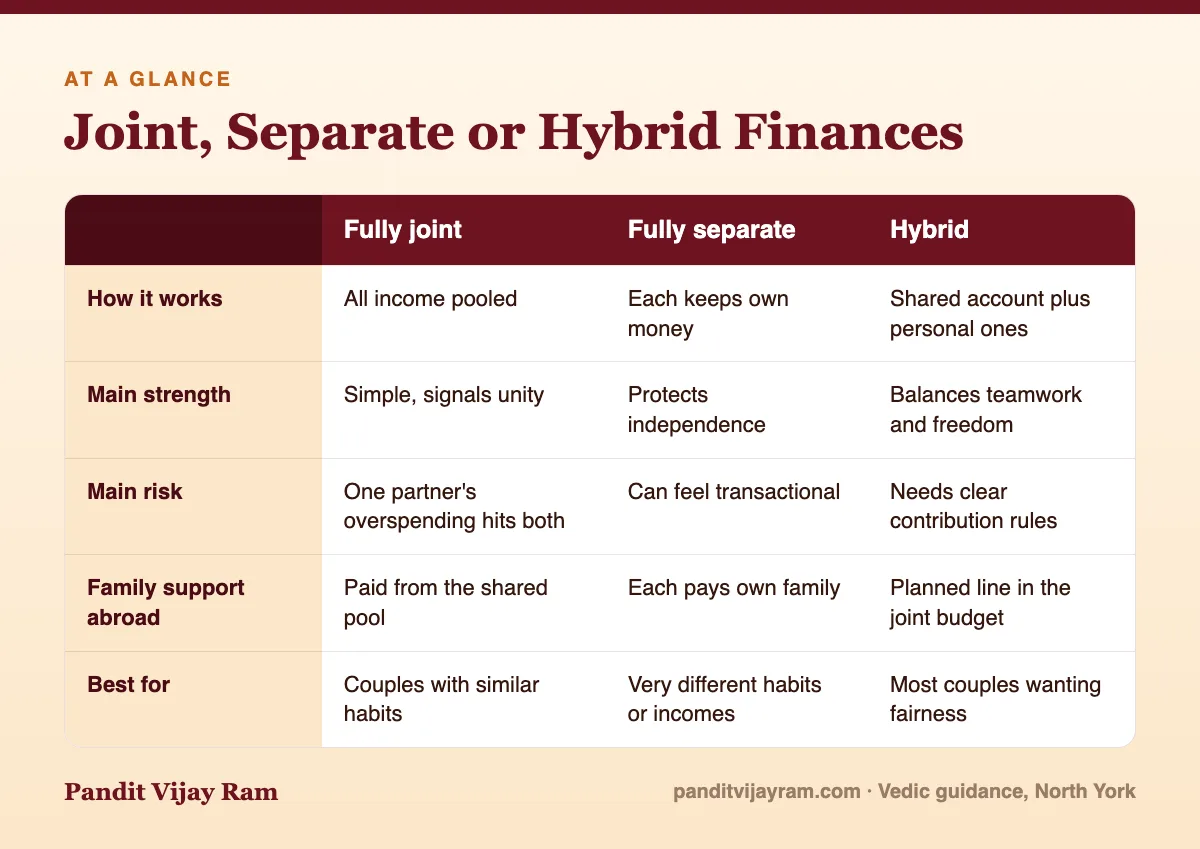
There is no single right answer. Many couples use a hybrid: a joint account for shared bills and goals, plus separate accounts for personal spending. Others pool everything or keep everything separate. What matters is that both partners understand the system, agree it is fair and can see the shared picture.
The three main approaches, with their strengths and risks:
- Fully joint. All income goes into shared accounts. It is simple and signals unity, but it can feel restrictive and leaves one partner exposed if the other overspends.
- Fully separate. Each keeps their own money and splits bills. It protects independence, but can feel transactional and may disadvantage a partner who earns less or stays home with children.
- Hybrid: yours, mine and ours. Both contribute to a joint account for rent, groceries, savings and family support, and keep personal accounts for individual spending. Many couples find this the fairest balance.
Splitting fairly does not always mean fifty-fifty. Some couples contribute in proportion to income, so each pays the same share of their pay. Unpaid work at home and caring for children or elders also count as contributions.
Whatever system you choose, both partners should know where the accounts are, have access to information about them, and have some money of their own. That protects both of you if illness, separation or a death in the family ever happens.
How do I talk to my partner about money without arguing?
Schedule a calm money meeting rather than arguing in the moment. Start with shared goals, review income and spending together, and agree on one or two changes. Use I statements, avoid blaming past purchases, and keep it short. Regular, brief meetings prevent the build-up that leads to explosive money fights.
A simple monthly money meeting might look like this:
- Goals first. Remind each other what you are working toward: a home, a wedding fund, paying off a card, supporting parents.
- Look at the numbers together. Income, fixed costs, family support, debt payments, and what is left.
- One improvement each. Each partner suggests one change, such as fewer takeaway meals or cancelling an unused subscription.
- Plan upcoming costs. Festivals, weddings, travel to visit family and gifts can be planned months in advance.
- End on something positive. Note progress, however small.
The Government of Canada's Financial Consumer Agency offers a free budget planner that many couples find helpful as a starting point.
If talks keep turning into the same fight, use the listening tools in our guide to communication problems in marriage. Some couples also benefit from a session with a non-profit credit counsellor or a fee-only financial planner, who can offer a neutral view.
When does money conflict become financial abuse?
Money conflict becomes financial abuse when one partner controls the other through money: taking their pay, blocking access to accounts, preventing work or study, running up debt in their name, or using money as punishment. It is a recognised form of abuse that often sits alongside other controlling behaviour and deserves support.
Disagreeing about spending is normal. These signs are not:
- Your partner takes your earnings or bank cards and gives you an allowance.
- You are not allowed to see bank statements, bills or tax documents.
- You are stopped from working, studying or keeping a job.
- Loans or credit cards are opened in your name without real consent.
- Money is withheld as punishment, or you must justify every small purchase.
- Your partner threatens to cut off support to your family abroad to control you.
Financial control is often one part of coercive control. Our guide to controlling partner signs explains the wider pattern and safety planning. Call 911 if you are in danger, and see the GTA domestic violence help guide for confidential support.
From a Vedic perspective, the second and eleventh houses are linked with wealth and gains, and a reading can show periods of financial strain. In a marriage problem consultation I may suggest prayers for steadiness, such as Lakshmi worship on Fridays, alongside a practical budget. Prayer supports patience; it never replaces a fair plan or professional advice.
The bottom line
Money fights couples have are usually about values, family duty and missing plans rather than numbers alone. Planning family support openly, choosing a fair joint, separate or hybrid system, and holding short regular money meetings reduce conflict. When money becomes a tool of control, it is financial abuse, and safety support comes first.
Key takeaways
- Money arguments carry values, family loyalty and fears about security.
- Family support abroad works best as a planned, shared budget line.
- A hybrid of joint and personal accounts suits many couples.
- Short monthly money meetings prevent build-up and blame.
- Controlling a partner through money is financial abuse, not a disagreement.