
Debt and Money Stress: Lakshmi Practices Alongside Real Planning

Debt has a way of filling every quiet moment. Bills arrive, phone calls go unanswered, and the worry follows people to bed. Many who come to me in North York ask for karz mukti, freedom from debt, hoping a mantra or puja will lift the weight. I understand that hope, and prayer has a place. But honest debt problems remedies begin elsewhere. This article starts with the practical steps that genuinely reduce debt in Canada: building a budget, talking to lenders, and getting free or low-cost help from non-profit credit counsellors and, where needed, licensed insolvency trustees. It explains how to avoid predatory offers that make things worse. Then it turns to the traditional spiritual practices, the Rin Mochan Mangal Stotra and Lakshmi worship, and how to use them as steady support rather than as a substitute for planning. Nothing here is financial advice, and no ritual promises a result. In more than forty years of practice, I have seen families climb out of serious debt. Every one of them did it with a plan, and prayer helped them stick to it.
What should you do first when debt feels overwhelming?
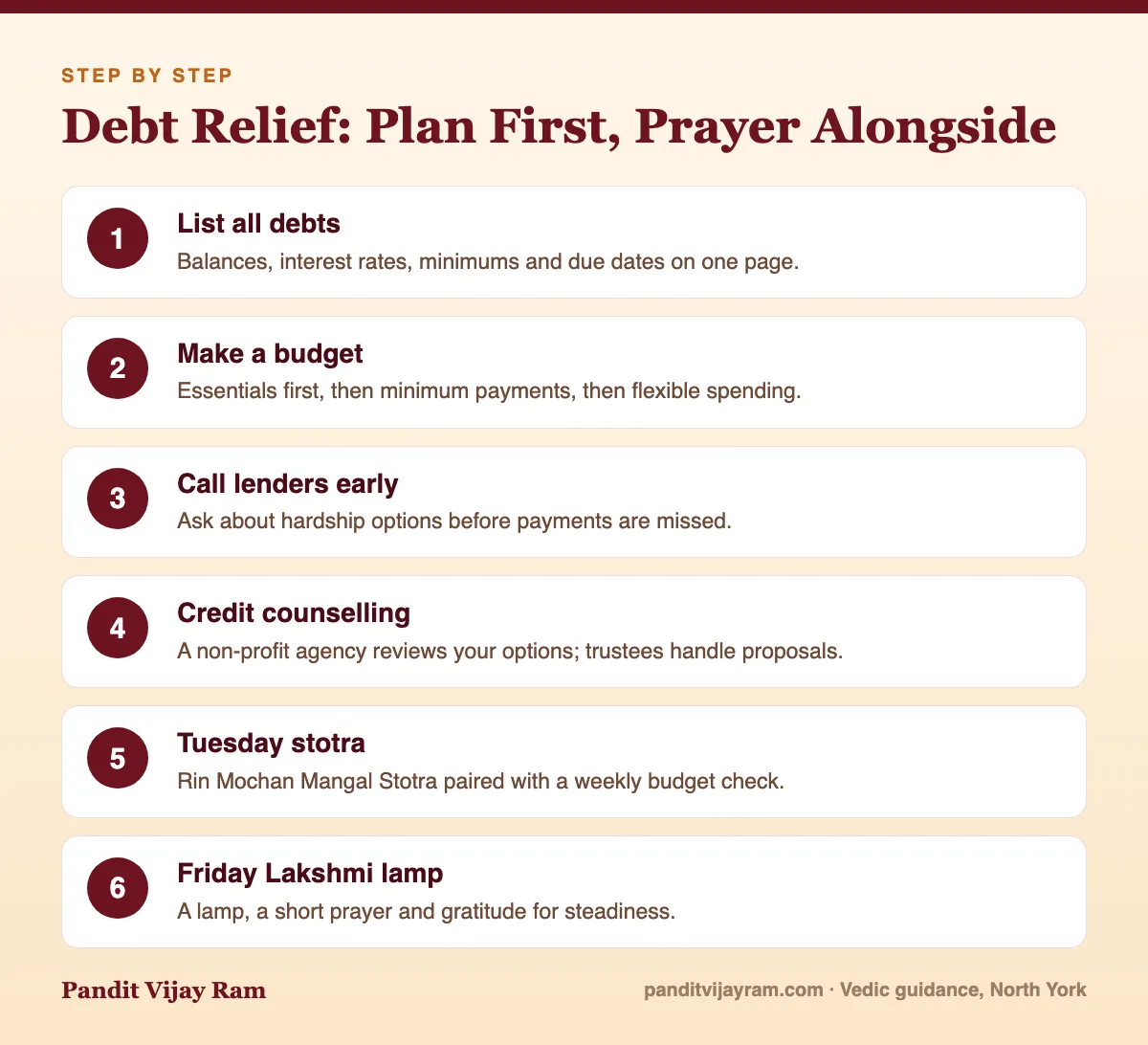
Start by writing down every debt, with its balance, interest rate, minimum payment and due date, alongside your monthly income and essential costs. Then contact lenders before payments are missed, and book an appointment with a non-profit credit counselling agency. Seeing the full picture on paper usually reduces panic and shows which steps matter most.
Fear makes people avoid opening envelopes. The first step is to face the numbers in a calm setting, ideally with a spouse or trusted family member.
- List every debt. Credit cards, lines of credit, car loans, student loans, tax owed, payday loans and informal family loans.
- Note the interest rate on each. High-interest debts usually cost the most over time.
- List income and essentials. Rent or mortgage, food, utilities, transport, insurance, childcare and medicine come first.
- Find the gap. Is there money left after essentials and minimum payments, or a shortfall?
- Call lenders early. Many lenders have hardship options, but they are easier to arrange before an account goes into collection.
- Book a credit counselling session. Non-profit agencies review your situation and explain options at little or no cost.
If debt follows a job loss, apply for Employment Insurance promptly; our guide to job loss and practical steps covers the first week.
If gambling is part of the picture, ConnexOntario offers free, confidential help with gambling problems. That help matters more than any remedy, and our article on why astrologers should not give trading or lottery tips explains why charts should never guide betting.

How do you make a budget to get out of debt?
Record all income and spending for a month, group spending into essentials, debt payments and flexible costs, then set limits for each group. Direct any extra money to the highest-interest debt first while keeping minimum payments on the rest. Review the budget weekly at first, because small adjustments made early keep a plan realistic.
The Financial Consumer Agency of Canada offers a free online budget planner, and many banks have similar tools. Pen and paper work just as well.
A simple structure:
- Essentials: housing, food, utilities, transport, insurance, childcare, medicine.
- Debt payments: at least the minimum on every account.
- Flexible spending: eating out, subscriptions, gifts, travel, shopping.
- A small buffer: even a modest emergency amount reduces the need to borrow again.
Two common repayment approaches:
- Highest interest first, sometimes called the avalanche method, usually saves the most money.
- Smallest balance first, the snowball method, gives quick wins that some people find motivating.
Cultural expectations can strain a budget. Weddings, festivals and gifts to relatives abroad are important in many families. It is not shameful to scale them to what you can afford.
Spiritual traditions have long taught restraint and contentment. In that sense a budget is not opposed to faith; it is a practical form of the same discipline. Our article on the money houses in a kundli makes the same point: charts never replace budgeting.
What does a non-profit credit counsellor do in Canada?
A non-profit credit counsellor reviews your income, spending and debts, helps you build a budget and explains your options. Where suitable, they may set up a debt management plan, negotiating with creditors so you make one monthly payment toward unsecured debts. For serious debt, they may refer you to a licensed insolvency trustee.
Credit counselling agencies are a sensible first stop when debt feels unmanageable. Many belong to Credit Counselling Canada, a national association of non-profit agencies.
What you can usually expect:
- A confidential review of your full financial picture.
- A practical budget and spending advice.
- An explanation of options such as debt management plans, consolidation and insolvency.
- Help talking to creditors in some situations.
For heavier debt, the options in Canada include a consumer proposal, a legal arrangement to repay part of what you owe, and bankruptcy. Both are administered only by licensed insolvency trustees, who are regulated federally by the Office of the Superintendent of Bankruptcy. Both have serious consequences for credit, so get proper advice first.
Watch for warning signs in companies that call themselves debt relief or debt settlement services:
- Large upfront fees before anything is done.
- Promises to erase debt quickly or stop all collection calls.
- Advice to stop paying creditors without explaining the consequences.
- Pressure to sign immediately.
If something feels wrong, check the company carefully, and report suspected fraud to the Canadian Anti-Fraud Centre. The same red flags appear in spiritual scams, as our guide to spotting spiritual scams explains.
What is the Rin Mochan Mangal Stotra and how is it recited?
Rin Mochan Mangal Stotra is a devotional hymn to Mangala, the planet Mars, traditionally recited for relief from debt. It lists the names of Mangala and asks for freedom from burdens. Families usually recite it on Tuesdays, after bathing, facing south or east, with a lamp and red flowers if available.
The stotra is widely attributed to the Skanda Purana, and the name means "hymn of Mars for release from debt". In Jyotish, the 6th house is linked with debts, disputes and illness, and Mars carries themes of effort, courage and property. The hymn's string of names for Mangala is recited as a prayer for strength to meet obligations.
A simple Tuesday practice:
- Bathe and sit in a clean place.
- Light a ghee or oil lamp, keeping it away from curtains and within sight.
- Offer red flowers or a little jaggery if you have them.
- Recite the stotra once, or several times if time allows, slowly and with attention.
- Close with a short prayer for wisdom in handling money.
Pronunciation is learnt best from a teacher or a careful recording. If Sanskrit feels difficult, reading a translation with sincere attention is still a meaningful prayer.
Many people pair Tuesday recitation with their budget review, so the prayer and the plan reinforce each other.
The hymn is not a financial tool. It cannot reduce a balance, stop interest or change a lender's decision. Its value is in steadiness and humility, which help people follow through on hard choices.
Which Lakshmi practices support financial discipline?
Traditional Lakshmi practices include lighting a lamp on Friday evenings, keeping the home and entrance clean, reciting Lakshmi mantras or the Shri Suktam, and giving in proportion to one's means. In Hindu thought, Lakshmi represents prosperity in a broad sense, including order, gratitude and wise use of wealth, not only money.
Lakshmi worship is often misunderstood as a request for windfalls. Classical teaching links her with orderliness, generosity, honesty and effort. Those qualities sit very comfortably beside a debt plan.
Practices families keep:
- Friday lamp. A ghee lamp at dusk, a short prayer and a moment of gratitude for what the household has.
- Clean entrance. Tradition holds that Lakshmi favours a clean, welcoming home. A tidy entrance also helps a stressed household feel more in control.
- Mantra. "Om Shreem Mahalakshmyai Namah" is a short, widely used Lakshmi mantra. Some families recite the Shri Suktam on Fridays.
- Respect for money. Keeping bills organised and wallets tidy is a traditional mark of respect for Lakshmi, and it happens to be good practice.
- Modest giving. Feeding birds, sharing food or small donations keep generosity alive without straining the budget.
For a full home method, see our guide to Lakshmi puja at home. Kubera is also worshipped for wealth; our article on the Kuber mantra and yantra discusses the tradition and warns against expensive "wealth yantras".
Be wary of anyone who says you must pay for an elaborate puja to clear your debt. Spending scarce money on such promises is the opposite of what Lakshmi practice teaches.
Can astrology or a puja remove debt?
No. Astrology and puja cannot remove debt, lower interest or change a creditor's decision. A chart may describe periods traditionally linked with financial strain, and prayer may help you stay calm and disciplined. Debt is reduced by budgeting, negotiation, professional advice and time. Anyone promising otherwise is making a claim no one can keep.
People in debt are especially vulnerable to promises. Some practitioners say a dosha or curse is blocking wealth and offer a costly ritual. That pattern adds debt rather than reducing it.
What a careful reading can honestly offer:
- A calm look at whether a dasha period is traditionally associated with financial pressure, which some people find helps them be patient.
- A simple remedy matched to the chart, such as a weekday mantra or modest charity, chosen so it costs little or nothing.
- Encouragement to keep the practical plan at the centre.
Emotional health matters too. Money stress is strongly linked with poor sleep, anxiety and conflict at home. If worry is affecting your health, talk to your family doctor. If you ever feel hopeless or think about harming yourself, call or text 9-8-8, Canada's Suicide Crisis Helpline.
If you would like a reading that respects these limits, Vijay Ram ji's kundli and horoscope service offers guidance without fear or pressure. The spiritual side should lighten your mind, never your wallet.
The bottom line
The most reliable debt problems remedies are practical ones: a written budget, early contact with lenders, and help from non-profit credit counsellors or licensed insolvency trustees. Avoid debt settlement offers that ask for large upfront fees or promise quick erasure. Spiritual practices such as the Rin Mochan Mangal Stotra on Tuesdays and Friday Lakshmi prayer can support calm and discipline, as long as they never replace the plan or cost money you need.
Key takeaways
- List every debt, interest rate and payment before deciding on any remedy.
- Non-profit credit counselling is a sensible first stop for unmanageable debt.
- Consumer proposals and bankruptcy in Canada are handled only by licensed insolvency trustees.
- Rin Mochan Mangal Stotra and Lakshmi practice support discipline; they do not clear debt.
- Avoid anyone, financial or spiritual, who demands upfront money and promises quick relief.