
The 2nd and 11th Houses: Money, Savings and Gains in a Chart
Money questions bring many people to an astrologer, often quietly and with some embarrassment. Why do savings never stick? Will income ever feel steady? Is something in the chart blocking prosperity? This article explains how 2nd house wealth and 11th house gains are actually read in a Vedic chart, for families in North York and across the diaspora. You will learn what each house signifies, how the two differ, which other houses join the money picture, what dhana yogas are and why they are over-promised, and a step-by-step way astrologers weigh it all. We will also be clear about the limits. In more than forty years of practice I have seen a chart describe a person's money habits with uncanny accuracy, yet I have never seen a chart pay a bill. A budget, a conversation with a non-profit credit counsellor, or a licensed financial adviser will do more for most money worries than any yoga. The chart is best used to understand yourself.
What does the 2nd house mean for wealth?
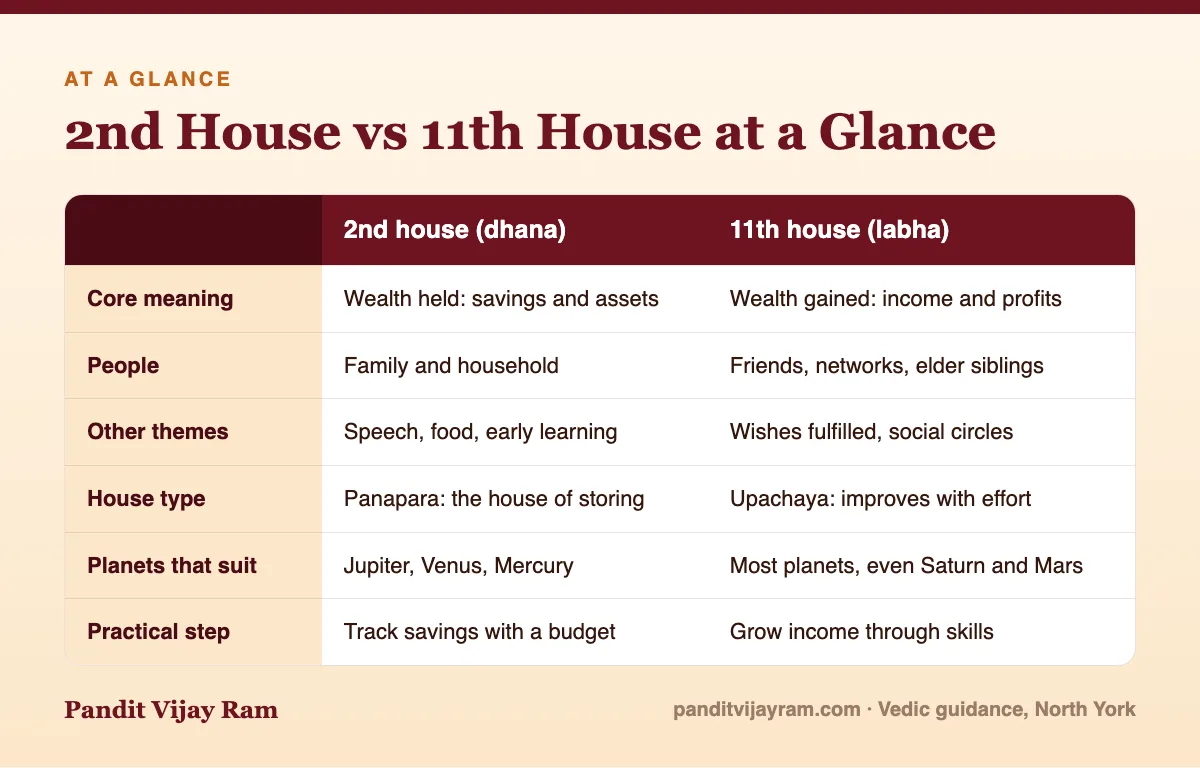
The 2nd house, dhana bhava, represents what you hold and keep: savings, family wealth, valuables, food, speech, the face and early upbringing. It is read as the store of resources rather than the flow of income. Its sign, occupants, lord and aspects describe how a person accumulates, values and protects money and possessions.
The 2nd house sits right after the lagna, the self. Traditional writers saw it as what the self gathers around it: family, food on the table, the voice used to ask for things, and the wealth put aside. Its main themes are:
- Accumulated wealth: savings, deposits, gold and jewellery, family assets.
- Kutumba, the family: the household you grew up in and the resources it shared.
- Speech: how you speak, including honesty and persuasion; important for sales, teaching and law.
- Food and values: eating habits and what you consider worth keeping.
- Early education: the learning given at home before formal schooling.
These meanings connect. Many people with a well-supported 2nd house describe families that saved carefully, spoke frankly about money and passed on practical habits. An afflicted 2nd can show, among other things, irregular saving, family disagreements about money, or impulsive spending on food and comfort.
Jupiter is the natural significator of wealth, dhana karaka, and its condition is checked alongside the 2nd. Venus adds comfort and luxury goods; Mercury, trade and accounts.
For where the 2nd fits in the wider chart, our guide to the twelve houses gives one-line meanings for each.

What does the 11th house show about income and gains?
The 11th house, labha bhava, is the house of gains: income, profits, returns on effort, elder siblings, friends, networks and fulfilment of wishes. It is an upachaya house, so its results tend to improve with age and effort. Almost any planet placed there is traditionally said to bring some kind of gain.
If the 2nd is the reservoir, the 11th is the river feeding it. It describes what flows in.
- Income and profits: salary increases, business returns, bonuses.
- Networks: friends, colleagues, professional associations, clubs.
- Elder siblings: and older friends who help or influence you.
- Wishes fulfilled: classical texts call it the house of desires realised.
The 11th is also the 2nd from the 10th, meaning it is the accumulation from your career. That is why many readers look at the 10th and 11th together for earned income.
Because it is an upachaya, like the 3rd, 6th and 10th, even natural malefics such as Saturn, Mars and Rahu tend to do well there, giving persistence or ambition in pursuit of gains. Saturn in the 11th is often seen in people whose income rises slowly but reliably.
There is a caution in classical texts too. The 11th is the 6th from the 6th, and some writers link a heavily afflicted 11th to gains that come with friction, or to desires that keep growing. That is a reminder that more income is not always more peace.
Our post on the 10th house and career covers the source of earnings in more depth.
What is dhana yoga in a kundli?
Dhana yoga is a family of combinations that link the wealth houses. Most definitions involve the lords of the 1st, 2nd, 5th, 9th and 11th connecting by conjunction, mutual aspect or exchange. Like raj yoga, it is common in some form, so its strength, placement and dasha activation matter far more than its presence.
The logic is straightforward. The 2nd and 11th are the houses of holding and gaining. The 5th and 9th are trikonas of merit and fortune. The 1st is the person. When their lords combine, the chart suggests a capacity to earn and keep.
Some commonly cited forms:
- 2nd and 11th lords together, or exchanging signs.
- The 5th or 9th lord with the 2nd or 11th lord.
- Jupiter strong and connected to the 2nd or 11th.
- Lagna lord linked to the 2nd or 11th lord, tying wealth to personal effort.
Named variants circulate widely: Lakshmi yoga, Kubera yoga and more. Some are classical; some seem to have been named online. Our article on what raj yoga really means explains why yoga labels are so often over-promised, and the same caution applies here.
What weakens a dhana yoga: debilitation or combustion of the planets involved, placement in the 6th, 8th or 12th, strong links to the 12th lord of expense, or a period sequence that never activates it.
Even a strong dhana yoga describes potential, not a bank balance. Wealth still depends on income choices, spending habits, debt, health, family obligations and the economy. If you are tempted to use a 'good yoga' as a reason to take a financial risk, please speak with a licensed adviser first.
How do astrologers read wealth in a birth chart?
Astrologers read wealth by combining several houses: the 2nd for savings, the 11th for gains, the 10th for earned income, the 5th and 9th for fortune, the 4th for property, the 8th for joint and inherited money, and the 12th for expenses. Their lords, Jupiter's strength and the running dasha complete the picture.
A step-by-step method that many practitioners follow:
- Check the 2nd house and lord. Is the lord strong by sign, well placed, free of combustion?
- Check the 11th house and lord. Same questions. Planets in the 11th add sources of gain.
- Look for links between the 2nd, 11th, 5th, 9th and lagna lords: the dhana yoga test.
- Weigh the 12th. A strong 12th lord linked to the 2nd can describe heavy spending, generosity or money sent abroad, which is common in diaspora families supporting relatives.
- Look at the 8th. Joint finances, inheritance, insurance and sudden changes.
- Assess Jupiter. As dhana karaka, its dignity colours the whole picture.
- Map the dashas. Periods of planets linked to the 2nd and 11th are when money themes are most active, for better or worse.
Some readers add the D2 hora chart for wealth, though many consider it a blunt tool with only two divisions per sign. Others use the 2nd and 11th from the Moon as well as from the lagna.
The most useful output is usually a description of habits: whether you are a natural saver or spender, whether gains come through networks or solo effort, and when pressure is more likely. That can be genuinely helpful for self-understanding. A kundli consultation works through these steps for one chart.
Can a chart replace financial planning?
No. A chart can describe tendencies and timing, but it cannot manage cash flow, reduce debt or choose investments. Start with a written budget, use free government tools for money management, and for debt speak with a non-profit credit counselling agency. Use astrology afterwards, for reflection and steady spiritual practice, not for financial decisions.
Practical steps before any remedy:
- Write a budget. The Financial Consumer Agency of Canada offers free budget planners and guidance on debt.
- Get help with debt early. Non-profit credit counselling agencies can review options confidentially.
- Use licensed professionals. For investments, taxes or major purchases, a licensed adviser or accountant, not a chart.
- Be wary of wealth promises. Nobody can promise money through a ritual, stone or yantra. Our article on Kuber mantra and yantra claims discusses this honestly.
- Never use astrology for trading or lotteries. See our position on why we give no market tips. If gambling has become a problem, ConnexOntario offers free, confidential help.
Once the practical side is in place, spiritual practice can support steadiness and gratitude. Many families keep a simple Friday Lakshmi prayer or give a small, regular amount to charity, which traditional texts link to the 2nd and 11th houses. Our guide to money stress and gentle remedies pairs these with practical steps.
Astrology here is spiritual guidance and a matter of personal faith. It is not financial advice.
The bottom line
Reading 2nd house wealth means looking at what you hold and keep, while the 11th shows what flows in through effort and networks. Dhana yogas link these houses with the 1st, 5th and 9th, but they are common and only describe potential, activated by dasha. A chart is best for understanding money habits; budgeting, credit counselling and licensed advice come first for any real financial decision.
Key takeaways
- The 2nd house, dhana bhava, governs savings, family resources, food and speech.
- The 11th house, labha bhava, governs income, gains, networks and elder siblings.
- Dhana yogas link the lords of the 1st, 2nd, 5th, 9th and 11th and are fairly common.
- The 12th, 8th, 10th and Jupiter also shape how money is read in a chart.
- A budget and qualified advice come before any astrological remedy for money worries.