
Marriage Problems in the Indian Community in Canada

Newcomer couples are often warned about the first hard years in Canada. Fewer people talk about what happens ten or twenty years later. The house is bought, the children are in school, the parents have arrived, and somehow the marriage feels thinner than ever. When people search "Indian couples Canada marriage problems", many are settled families or Canadian-born partners, not new arrivals. I meet them often in North York and across the GTA. This guide looks at the pressures that build once a family is established: in-laws in the same house, the strain of caring for parents and children together, careers and mortgages, and the very different expectations a second-generation partner may bring. You will also find where to get help without feeling ashamed. In more than forty years of practice I have learned that the problems settled couples describe are rarely about falling out of love. They are about two people who stopped having time for each other while doing everything else right.
What marriage problems are common for settled Indian couples in Canada?
The most common are exhaustion and distance rather than dramatic fights. Long commutes, shift work and high housing costs leave little time together. Add children's activities, temple or gurdwara commitments and care for parents, and couples drift into living as business partners. Unspoken resentment about who carries more often follows.
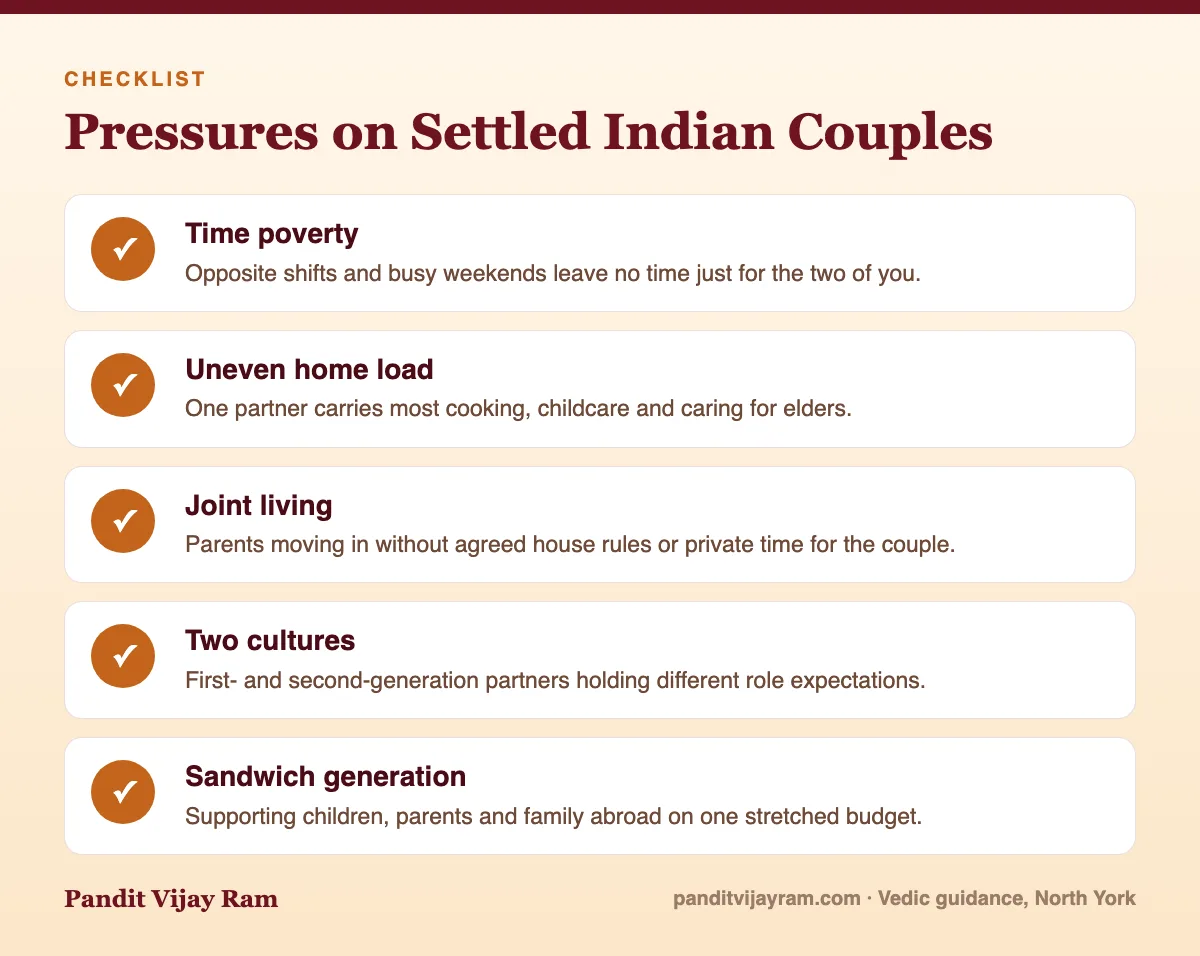
The issues I hear from established families tend to cluster:
- Time poverty. Both partners work, often at opposite hours. Weekends fill with errands and family events.
- Uneven load at home. One partner, usually the wife, carries most of the cooking, childcare and caring for elders, even when both earn.
- Comparison. Community gatherings can turn into quiet contests about houses, cars and children's marks.
- Loneliness inside the marriage. Couples talk only about logistics and stop sharing feelings.
- Old wounds. Hurts from the early immigrant years, never discussed, resurface later.
These are different from the arrival-stage pressures described in our guide to marriage problems after immigrating to Canada, which focuses on newcomers. Settled couples usually have more stability but less energy, and they assume the hard part is over.
A useful first step is a weekly half-hour that belongs only to the two of you. No phones, no children, no planning. Just tea and a real question: what was hardest for you this week?

How is marriage different for second-generation Indian Canadians?
Second-generation partners often expect an equal, companionate marriage with shared chores and open emotional talk, while also honouring parents. Tension arises when one partner, or the families, hold more traditional role expectations. Marrying someone raised in India can add a gap in habits, gender roles and ideas about privacy that both sides need to discuss openly.
Children of immigrants grow up translating between two worlds. At home, respect may mean silence. At school and work, it may mean speaking up. Many carry both codes into marriage.
Common friction points:
- Whose parents get priority at festivals, weekends and holidays.
- How much say parents have in buying a home, naming a child or choosing a school.
- Whether household work is shared equally or assigned by gender.
- How openly to discuss emotions, mental health or intimacy.
When a Canadian-raised partner marries someone who grew up in India, the gap can be wider than either expected. One may value independence; the other may see close family involvement as love. Neither view is wrong. Our article on cultural differences in a relationship looks at these first- and second-generation clashes in more depth.
What helps is naming the expectation instead of fighting over each incident. Saying "I grew up thinking a husband does not cook" turns a battle into a conversation you can actually have.
Why do in-laws and joint living strain Indian marriages in Canada?
Many couples sponsor parents or welcome them for long stays, often for childcare help. The support is real, but so is the loss of privacy and decision-making space. Strain grows when one spouse feels outnumbered, when parents correct parenting or cooking, or when the couple never agreed on house rules before the move.
Joint living can be a blessing. Grandparents pass on language, prayer and stories. Children grow up surrounded by love. Yet the same arrangement can quietly push a marriage aside.
Steps that tend to help:
- Agree before parents arrive. Discuss length of stay, rooms, cooking, childcare and money.
- Each partner handles their own parents. A spouse raising a concern with their own mother or father is usually heard more easily.
- Protect private time. A closed bedroom door or a regular walk together is not disrespect.
- Back each other in public. Disagree privately, not in front of relatives.
Newly married partners stepping into an existing household face a particular adjustment, covered in our guide to adjusting to a new family after marriage. Here the concern is long-established couples whose parents move in later.
If relatives are pressuring a spouse with insults, demands for money or gifts, or threats, that is not a normal in-law conflict. It deserves outside help, and the safety section below explains where to start.
How do money and the sandwich generation affect Indian couples?
Many Indian Canadian couples are in the sandwich generation, supporting children while caring for ageing parents, sometimes in two countries. Mortgage costs, remittances, tuition and medical help for parents stretch budgets. Conflict often arises over whose family receives support and whether decisions were made together. Clear, shared money plans reduce resentment.
The phrase sandwich generation describes adults caught between the needs of children and parents. In the GTA this often comes with a large mortgage and two demanding jobs.
Money questions that settled couples benefit from revisiting:
- How much do we send to family in India, and does each of us agree?
- Who pays for parents' care, travel or health costs here?
- Are we saving for our own retirement, not only for others?
- Do both partners know the accounts, passwords and debts?
Secret loans to relatives, hidden credit card debt or one spouse being kept out of financial decisions break trust quickly. Our guide to money fights in couples covers remittances and joint finances in detail.
For neutral budgeting help, a non-profit credit counsellor is a good start. Vijay Ram ji does not give financial advice. In a consultation he may look at the planetary periods behind a stressful phase and suggest a prayer routine for patience, but practical planning belongs with the right professionals.
Where can Indian couples in Canada get help without shame?
Registered couples therapists, workplace employee assistance programs and community family-service agencies all support Indian families, often in Hindi, Punjabi, Gujarati or other languages. Legal Aid Ontario and family law information centres help if separation is being considered. Abuse calls for safety planning and police. Spiritual guidance can sit alongside these supports.
Shame keeps many couples away from help. Families fear gossip, or believe that counselling means the marriage has failed. In my experience, couples who reach out early usually have more choices.
- Counselling. Our guide to relationship counselling in Toronto explains how to check a therapist's registration and use an EAP.
- Legal information. If one of you is thinking about separation, read our guide to legal aid for family matters in the GTA before signing anything.
- Safety. Hitting, threats, controlling money or passports, or pressure over dowry are serious. See domestic violence help in the GTA and call 911 in an emergency.
- Mental health. If low mood lasts weeks, see your family doctor. In crisis, call or text 988.
For couples who also want a spiritual perspective, Vijay Ram ji's marriage problem guidance offers kundli insight and prayer for the harmony both partners want. He does not promise outcomes and will always encourage you to keep using practical help too.
The bottom line
Indian couples in Canada often face marriage problems that build quietly after settling: time pressure, joint living, second-generation expectations and the weight of supporting two generations. Naming expectations, agreeing house and money rules, and protecting time together prevent much of the strain. When it is heavier than that, counselling, legal information and safety services are there, and spiritual guidance can stand beside them.
Key takeaways
- Settled couples struggle more with exhaustion and distance than with dramatic fights.
- Second-generation partners often expect equal roles while still honouring parents.
- Agree house rules before parents move in, and let each partner speak to their own parents.
- Money plans covering remittances, elder care and retirement reduce resentment.
- Counselling, legal aid and safety services can be used without shame.