
Devotional Mantras for a Heavy Heart After a Breakup

The nights after a breakup can be the loudest. The mind replays every conversation, the phone feels heavy in the hand, and prayer may be the only thing that feels steady. Many people search for a mantra for lost love hoping for words that will return someone. Clients in North York and across the GTA have asked me for exactly that, often in tears. I tell them the same thing each time, as kindly as I can: a mantra cannot move another person's heart, and it should never be used to try. What it can do is give your own heart somewhere to rest. This guide explains which devotional mantras suit grief and heartbreak, what they mean, how to chant them in a simple daily routine, and how to tell when you need more than prayer. In more than forty years of practice I have found that the people who heal best are those who stop chanting at the person they lost and start chanting for the person they are becoming.
Is there a mantra for lost love that brings someone back?
No genuine Vedic mantra is meant to override another person's choice, and any practitioner who promises one is selling something. The devotional tradition treats mantra as a way to purify and steady your own mind. After a breakup, that means mantras for acceptance, courage and peace, with the other person's freedom left fully intact.
Online lists of mantras to make an ex return usually borrow fragments from tantric texts, remove their context and attach invented promises. The article on why copied vashikaran mantras mislead explains how these lists feed scam funnels.
There is also a spiritual reason to stop. Chanting with the aim of bending someone's will keeps your attention fixed on them, which deepens the wound you are trying to heal. In the Gita's language, it ties you more tightly to the fruit of the action instead of the action itself.
So I ask clients to change the question. Not which mantra brings them back, but which mantra helps me sleep, stop checking my phone and act with dignity. That question has real answers, and the rest of this guide is about them.
If you hope to reconcile, the respectful route is honest contact when it is welcome, counselling and patience, not ritual pressure. Vijay Ram ji's love problem guidance works on that basis, with a reading of your own chart and practical advice rather than any attempt to control the other person.

Which mantras help with heartbreak and grief?
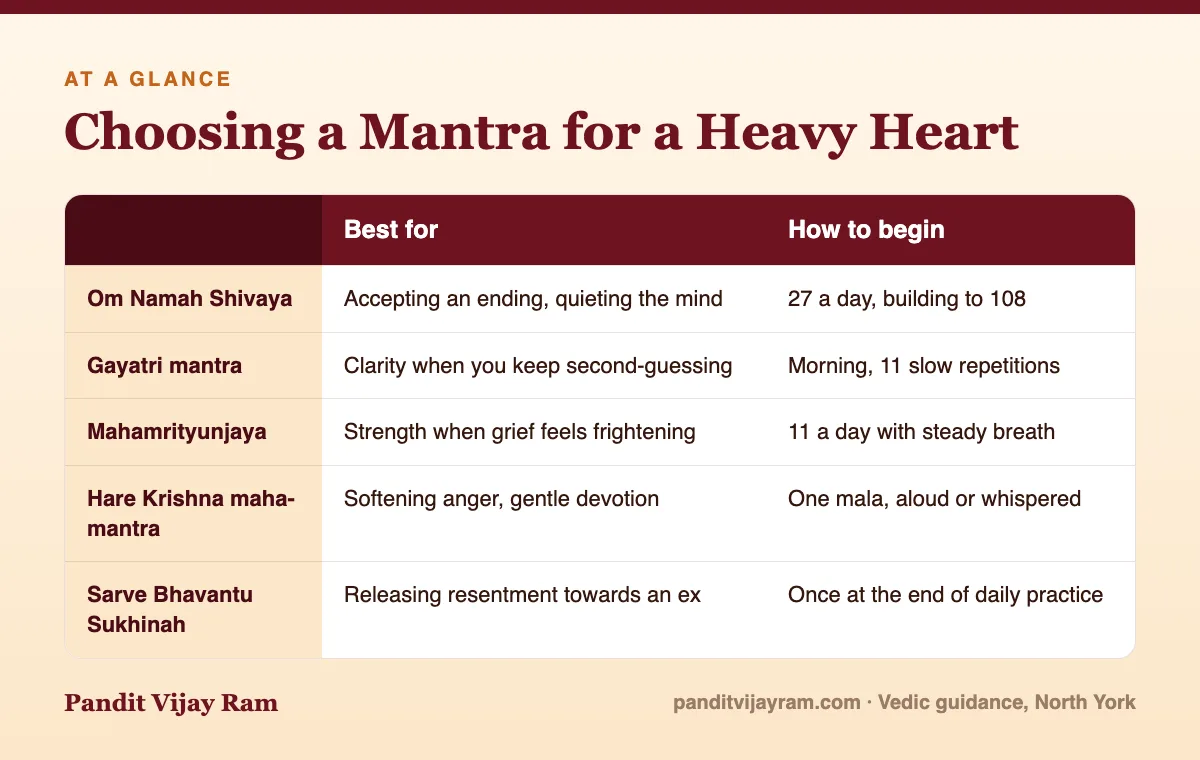
Om Namah Shivaya is the mantra most often given for heartbreak, because Shiva is worshipped as the one who absorbs pain and endings. The Gayatri mantra is chosen for clarity, the Mahamrityunjaya for strength in fear and grief, and the Hare Krishna maha-mantra for gentle devotion. Choose one and stay with it.
Here is a short guide to matching a mantra with what your heart needs most:
- Om Namah Shivaya, the five-syllable Panchakshara. For accepting an ending and letting the mind grow quiet. Simple to learn and suitable for anyone.
- The Gayatri mantra, from the Rig Veda, addressed to the light of Savitr. For clear thinking when you keep second-guessing yourself.
- The Mahamrityunjaya mantra, also from the Rig Veda, addressed to Shiva as Tryambaka. For strength when grief feels frightening or physical.
- Hare Krishna, Hare Rama, the maha-mantra of the Vaishnava tradition. For softness and devotion when anger at the other person is strong.
- Om Shanti, Shanti, Shanti. A brief peace invocation for moments of panic, at work or on the bus.
- The Hanuman Chalisa. For courage and routine when you need to get up and keep going.
Pick one as your main practice for at least forty days. Changing mantras every few days usually reflects restlessness, not progress. If you already have a family deity or a mantra given by a teacher, that remains your first choice. The wave-one guide to protective mantras for heavy energy covers others that some families use.
What does Om Namah Shivaya mean for someone grieving a relationship?
Om Namah Shivaya means a bow or surrender to Shiva, the auspicious one. For someone grieving a relationship, it carries a story: Shiva himself mourned the loss of Sati, withdrew into deep meditation, and was later reunited with her in a new form as Parvati, through her own long tapas rather than his pursuit.
The Puranic story is worth knowing because it does not deny grief. After Sati gave up her life at her father Daksha's sacrifice, Shiva carried her body across the world in sorrow. Only when the grief had run its course did he sit in stillness. Many devotees take comfort in a god who grieved openly.
Notice also what happened next. The reunion came when Parvati chose to seek Shiva through her own devotion and discipline. Nobody was compelled. In this sense the story is a model of love that is freely given on both sides.
When you chant namah, you are practising a small surrender: of the need to control the outcome, of the replaying, of the urge to send one more message. You are not giving up on love. You are giving up on forcing it.
For daily practice the meaning matters more than flawless Sanskrit. Say the syllables clearly and slowly. If you would like help with pronunciation, ask at your local mandir or listen to a recording by a trained priest before you begin. Over time the words become a refuge you can return to at any hour.
How do you chant a mantra for peace after a breakup?
Sit at the same time each day, ideally early morning or before sleep, light a lamp if it is safe, and set a sincere intention for your own peace. Chant slowly, aloud, in a whisper or silently, counting on a mala. Start with 11 or 27 repetitions and build towards one full round of 108.
A simple routine that fits a working day:
- Prepare the space. A clean corner, a small image or no image at all, a lamp or candle kept away from curtains and never left burning when you leave.
- Sit and breathe. Five slow breaths before you begin, letting the out-breath be longer than the in-breath.
- State your intention. Something like: may I find peace and act with kindness, towards myself and towards the person I loved.
- Chant. Tradition names three ways: vachika, spoken aloud; upamshu, a whisper; and manasika, silent. Aloud is easiest when the mind races.
- Count with a mala. Move one bead per repetition. A rudraksha or tulsi mala is traditional, but any string of 108 beads works.
- Close gently. Sit quietly for a minute, then write down one thing you will do differently today.
Keep the phone in another room. Many people find that the urge to check it comes most strongly right after chanting, so give yourself ten quiet minutes. The routine pairs well with the prompts in journaling and prayer after a breakup.
Can I pray for my ex's happiness without wanting them back?
Yes, and it is one of the most healing practices after a breakup. Praying for someone's wellbeing without attaching a condition is close to the Vedic ideal of desireless action. The widely recited prayer Sarve Bhavantu Sukhinah, may all beings be happy, lets you include your former partner without asking anything of them.
Many clients are surprised when I suggest this. They expect it to hurt. In practice it often brings relief, because resentment is heavy to carry, and praying for someone's good is one way to set it down.
The full prayer asks that all beings be happy, all be free from illness, all see what is good, and none suffer. You can recite it once at the end of your daily mantra and, if it feels right, hold your former partner in mind as one of those beings. You are not sending them a message. You are releasing a knot in yourself.
This is different from praying for a reunion. If you notice yourself adding a hidden request, such as may they be happy, with me, gently drop the addition and say the prayer as it stands.
Some people are not ready for this, especially after betrayal or cruelty. That is fine. Begin by praying for your own healing and for the people who supported you. Forgiveness grows in its own time, and the guide to forgiving an ex discusses it as a release for you rather than a duty owed to them.
When is mantra not enough after a breakup?
Mantra supports emotional healing but does not replace medical or psychological care. If sadness lasts for weeks, sleep or appetite change sharply, you stop functioning at work, or you think about harming yourself, see your family doctor. In a crisis in Canada, call or text 9-8-8 at any hour of the day or night.
Grief after a breakup is normal and can be intense. Signs that it has become something more include:
- low mood most of the day, most days, for more than two weeks;
- losing interest in things you used to enjoy;
- sleeping far more or far less than usual, or eating very differently;
- drinking or using substances to get through the evening;
- thoughts that life is not worth living.
None of these mean your faith has failed. They mean your body and mind need care, and a doctor or counsellor is part of that care. The guide to depression after a breakup describes the signs in more detail, and the South Asian mental health guide for the GTA lists culturally aware support.
It is also worth asking whether the relationship ended in fear. If you were threatened, controlled or followed, your safety comes before any prayer. Speak with the police or a domestic-violence service. Mantra can sit alongside all of this support, never in place of it.
The bottom line
A mantra for lost love, used rightly, is a prayer for your own heart, not a lever on someone else's. Om Namah Shivaya, the Gayatri, the Mahamrityunjaya and the maha-mantra each suit a different part of grief, and steady daily practice matters more than numbers. Praying for a former partner's happiness without conditions can release resentment. When sadness turns into something heavier, a doctor, a counsellor or 9-8-8 belongs beside your practice.
Key takeaways
- No genuine mantra is meant to override another person's choice.
- Om Namah Shivaya is the mantra most often given for acceptance after an ending.
- One mantra kept steadily for forty days helps more than switching every week.
- Praying for a former partner's wellbeing without conditions can ease resentment.
- Persistent low mood needs a family doctor; in crisis, call or text 9-8-8.