
Spiritual Healing After a Breakup: A Gentle Forty-Day Routine

A single cleansing on the night of a breakup can bring relief, but heartache rarely leaves in one evening. Spiritual healing after breakup pain usually needs something slower: a daily rhythm that holds you while the grief moves through. Many people in North York ask me for exactly that, a practice they can do at home, without expense, that fits around work and family. This guide offers a gentle forty-day routine. You will see why forty days is a traditional length for a vow, what to do each morning and evening, how the practice shifts across four ten-day phases, what to do if you miss a day or feel worse, and how to close the forty days with gratitude. Nothing here asks you to influence your former partner or to forget them by force. In more than forty years of guiding people through loss, I have seen that the heart heals best when it is given steady attention, kind routines and the company of the divine, one ordinary day at a time.
What is spiritual healing after a breakup?
Spiritual healing after a breakup means using prayer, mantra, breath and reflection to steady your mind, grieve honestly and rebuild your sense of self. It works alongside friends, sleep and, where needed, medical care. Its focus is your own peace and growth, not changing your ex's feelings or choices.
A breakup touches every layer of life: sleep, appetite, confidence, friendships, faith. Spiritual practice gives the inner layer some care. It offers a place to bring the pain each day, a sense that you are held by something larger, and quiet moments in which clarity can grow.
This routine differs from two related practices on the site:
- A one-time reset on the first night, described in clearing heavy energy after a breakup, is for immediate relief.
- A focused release of emotional ties, described in cord cutting after a past relationship, is a single ritual you can fold into this routine.
The forty-day practice is the slow, steady work in between. It asks for about twenty minutes a day, a small lamp, a mala if you have one, and a notebook. It suits people of any tradition; you can replace the Vedic mantras with prayers from your own faith.
It is not therapy and not medicine. Think of it as daily care for the spirit, the same way a walk is daily care for the body.
Why follow a forty-day routine for healing?
Forty days is a traditional length for a vow or spiritual discipline in several traditions, and it is long enough for a daily habit to take root. It gives grief a container with a beginning and an end, so you are not asked to feel better overnight.
The number forty appears in many traditions connected with this site's readers. The Hanuman Chalisa takes its name from its forty verses. Many South Asian families observe a forty-day rest after childbirth. Sufi practice knows the chilla, a forty-day retreat of prayer. Lent lasts forty days in Christianity, and many South Asian Muslim families mark a chehlum forty days after a death. South Indian temple practice often uses a mandala of around forty-one to forty-eight days for a vow.
There is a practical side too. Repeating a small action every day for several weeks makes it feel natural rather than forced. By the end, you have a habit that can stay with you after the forty days are finished.
A fixed period also helps with grief. Heartbreak can feel endless. A routine that says, "for these forty days I will care for myself in these simple ways" gives the mind something it can hold. It does not promise that the pain will be gone on day forty. It promises that you will have shown up for yourself forty times.
If forty feels too long, start with eleven or twenty-one days and extend. The spirit of the vow matters more than the count.
What does the daily spiritual healing practice look like?
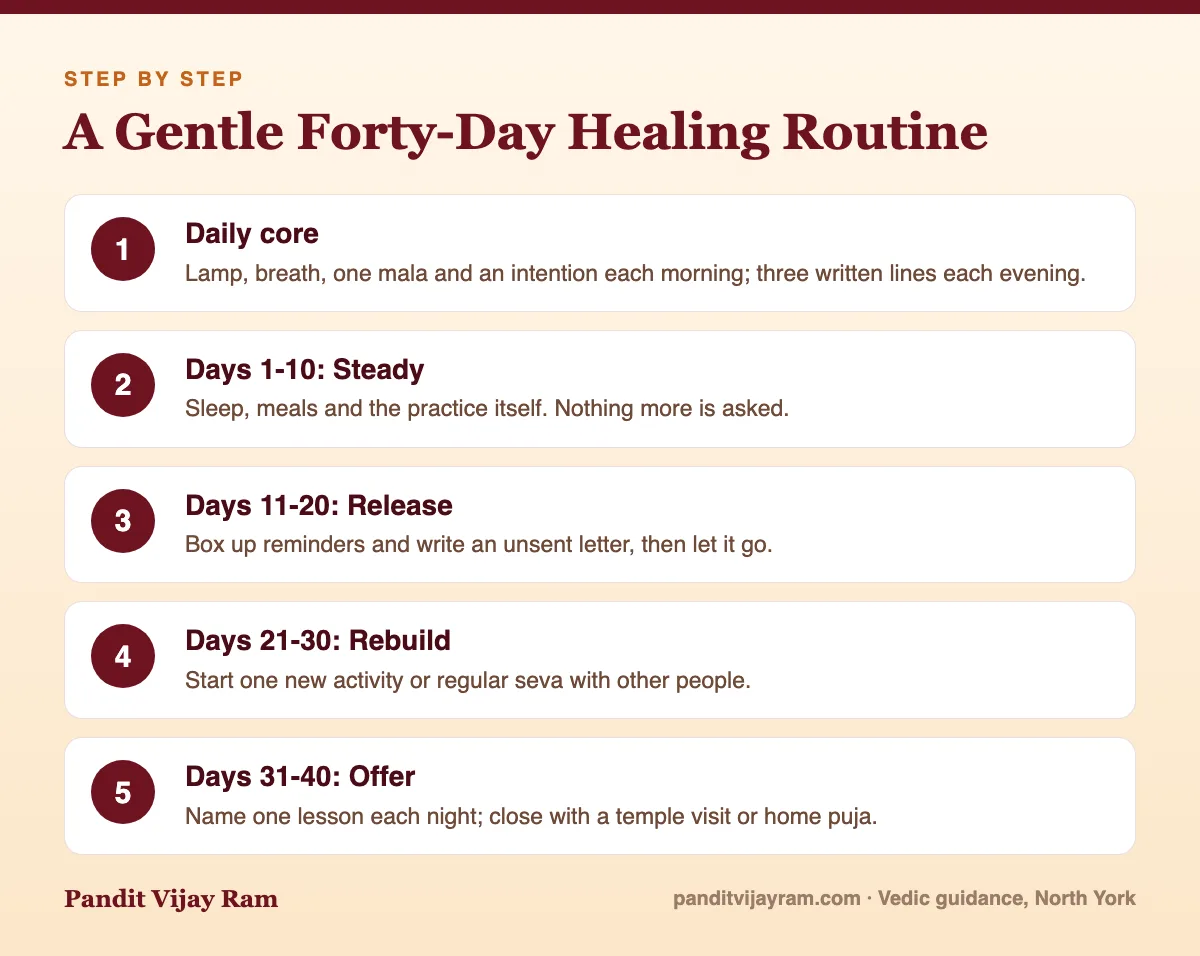
Each day has a short morning practice and a short evening practice. In the morning you wash, light a lamp, breathe slowly, chant one mala and set an intention for your own peace. In the evening you write a few lines, offer thanks and prepare for sleep. Together they take about twenty minutes.
Here is the daily core. Keep it simple enough to do on your hardest day.
Morning, about twelve minutes:
- Wash and sit. Wash your face and hands, then sit before a small lamp or a picture of your chosen deity.
- Light the lamp. A ghee or oil diya on a stable plate, away from curtains. An electric diya is fine in apartments.
- Breathe. Five slow rounds of anulom vilom, alternate-nostril breathing, or simply in for four counts and out for six.
- Chant one mala. 108 repetitions of a mantra such as Om Namah Shivaya or Om Shanti, or a prayer from your own faith.
- Set the day's intention. One line, for example: "Today I will be gentle with myself and take one step forward."
Evening, about eight minutes:
- Write three lines. One feeling, one thing that went well, one thing you are thankful for.
- Offer the day. A short prayer handing the day's pain to the divine.
- Wind down. Phone away, lights low, a regular bedtime.
More verses suited to heartache are in devotional mantras for a heavy heart, and evening writing prompts are in journaling and prayer after a breakup.
How does the routine change over the forty days?
The forty days are divided into four phases of ten days. Days one to ten focus on steadying, eleven to twenty on releasing, twenty-one to thirty on rebuilding, and thirty-one to forty on gratitude and offering. The daily core stays the same; each phase adds one small practice.
Add one element per phase on top of the daily core:
- Days 1 to 10, steadying. Focus on sleep, meals and showing up for the practice. Tell one trusted person what you are doing. Nothing more is asked.
- Days 11 to 20, releasing. Put photos and gifts in a box. Write an unsent letter saying everything you wish you had said, read it aloud before your lamp, then tear or safely burn it. Some people add a cord-cutting prayer during this phase.
- Days 21 to 30, rebuilding. Begin one new thing: a class, a walking group, volunteering at a temple kitchen, gurdwara langar or food bank. Seva, selfless service, turns attention outward and reminds you of your worth.
- Days 31 to 40, offering. Each evening, name one thing the relationship taught you. Begin to offer thanks for what was good, without pretending the pain did not happen.
On day forty, close the vow. Visit a temple or place of worship, or hold a small home puja with a lamp, flowers and sweets shared with family. Some people request a formal puja or havan for their own peace and fresh beginnings; the options are on the puja and anushthan page. A modest donation to a cause you care about is also a traditional way to finish.
What if I miss a day or feel worse during the routine?
Missing a day is normal; simply continue the next day without starting over. Some days will feel worse, especially around anniversaries or news about your ex. If low mood deepens for two weeks or more, or you feel hopeless, see your family doctor, and call or text 988 in a crisis.
A vow made in kindness should be kept in kindness. Traditional rules about restarting a vow after a missed day are meant for formal anushthans, not for a healing routine done at home. If you miss a day, light the lamp the next morning and carry on.
Expect waves. Grief does not move in a straight line, and the releasing phase in particular can stir up strong feelings. Common hard moments include:
- a birthday or anniversary that falls within the forty days,
- seeing your ex, or news that they have moved on,
- family members asking questions you are not ready to answer.
On such days, shorten the practice to its smallest form: one lamp, three breaths, one line of prayer. That still counts.
Some people want to add a fast. If you do, keep it light, drink enough water, and skip it entirely if you are pregnant, diabetic, on medication or already struggling to eat. A breakup is not the moment to push your body hard.
Watch for signs that sadness is becoming something more: weeks of broken sleep, no appetite, no interest in anything, or thoughts that life is not worth living. These call for your family doctor. The signs are explained in breakup depression. For a supportive conversation alongside that care, a love problem consultation is available.
The bottom line
Spiritual healing after breakup grief works best as a steady daily rhythm rather than a single event. A forty-day routine gives that rhythm shape: a short morning and evening practice, four ten-day phases of steadying, releasing, rebuilding and offering, and a gentle closing on the fortieth day. Missed days and hard days are part of the path, and deepening low mood is a reason to see a doctor. The practice is for your own peace and growth, and it can stay with you long after the forty days end.
Key takeaways
- A forty-day routine gives breakup grief a gentle, steady structure.
- The daily core is about twenty minutes: lamp, breath, one mala, intention and three written lines.
- Each ten-day phase adds one practice: steadying, releasing, rebuilding, offering.
- Missing a day is fine; continue without starting over.
- Weeks of low mood need a family doctor; in crisis, call or text 988.