
Vashikaran Mantras Online: Why Those Lists Mislead People
It usually starts late at night. Someone is hurting after a breakup or a cold spell in their marriage, and they search for a vashikaran mantra. Within minutes they have a page of numbered chants, each with a promise attached, and a phone number at the bottom. A week later they are chanting something they cannot pronounce and wondering why nothing has changed. People in North York and across the GTA bring these printouts to me more often than you might expect. This article explains why such lists mislead, even when the syllables look authentic. You will see what a traditional mantra carries that a copied line leaves out, how invented 'results' are manufactured, how the scam funnel usually works, and which devotional mantras are safe and meaningful to chant instead. In more than forty years of practice I have never seen a pasted chant mend a relationship. I have seen many people find steadiness once they chant for their own heart rather than against someone else's.
Do vashikaran mantras from the internet really work?
There is no reliable sign that a mantra copied from a website can make another person love, obey or return to someone. The lists rarely name a source text, give no teacher or context, and promise outcomes no tradition promised. What people do notice is temporary hope, then disappointment, and sometimes a request for money.
It helps to look at what these pages actually contain. Most have the same shape: a heading such as 'powerful mantra for love', a line of Sanskrit-looking syllables, an instruction to chant a set number of times, and a claim that the target will 'come under your control'.
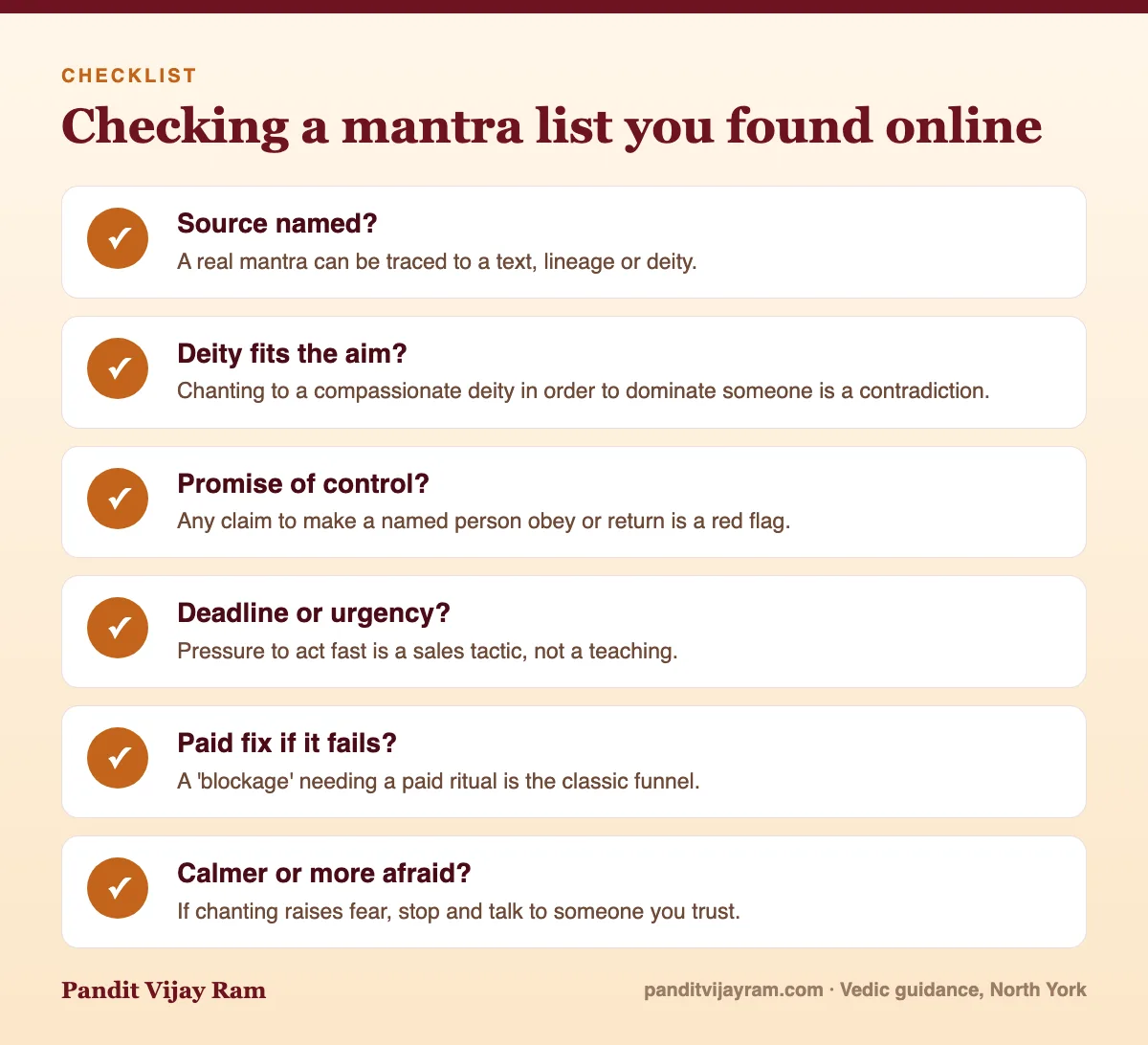
Ask a few questions of any list you find:
- Where is it from? A real mantra can usually be traced to a text, a lineage or a deity. Most lists name none.
- Who wrote this page? Anonymous pages with phone numbers are adverts, not scholarship.
- What does it promise? Control over a named person is not something any honest teacher offers.
- What happens if it fails? If the answer is 'call us for a stronger ritual', you are reading a sales page.
There is also the plain human reality. Whether someone returns depends on what happened between you, how they feel now and what they choose. A chant cannot overwrite that, and believing it can tends to keep people stuck.
Our guide on whether love back spells work looks at what usually decides reconciliation. If you want the word itself explained, start with what vashikaran means in Sanskrit.

Why is chanting a mantra without context a problem?
In Hindu practice a mantra comes with a deity, a purpose, a correct pronunciation and usually a teacher's guidance. Many also carry a viniyoga, a short statement of seer, metre and deity. A list strips all of that away. What remains is sound without understanding, often mispronounced and attached to an intention the tradition would reject.
Traditional manuals introduce a mantra before giving it. The opening lines, called viniyoga, name the rishi who first heard it, the chhanda or metre, the devata addressed, and the purpose. Many mantras were passed on only through diksha, initiation by a teacher who checked that the student was ready.
Compare what a copied list gives you:
- No deity, or a deity named without any devotion attached.
- Transliteration that drops long vowels and nasal sounds.
- A repetition count with no reason given.
- A goal, such as control of a spouse, that has nothing to do with the deity's nature.
The last point matters most. A mantra to a protective or compassionate deity, chanted to dominate someone, is a contradiction. Teachers have long said that the intention behind a chant shapes it as much as the syllables.
There is a gentler concern too. People who chant something they fear or do not understand often feel anxious afterwards, and anxiety then looks like a 'side effect'. Our article on love spell side effects describes how that worry builds.
If you want to chant, choose a well-known devotional mantra and learn it properly, perhaps with help. Vijay Ram ji's attraction and harmony guidance starts with exactly that conversation.
How do online mantra scams usually work?
Most follow a funnel. A free mantra brings you in, a deadline creates pressure, a 'blockage' is diagnosed when nothing changes, and a paid ritual is offered to remove it. Fees then climb, sometimes with warnings of danger if you stop. Recognising the pattern early is the best protection.
The stages are remarkably consistent across websites and messaging apps:
- Hook: a free chant with dramatic claims and a contact number.
- Urgency: 'chant for seven days only' or 'the stars close this window soon'.
- Diagnosis: when nothing changes, you are told someone has placed an obstacle or that your chanting was flawed.
- Upsell: a special puja, an energised object or a 'strong' version, each for a fee.
- Escalation: higher fees, then threats about what happens if you stop.
Warning signs to act on:
- Requests for gift cards, cryptocurrency or wire transfers.
- Pressure to keep the matter secret from family.
- Claims of danger to you or your children unless you pay.
- Reviews that all sound alike, posted around the same time.
If you have sent money, stop paying, keep the messages, tell your bank and report it to the Canadian Anti-Fraud Centre. You are not foolish for trying; these funnels are designed by people who study heartbreak.
Our longer guide to fake love spell casters online covers reviews and payment tricks in detail.
Is there a safe mantra for husband and wife harmony?
Yes, if the mantra is devotional and the intention is shared harmony rather than control. Many couples chant Om Uma Maheshwarabhyam Namah to Shiva and Parvati, or Om Namah Shivaya together. These ask for patience, affection and understanding. They respect both partners, and they work best alongside honest conversation and, where needed, counselling.
The phrase 'mantra for husband' is among the most searched in this area. Often the person searching is lonely inside a marriage, not trying to dominate anyone. That need deserves a kind answer.
Devotional choices that are widely used and safe:
- Om Uma Maheshwarabhyam Namah: a salutation to Parvati and Shiva as the ideal couple. Suitable for both partners.
- Om Namah Shivaya: the five-syllable mantra, for calm and steadiness, chanted alone or together.
- The Gayatri mantra: for clarity of mind before a difficult conversation.
- Om Shum Shukraya Namah: a Friday salutation to Venus, asking for sweetness and grace in yourself.
How to keep it healthy:
- State your intention as harmony for both of you, never as making your spouse do something.
- Keep the practice short and regular rather than long and anxious.
- Pair it with one real action that week, such as a calm talk or a shared meal.
Where there is shouting, fear or control in the home, prayer is not enough on its own. Our article on husband and wife arguments covers chart factors and communication, and Vijay Ram ji's marriage guidance can help a couple find a fair starting point.
When should you stop chanting and get other help?
Stop if chanting has become compulsive, if you feel more afraid rather than calmer, if you are losing sleep or money, or if you are using it to avoid a decision. Those are signs to talk to your family doctor, a counsellor or a trusted elder, and to set the list aside.
Chanting is meant to settle the mind. When it does the opposite, the practice is no longer serving you, whatever the source.
A simple check you can do tonight:
- Am I chanting because I feel peace, or because I am scared of what happens if I stop?
- Have I spent money I needed on rituals this month?
- Am I sleeping and eating normally?
- Have I contacted the other person repeatedly after they asked for space?
If two or more answers worry you, pause the practice for a while. Speak to your family doctor about sleep and mood. If thoughts of the person feel impossible to switch off, a counsellor can help; our page on unwanted obsession and spiritual help explains why.
If you ever feel unsafe or think about ending your life, call or text 9-8-8, Canada's Suicide Crisis Helpline, at any hour.
Once things are steadier, a short devotional routine can return in a healthier form. Many people find that a few minutes of chanting for their own heart does more than an hour aimed at someone else.
The bottom line
A vashikaran mantra from an online list arrives without its source, deity, pronunciation or teacher, and with promises that no tradition made. Such lists often serve as the first step in a funnel that ends in fees and fear, so knowing the pattern protects you. Devotional mantras chanted for your own heart, or for harmony that both partners want, are safe and meaningful. When chanting turns anxious or compulsive, set it aside and reach out to a doctor, counsellor or someone you trust.
Key takeaways
- Copied mantra lists drop the source, deity, metre and teacher.
- No chant can override another person's feelings or choices.
- Free mantra, urgency, diagnosis, upsell: that is the scam funnel.
- Devotional chants for shared harmony are a safe alternative.
- Report payments demanded under threat to the Canadian Anti-Fraud Centre.