
Journaling and Prayer After a Breakup

After a breakup the mind can feel like a crowded room, with every voice talking at once. Memories, regrets, arguments you wish you had won, and fears about the future crowd in, especially at night. Journaling after breakup gives those voices a page to speak on, one at a time. Prayer gives them somewhere to rest afterwards. Many people I sit with in North York have never kept a journal and worry they will not know what to write. That is why this guide offers specific prompts for the early days, the middle weeks and the time of rebuilding, and pairs each stage with a short prayer or mantra. You will also learn how to keep a simple prayer journal, what to do when writing makes you feel worse, and how to use reflection without turning it into endless rumination. Over four decades of guiding people through heartbreak, I have seen that the combination of honest words on paper and quiet words to the divine steadies a person more than either alone. You do not need to be a writer or deeply religious. You need ten minutes, a notebook and willingness.
Does journaling really help after a breakup?
For many people, yes. Writing about painful experiences in a structured way, sometimes called expressive writing, has been studied as a tool for processing emotion. It helps turn swirling thoughts into a story with a beginning and an end. It works best when it includes reflection and meaning-making, not only repeated venting.
Journaling helps in three main ways after a relationship ends:
- It slows the mind. Writing by hand is slower than thinking, so thoughts arrive one at a time instead of all at once.
- It reveals patterns. Reading back over a few weeks, you may notice what triggers bad days and what helps.
- It holds what you cannot say aloud. In families where the relationship was private, a journal may be the only place your grief can be spoken.
There is one caution. Writing the same complaints every day, without any new question or insight, can deepen the groove of rumination rather than release it. A useful rule is to end each entry with a question that points forward, such as "What do I need today?" or "What is one kind thing I can do for myself?"
Keep your journal private and safe. Do not post entries on social media or send pages to your ex. If you feel a strong urge to contact them after writing, wait a full day and read should I text my ex before acting.
One specific kind of writing, the letter you never send, is covered in detail in finding closure after a breakup. The prompts below are for everyday reflection.

What should I write in a breakup journal?
Write what you feel, what you remember, what you have learned and what you hope for. Use prompts suited to where you are: raw feelings in the first weeks, reflection on patterns in the middle, and future plans when you are rebuilding. Ten minutes and two prompts a day are plenty.
Choose one or two prompts per day from the stage that fits you now.
Early days: letting it out
- Right now, my body feels... and my mind keeps saying...
- The moment I miss most is...
- The thing I am most afraid of is...
- Today I got through by...
Middle weeks: making sense
- What did this relationship teach me about what I need?
- Where did I ignore my own feelings to keep the peace?
- What pattern from my family or past relationships showed up here?
- What did I do well in this relationship?
Rebuilding: looking forward
- Three things I enjoy that have nothing to do with them are...
- A value I want my next relationship to honour is...
- One small step I will take this week toward the life I want is...
- The person I am becoming is someone who...
Write freely without correcting spelling. If a prompt brings tears, that is not failure; it is release. If you notice every entry circling back to worthlessness, the exercises in rebuilding self-worth after rejection may help you challenge that thought directly.
What prayers or mantras help after a breakup?
Short prayers that ask for your own peace, clarity and strength help most. Many Hindu families use "Asato ma sadgamaya", the Gayatri mantra, "Om namah Shivaya" or the Hanuman Chalisa. A heartfelt sentence in your own words is equally valid. Prayer after heartbreak should never be used to influence or bind another person.
Here are a few short prayers you can write at the top of a journal page or recite after writing.
- Asato ma sadgamaya, from the Brihadaranyaka Upanishad: "Lead me from the unreal to the real, from darkness to light, from death to immortality." A gentle prayer for clarity when the mind feels confused.
- Om namah Shivaya: a simple chant for inner stillness, often repeated quietly on a mala.
- The Gayatri mantra: a prayer for the light of wisdom to guide the mind, traditionally recited at dawn and dusk.
- A prayer for both: "May I be at peace. May they be at peace. May what is best for both of us unfold."
- In your own words: "Please give me the strength to face today, and the wisdom to let go of what is not mine to hold."
Readers from other faiths can do exactly the same with their own prayers, whether a shabad from Gurbani, a personal dua or a psalm. What matters is sincerity and the intention of your own healing.
For a fuller set of mantras for a heavy heart, see mantras for a heavy heart after a breakup. For a longer daily devotional routine, the guide on spiritual healing after a breakup offers a structured plan.
How do I keep a prayer journal?
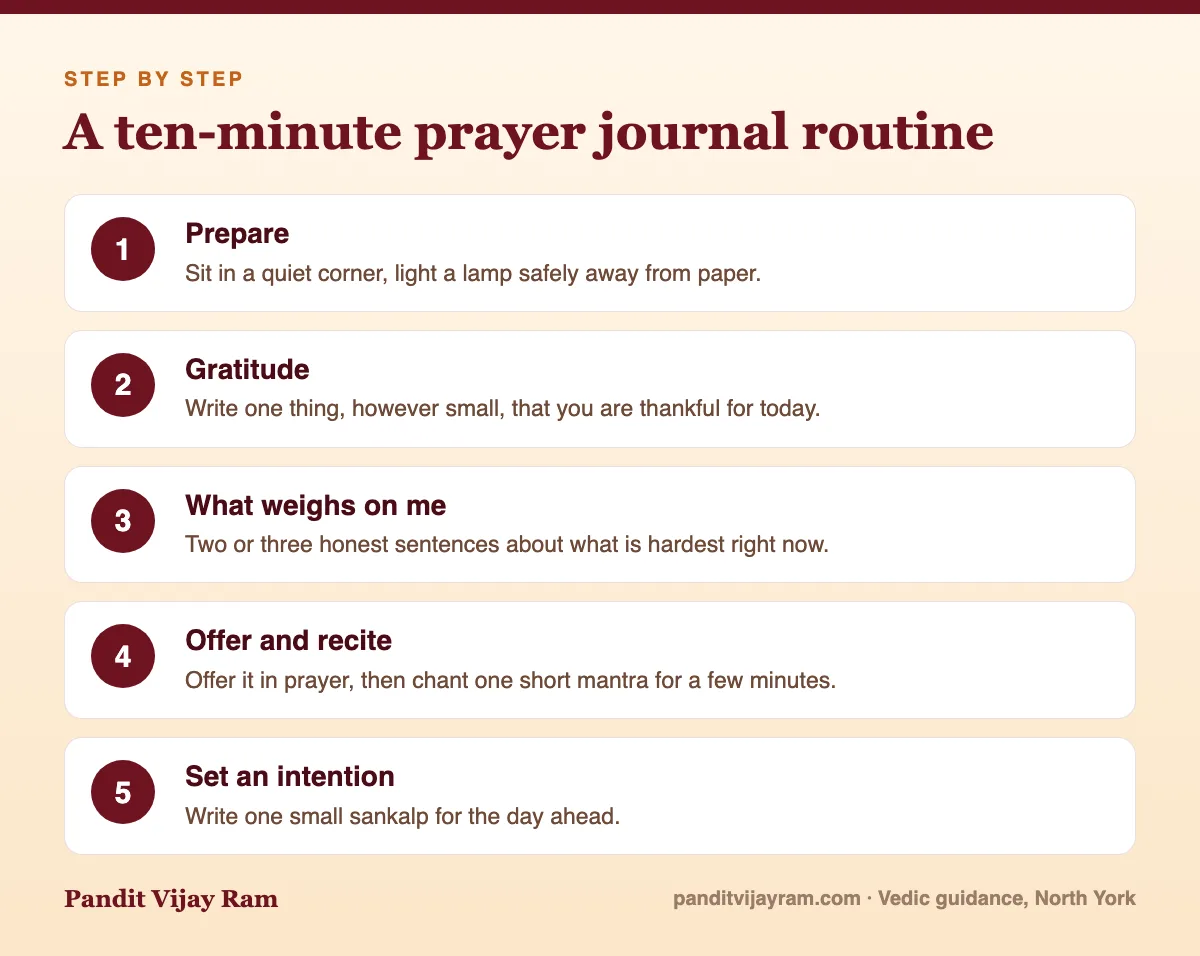
Keep a prayer journal by pairing a short daily entry with a few minutes of prayer. Begin with a line of gratitude, write what is troubling you, offer it in prayer, and end with one intention for the day. Over time the journal becomes a record of what you prayed for and how you have changed.
A simple ten-minute routine works well, morning or evening:
- Prepare. Sit near your home altar or any quiet corner. Light a lamp or incense if you wish, safely away from paper.
- Gratitude. Write one thing, however small, that you are thankful for today: a friend's call, a good meal, a moment of calm.
- What weighs on me. Write two or three sentences about what is hardest right now.
- Offer it. Read those sentences quietly, then say, "I offer this to You." Picture setting it down at the feet of your chosen deity.
- Recite. Chant one short mantra or prayer, eleven times or for a few minutes.
- Intention. Write one sankalp, a small resolution for the day, such as "Today I will eat properly and call my sister."
Once a week, read back over your entries. Many people are surprised by how much has shifted. Mark answered prayers, not as proof of magic, but as signs of strength you did not know you had.
If you would like guidance on which deity or practice suits your temperament, a calm conversation through the love problem consultation can help. It focuses on your own peace, never on influencing your former partner.
What if journaling makes me feel worse?
Some days writing will bring up strong feelings, which is normal. If it consistently leaves you more distressed, shorten entries, switch to gratitude or forward-looking prompts, or write only with a supportive person nearby. If writing uncovers thoughts of self-harm or deep hopelessness, stop and reach out to a doctor or 9-8-8.
Journaling is a tool, not a test. If it is not helping, adjust it.
- Set a timer. Write for ten minutes, then close the book. Boundaries stop writing from becoming hours of rumination.
- Change the time. Writing late at night can stir the mind before sleep. Try morning instead.
- Change the focus. For a week, write only about the present: what you did, ate and noticed.
- Close with prayer. End every entry with a few calming breaths and a short mantra so the session finishes in stillness, not agitation.
- Share selectively. Some people find reading an entry to a counsellor helpful. Choose someone trained, not someone who will spread it around.
Pay attention if your writing keeps returning to themes of being a burden, wanting to disappear or not seeing a future. These are signs to talk to someone now, not to write more. Call or text 9-8-8 at any hour in Canada, or see your family doctor. The guide on breakup depression explains the signs to watch.
Journaling and prayer are companions to professional care, not replacements for it. Used gently, they help many people find their footing again.
The bottom line
Journaling after breakup turns crowded thoughts into words you can see and understand. Stage-based prompts move you from raw feeling to reflection to rebuilding, and a short prayer at the end of each entry brings stillness. A prayer journal records both your struggles and your growth. If writing deepens distress, adjust it and reach out for support.
Key takeaways
- Ten minutes of writing a day is enough to make a difference.
- Choose prompts that match your stage: feeling, reflecting or rebuilding.
- End each entry with a forward-looking question and a short prayer.
- Prayer after heartbreak asks for your own peace, never control over someone else.
- If writing stirs hopelessness, stop and reach out to a doctor or 9-8-8.