
Problems in the First Year of Marriage

Everyone told you the first year would be magical. The photos are beautiful, the relatives still call with blessings, and yet some evenings you sit in silence wondering why this feels so hard. First year of marriage problems are among the most common worries newlyweds bring to me, often with a sense of embarrassment, as if struggling this early means something is wrong. It usually does not. Couples in North York and across the GTA are dealing with wedding debts, new jobs, long commutes, families on both sides and sometimes a move across the world, all at the same moment. This guide covers the problems that typically appear in the first year, why newlyweds argue once the honeymoon phase is over, how to make fair agreements about money, chores and family visits, how to handle pressure about having children, and when to seek counselling or spiritual guidance. In more than forty years of practice, I have noticed that the first year shapes the habits of a marriage. Couples who learn to repair small hurts now find later storms much easier to weather.
What are the most common problems in the first year of marriage?
The most common first-year problems are arguments over money and spending, uneven household work, irritating daily habits, how much time to spend with each family, differing expectations about intimacy, pressure about children, and adjusting to a new home, city or country. Most reflect two separate lives merging, not a poor match.
Before the wedding, most couples see each other at their best: dressed up, rested and on their way somewhere enjoyable. Marriage brings the rest: tiredness, bad moods, dirty dishes and Monday mornings. Typical first-year strains include:
- Money. One saves, one spends. Wedding costs, loans or money sent to parents add pressure.
- Chores. Each assumed the other would handle cooking, cleaning or bills.
- Habits. Sleep schedules, cleanliness, phone use, snoring, television volume.
- Two families. Whose parents for Diwali, Eid or Christmas? How often to visit? How much to share?
- Intimacy. Different expectations about closeness are common and deserve patience. The guide to intimacy problems in marriage covers this respectfully.
- Friends. Fitting old friendships into a married life.
- Big changes at once. New jobs, a move, or one partner immigrating to join the other.
If you married through family introductions, the guide on arranged marriage problems after the wedding addresses the extra task of getting to know a near-stranger. If you moved into your spouse's family home, see adjusting to a new family after marriage.

Why do newlyweds fight so much after the honeymoon phase is over?
Newlyweds often fight more because the excitement of the wedding fades just as daily routines, money and family responsibilities arrive. Each partner brings unspoken rules from their childhood home, and every difference has to be settled for the first time. Frequent early arguments are normal; how you argue matters more than how often.
The honeymoon phase is real. In the early months, affection and novelty make it easy to overlook small differences. As life settles, those differences become visible and need decisions. Who pays which bill? Does the towel go on the rail or the hook? Do we tell my mother about our argument?
Underneath, many fights are about deeper needs:
- Respect. Feeling that your way of doing things is valued.
- Belonging. Feeling that your spouse puts the marriage first, especially in front of family.
- Security. Feeling safe about money and the future.
- Appreciation. Feeling seen for the effort you make.
Healthy first-year arguments share a few features: they stay on one topic, neither partner insults the other or their family, either can call a break, and both return later to make peace. Couples who learn to apologise and accept apologies in the first year build a skill that serves them for decades.
If arguments are already following the same exhausting pattern every time, the guide to why couples fight so much explains pursue-and-withdraw cycles and how to break them.
One important line: shouting to frighten, breaking things, threats, or controlling money and movements are not normal newlywed fighting. They are warning signs of abuse, explained in signs of a controlling partner.
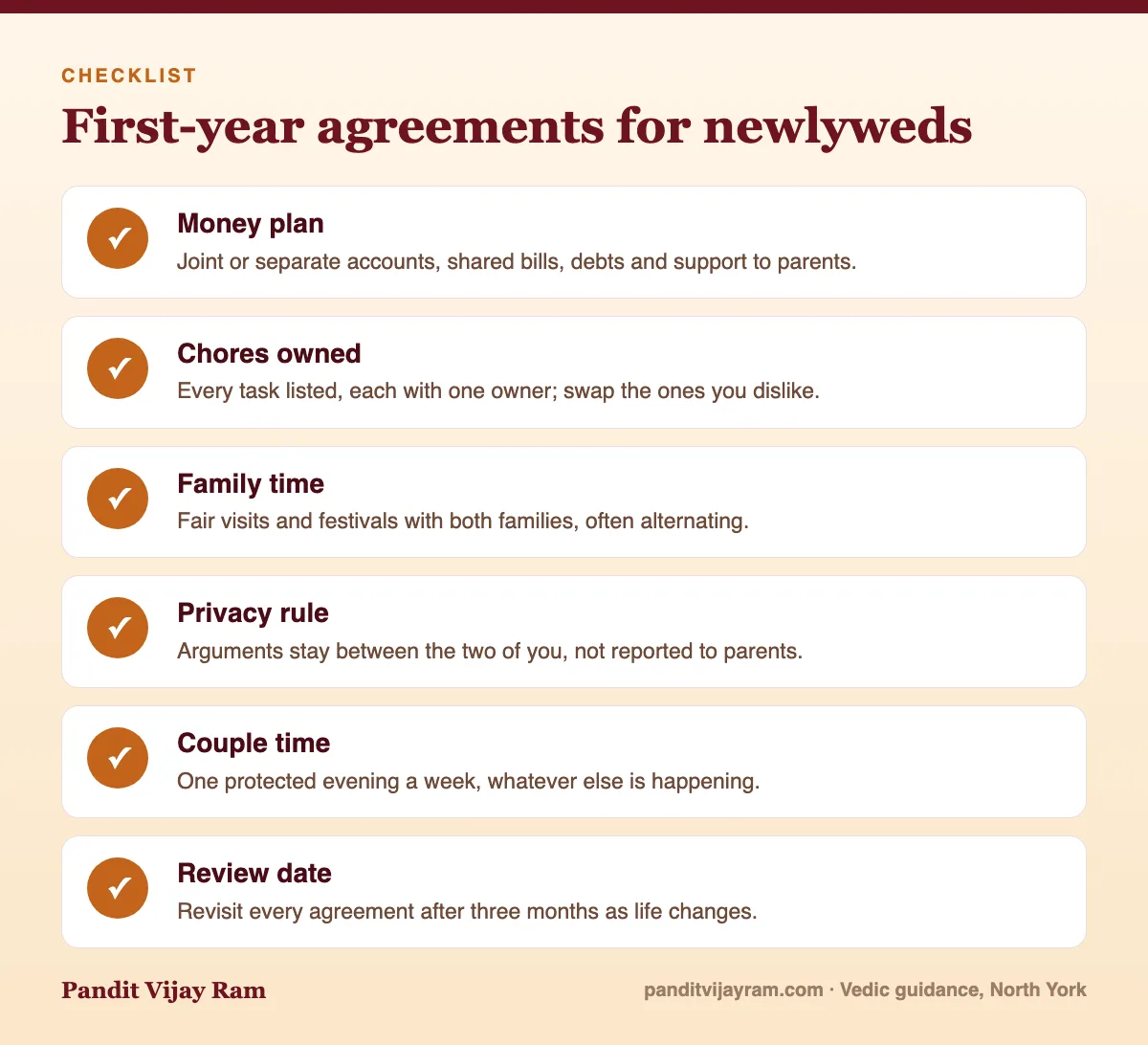
How can newlyweds agree on money, chores and family visits?
Sit down together early in the year and write simple agreements: how you will combine or separate money, who handles which chores, how holidays and visits are shared between both families, and how much support goes to parents. Review the agreements every few months, because the first year brings many changes.
Written agreements may sound formal, but they prevent a great deal of guesswork. A first-year agreement can be one page with these headings:
- Money. Joint account, separate accounts or both? Who pays rent or mortgage, groceries, phones and car costs? Any wedding debts to clear first? How much will each send to parents, and how is that decided? The article on money fights between couples includes a fair method for remittances.
- Chores. List every task and agree who owns each one. Swap tasks either partner strongly dislikes.
- Family time. How often do you visit each set of parents? Which festivals go to whom? Alternating is often fairest.
- Privacy. What stays between the two of you? A simple rule many couples adopt: arguments are not reported to parents.
- Couple time. One protected evening a week, whatever else is happening.
- Review date. Pick a date three months away to revisit everything.
A decision rule for disagreements: if one partner cares strongly and the other only mildly, the stronger preference usually wins this time, and the other gets priority on the next disagreement. Keeping it balanced over time matters more than winning any single point.
How should newlyweds handle pressure to have a baby?
Decide together, privately, when and whether you want children, and give relatives one short, united answer. Questions about "good news" are common in South-Asian and Caribbean families, but the timing belongs to the couple. If there are health concerns or difficulties conceiving, a family doctor or fertility specialist is the right first step.
Within weeks of the wedding, many couples hear the question at every gathering: "Any good news?" For some it is light teasing. For others, especially brides, it becomes a daily weight, and it can cause tension if the couple has not yet agreed between themselves.
Helpful steps:
- Talk to each other first. Share honest feelings about children, timing, careers and finances, without judgment.
- Agree on a shared answer. Something like "When God wills, we will tell you" or "We are enjoying married life for now" ends most conversations politely.
- Each speaks to their own family. If a mother-in-law presses repeatedly, her own son or daughter should ask her kindly to stop.
- Protect each other. Never blame your spouse in front of relatives, and never let family assume the delay is one partner's fault.
- See a doctor if needed. If you have been trying for a while without success, or have health concerns, speak with your family doctor. Prayer can be a comfort, but medical care comes first.
Many families also turn to traditional prayer at this time, such as Santan Gopal mantra or a puja for blessings. These are expressions of hope and faith, never a medical treatment, and they belong alongside proper medical care. If a doctor is involved and you would like spiritual support too, the marriage guidance page explains what a reading and prayer can offer.
When should newlyweds seek counselling or spiritual guidance?
Seek counselling when the same argument repeats without resolution, when either partner feels lonely or regretful for weeks, when family interference is causing serious strain, or when trust has been damaged. Early counselling is a sign of commitment, not failure. Spiritual guidance can support that work, but abuse always calls for safety help first.
Many couples wait years before seeking help, by which time patterns are deeply set. The first year is actually an ideal time, because habits are still forming. Consider counselling if:
- You avoid certain topics because they always turn into fights.
- One of you has started confiding in parents or friends instead of each other.
- Either of you is regularly sleeping badly, crying or feeling hopeless. See your family doctor as well, and in a crisis call or text 988.
- A serious discovery, such as hidden debt or dishonesty, has shaken trust.
- You simply want to build strong habits from the start.
If you did not have marriage preparation before the wedding, many of the topics covered in premarital counselling are just as useful in the first year.
From a Vedic perspective, the first year is often marked by family customs: a bride's first Karva Chauth or Teej, a first Lohri, first festival visits to each home. These can be joyful when both partners choose how to take part. A reading can describe each partner's temperament and note whether one is in a demanding dasha, which may encourage patience. It describes tendencies, never a verdict on your marriage.
If there is fear, threats, control or harm, this is not a first-year adjustment. Call 911 in an emergency and seek a domestic-violence service before any counselling as a couple.
The bottom line
First year of marriage problems are normal: two lives, two families and many unspoken expectations are merging at once. Clear early agreements on money, chores and family time, a united answer to outside pressure, and learning to argue and repair fairly will ease most of the strain. Counselling in the first year is a strong investment, spiritual guidance can support it, and fear or control always calls for safety help first.
Key takeaways
- Most first-year strains come from two separate lives merging.
- How you argue and repair matters more than how often you argue.
- Write simple agreements on money, chores and family visits, then review them.
- Decide privately about children and give relatives one united answer.
- Early counselling builds strong habits; abuse needs safety help first.