
Arranged Marriage Problems After the Wedding
The wedding was beautiful. Both families were happy, the kundli matched well, and everyone said you made a lovely pair. Then the guests went home, and you found yourself sharing a life with someone you had met perhaps a handful of times. Arranged marriage problems rarely look dramatic at first. They look like awkward silences at dinner, surprise at how your spouse spends money, or confusion about who decides what. Couples in North York, Brampton and Mississauga describe these early months to me with a mix of hope and worry. This guide looks at the common difficulties after an arranged wedding, practical ways to get to know your spouse as a person, how to handle different expectations, why parents and matchmakers need to step back, and what to do if you feel regret or that you were pushed into the marriage. In more than forty years of guiding families, I have seen many arranged marriages grow into deep companionship. That growth is not automatic. It comes from two people choosing each other again, every day, after the families have done their part.
What are common arranged marriage problems after the wedding?
Common problems include feeling like strangers, mismatched expectations about work, money, intimacy and children, a spouse who seems different from the person presented before the wedding, ongoing involvement from both families, and loneliness, especially when one partner has moved countries to join the other. Most are adjustment problems, not signs of a wrong match.
Arranged marriages in our communities vary widely. Some couples dated for months with family blessing; others met two or three times under supervision. The less time you had, the more you will learn after the wedding. Typical difficulties include:
- Not knowing each other. You may know your spouse's degree and family background but not how they handle stress, what makes them laugh or what they fear.
- Presentation versus reality. During the rishta process, both families show their best side. Habits around temper, cleanliness, religion or drinking can be a surprise.
- Different expectations. One assumed both would work; the other assumed one would stay home. One expected to live separately; the other expected a joint family.
- Intimacy pressure. Physical closeness with someone you barely know can feel overwhelming. It deserves patience, privacy and mutual consent.
- A spouse from abroad. When one partner immigrates to join the other, they may lose their career, friends and independence overnight. The guide on marriage problems after immigration covers that strain in depth.
If you are still before the wedding, the guide to preparing for an arranged-marriage first meeting lists questions that prevent many of these surprises.

How do you get to know a spouse you barely knew before marriage?
Treat the first months like a courtship. Set aside regular time to talk without family present, ask open questions about childhood, hopes and worries, share your own stories honestly, do new activities together and notice what your spouse values. Friendship grows through curiosity and small kindnesses repeated over time.
Many couples in arranged marriages say the friendship came after the wedding, and that it was worth the wait. You can encourage it deliberately:
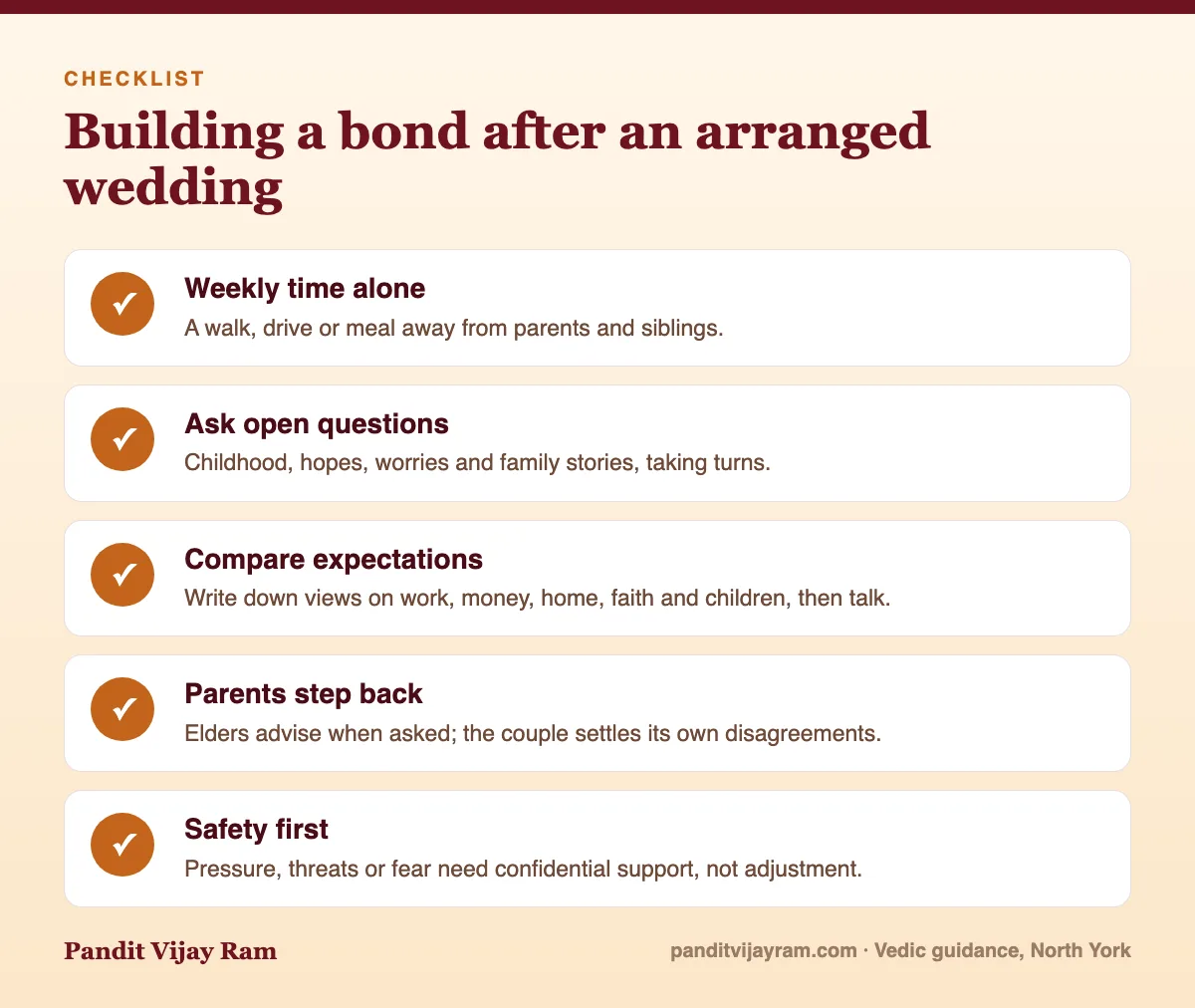
- Weekly time alone. A walk, a drive or a meal out. Away from parents and siblings, people relax and talk differently.
- Question evenings. Take turns asking things like "What was your favourite place as a child?", "What do you miss most about home?" or "What worries you about the future?"
- Share daily life. Cook together, shop together, sort the paperwork together. You learn a great deal about someone through ordinary tasks.
- Learn their family history. Ask about grandparents, migration stories and family struggles. These explain many habits.
- Do something new. A class, a hike or exploring a part of the city neither knows. New experiences create shared memories.
- Give grace. First impressions are often formed under stress. A shy or awkward spouse may open up slowly.
Emotional and physical closeness can grow at their own pace. Agree on what feels comfortable, and do not let relatives' expectations, such as questions about "good news", rush either of you.
Practical compatibility beyond the chart matters here. The checklist in compatibility beyond kundli covers money, roles and lifestyle questions worth exploring together.
What should you do when your expectations of marriage are different?
Write down your expectations separately about work, money, household roles, living arrangements, religion, children and family visits, then compare them calmly. Identify where you already agree, where you can compromise and where you need help. Different expectations are normal in arranged marriages; what matters is negotiating them openly.
In an arranged marriage, many expectations were assumed rather than discussed. Families may have agreed on broad terms, but the details of daily life were left for the couple. Bringing them into the open prevents years of quiet resentment.
A simple exercise many couples find useful:
- Each partner writes their honest expectations for the next few years under headings: career, money, home, in-laws, faith practice, children, social life.
- Compare side by side. Circle where you agree. Mark where you differ.
- Sort the differences into three groups: easy to adjust, needs a trial period, and deeply important to one of you.
- Start with the easy ones. Early agreements build trust for the harder conversations.
A useful decision rule: if something is deeply important to one partner and only mildly important to the other, the one who cares more should usually get their way, with the other's needs respected elsewhere. If both feel strongly in opposite directions, a counsellor can help.
Remember that expectations about intimacy, children and timing deserve particular sensitivity. Neither family nor spouse should pressure anyone on these. If you are wondering whether the chart has anything to add, a marriage guidance reading can describe temperaments, but the decisions belong to the two of you.
How involved should parents be after an arranged marriage?
Parents who arranged a marriage often feel responsible for it and stay closely involved, but a new couple needs room to make their own decisions and mistakes. Respectful distance works best: parents offer advice when asked, avoid taking sides in arguments and let the couple settle their own conflicts privately.
In arranged marriages, families may treat the marriage as their project. When problems appear, a mother may call the other family, a father may lecture the son-in-law, or matchmakers may be asked to intervene. This usually makes things harder, because the couple never learns to solve problems together.
Healthy family roles after the wedding:
- Parents as elders, not managers. Their wisdom is valuable when invited. Daily decisions about money, work and the home belong to the couple.
- No running commentary. Each spouse should avoid reporting every disagreement to their own parents. What parents hear in anger, they remember long after the couple has made up.
- Each partner speaks to their own family. If boundaries need setting, the son talks to his parents and the daughter talks to hers.
- A united message. "We are working this out together" is enough for curious relatives.
If you are living with in-laws, the separate guide to adjusting to a new family after marriage covers daily life in a joint household. For the wider set of first-year pressures every newlywed couple faces, see problems in the first year of marriage.
What if you regret your arranged marriage or felt pressured into it?
Early regret is common and often fades as a couple builds friendship. Feeling you had no real choice is different. Forced marriage is a crime in Canada, and anyone who was pressured, threatened or is now afraid deserves confidential support. A counsellor or support service can help you understand your options safely.
Many people feel a wave of doubt after an arranged wedding. "Did I make a mistake?" is a natural question when the person beside you is still unfamiliar. Give the relationship honest effort, ideally with counselling, before deciding what that feeling means. Regret that eases as you get to know each other is adjustment.
Some situations are not adjustment:
- You were told you could not refuse, or you agreed under threats of harm, disownment or shame.
- Your passport, documents, phone or money are being kept from you.
- You are afraid of your spouse or of either family.
- You are being pressured or forced into physical intimacy.
If any of these apply, your safety comes first. Call 911 in an emergency. The guide to domestic-violence help in the GTA lists confidential services, including those experienced with forced marriage and honour-based pressure. Every adult has the right to decide whether to stay in a marriage.
From a Vedic view, a chart can describe tendencies in a marriage, but it never obliges anyone to stay in harm. No dosha, horoscope match or family promise outweighs a person's safety and free will. Where both partners genuinely want to build their marriage, prayer for patience and goodwill can support that choice.
The bottom line
Arranged marriage problems after the wedding are usually about two near-strangers learning each other, unspoken expectations and families who stay too closely involved. Deliberate time together, open comparison of expectations and parents stepping back help most couples build a genuine bond. Where there was pressure, fear or coercion, safety and confidential support come before any attempt to adjust.
Key takeaways
- Most early arranged-marriage problems are adjustment, not a wrong match.
- Treat the first months like a courtship, with regular time alone.
- Write down and compare expectations before resentment builds.
- Parents help most as elders who advise when asked.
- Forced marriage is a crime in Canada; safety always comes first.