
Intimacy Problems in Marriage: A Respectful Guide

Few topics are harder to raise in a South-Asian or Caribbean household than this one. Many of us grew up in homes where nobody spoke about physical closeness at all, so when it fades in our own marriage we feel ashamed, confused or quietly rejected. Questions about intimacy problems marriage counsellors hear every week are often the ones people never say aloud to family. Couples in North York and across the GTA sometimes raise it with me only at the very end of a consultation, after an hour of talking about everything else. This guide is written with respect and without explicit detail. It covers the ordinary reasons closeness fades, why a doctor should be your first stop, how to talk to your spouse without blame, what a therapist can offer, and how faith can support a couple without pressure. In more than forty years of guiding families, I have learned that distance in the bedroom is usually a symptom of something else in the marriage, and that it softens when the something else is cared for gently.
What causes intimacy problems in a marriage?
Most intimacy problems come from ordinary pressures rather than a lack of love: exhaustion, long shifts, money stress, a new baby, health conditions, medication side effects, grief, low mood, pain, or resentment that was never spoken. In joint-family homes, a simple lack of privacy can matter more than couples admit.
When closeness fades, people often jump to the most painful explanation: "My spouse no longer finds me attractive" or "There must be someone else." Far more often, the cause is quieter. Common ones include:
- Fatigue and schedules. Opposite shifts, two jobs, long commutes on the 401 or overnight work leave little energy for anything but sleep.
- Life changes. Pregnancy, the months after birth, menopause, ageing and recovery from surgery all change the body and the mind.
- Health and medicines. Many conditions and prescriptions can affect desire or comfort. Only a doctor can sort these out.
- Emotional hurt. Unresolved arguments, criticism in front of relatives, or feeling unappreciated make physical closeness feel unsafe.
- Privacy. Thin walls, a shared room with a child, or parents living down the hall can shut closeness down entirely.
- Different upbringings. Shame learned in childhood can make it hard to express needs even within a loving marriage.
A desire mismatch, where one partner wants closeness more often than the other, is also very common and not a sign of a broken marriage. It needs conversation and sometimes professional help, not pressure.
If the distance feels emotional rather than physical, the guide to a spouse who has become distant looks at that pattern more broadly.

Should you see a doctor about intimacy problems first?
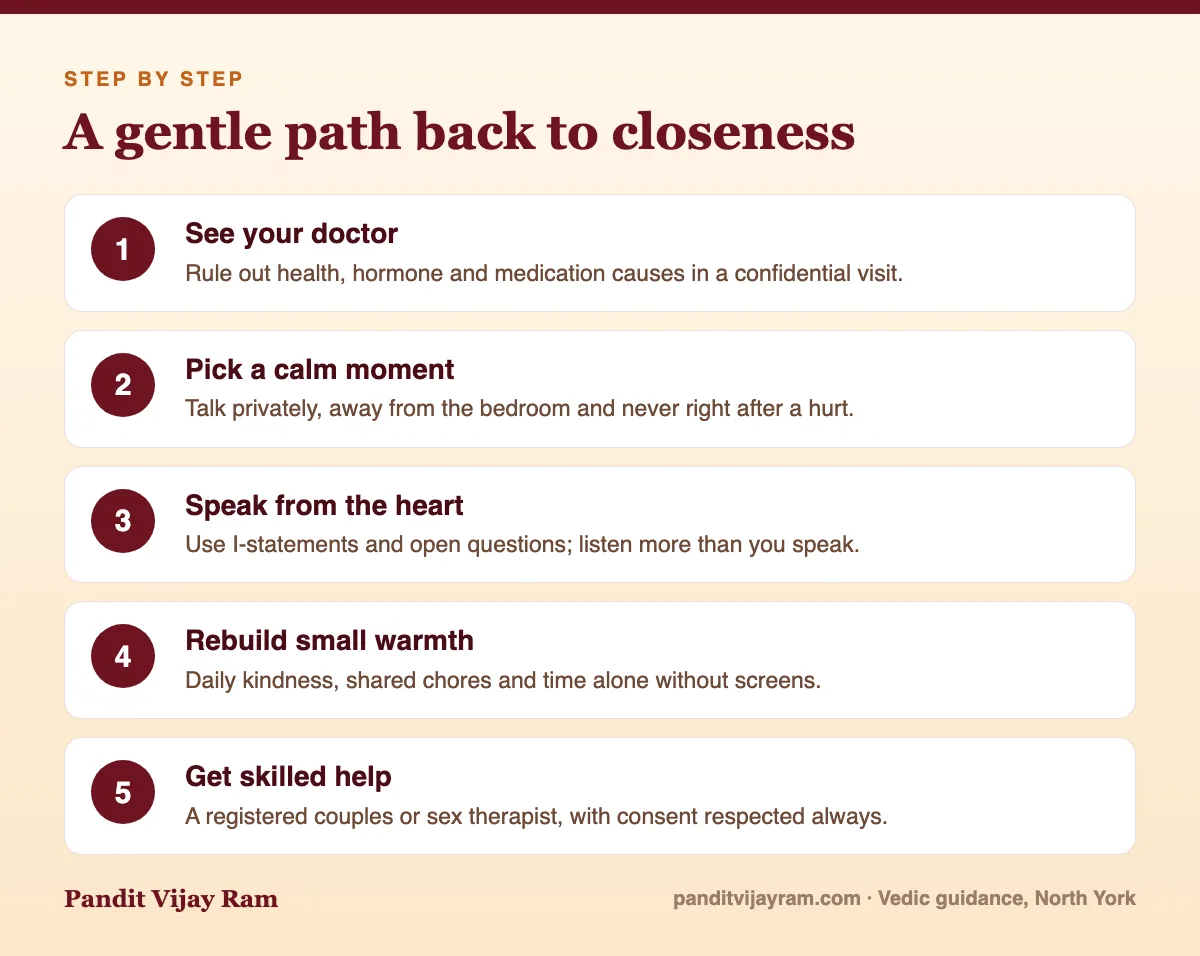
Yes. A family doctor should be the first stop, because many causes of reduced desire, pain or difficulty are physical or linked to medication, hormones or mood. A doctor can check these confidentially and refer you onward. No astrologer, healer or online product can replace that assessment, and none should claim to.
Many people skip this step out of embarrassment. Doctors in Ontario discuss these concerns every day, and conversations are confidential. You can book a visit alone; you do not need your spouse to come.
Before the appointment, it helps to note:
- When the change began and whether anything else changed around then, such as a new medicine, a birth, a job or a loss.
- Whether the issue is desire, comfort, pain, or something else.
- Your sleep, mood, alcohol use and stress levels.
- Any prescriptions, supplements or herbal products you take.
Your doctor may suggest tests, adjust a medicine or refer you to a specialist, a pelvic health physiotherapist or a mental-health professional. Low mood and anxiety affect closeness more than most people realise, and they are treatable. The guide to South-Asian mental health support in the GTA lists culturally aware services.
Please be careful with anything sold as a quick fix. Pills, oils, "special" amulets or rituals marketed online with promises about performance or desire can be unsafe, and some are simply fraud. A genuine spiritual guide will always send you to a doctor first.
How do you talk to your spouse about lack of intimacy without blame?
Choose a calm, private moment away from the bedroom, speak about your own feelings rather than your spouse's failings, and ask an open question. Listen more than you speak. The goal of a first conversation is understanding, not a solution, so it is fine to end it with a plan to talk again.
Timing matters. Late at night, after a rejection, or in the middle of an argument are the worst moments. A quiet walk, a drive or a cup of tea on a weekend morning work better.
A gentle way to structure the talk:
- Start with care. "I love you and I miss feeling close to you."
- Use I-statements. "I feel lonely sometimes" lands very differently from "You never want me."
- Ask, then wait. "Is something weighing on you? Is anything making this hard?" Allow silence.
- Accept what you hear. Your spouse may mention tiredness, a health worry, or a hurt you caused. Thank them for telling you instead of defending yourself.
- Agree on one small step. A doctor's visit, more time alone together, or simply holding hands while watching television.
Remember that closeness is more than the physical. Small daily kindnesses, help with chores, a compliment, ten minutes of real conversation, often rebuild warmth faster than any discussion of the problem itself. Our guide to communication problems in marriage has further tools.
One principle is not negotiable: no one owes their spouse physical intimacy. Pressure, guilt and threats are never acceptable within marriage, and forced sexual contact is a crime in Canada whether or not the couple is married. Consent belongs to each person every time.
Can a couples counsellor or sex therapist help with a sexless marriage?
Often, yes. A couples counsellor helps with the emotional distance and resentment that usually surround the problem, while a sex therapist is trained specifically in concerns about desire, comfort and closeness. Sessions are talk-based and private. Many therapists in the GTA work with South-Asian and newcomer couples and understand family and faith sensitivities.
Many couples assume therapy for intimacy will be uncomfortable or explicit. In practice, a first session usually looks like any other counselling appointment: two people talking about stress, communication, history and hopes, at their own pace.
What a therapist may help with:
- Understanding why closeness faded, without either partner being blamed.
- Managing a desire mismatch fairly.
- Addressing anxiety, past trauma or shame that block closeness.
- Rebuilding affection gradually, with exercises the couple practises privately at home.
- Working alongside a doctor when there is a medical side to the problem.
When choosing someone, check that they are registered. In Ontario that usually means a registered psychotherapist, social worker or psychologist with their regulatory college. You can ask whether they have experience with your community, faith or language before booking. The guide to relationship counselling in Toronto explains how to search directories and what to ask in a first call.
If only one partner is willing to attend, individual therapy is still worthwhile. Changes in one person often shift the whole relationship.
What can Vedic tradition offer a couple facing intimacy problems?
Vedic tradition treats married life, grihastha, as sacred, and sees affection between spouses as part of dharma. It can offer prayer for patience and warmth, shared devotional time and chart insight into each partner's temperament. It does not offer medical treatment, and it never justifies pressuring a spouse.
In Jyotisha, Venus (Shukra) is traditionally linked with affection, pleasure and harmony, and the seventh house with partnership. A reading may note that a dasha period of Saturn or Rahu coincides with heavier responsibilities or withdrawal. That can help a couple be gentler with each other, but it describes a tendency, never a verdict, and it is not a diagnosis.
Supportive practices couples tell me they find helpful:
- A shared evening lamp. Lighting a diya together and sitting quietly for five minutes, phones away.
- Friday prayer. Some couples offer white flowers or sweets to Lakshmi or Shiva-Parvati on Fridays as a prayer for harmony. It is devotion, not a technique.
- Gratitude. Naming one thing you appreciate in your spouse each night softens resentment over time.
What I will not do is offer a ritual to "make" a spouse desire someone, or suggest any remedy instead of a doctor. If you are curious how a reading looks at marriage more broadly, the marriage problem guidance page explains it. For a wife who seems to have withdrawn more generally, see the guide to when a wife is not interested.
The bottom line
Intimacy problems in marriage are common, private and usually rooted in stress, health or unspoken hurt rather than a loss of love. A family doctor should be the first stop, followed by a calm, blame-free conversation and, if needed, a registered couples or sex therapist. Faith can support patience and warmth, but consent and medical care always come first.
Key takeaways
- Fading closeness usually reflects stress, health, privacy or hurt, not a lack of love.
- See a family doctor first; many causes are physical or linked to medication.
- Talk at a calm time, using I-statements and open questions.
- Registered couples and sex therapists offer private, talk-based help.
- No one owes a spouse intimacy; pressure or force is abuse.