
Adjusting to a New Family After Marriage

One week you are a daughter or son in your parents' home, where you know where every spoon lives and which aunty to avoid at weddings. The next, you are waking up in a house full of people whose habits you are only starting to learn. Joint family adjustment is one of the quietest challenges of marriage, and one of the least discussed. New brides and grooms in North York, Brampton and across the GTA often tell me they feel guilty for struggling, because everyone is being kind. This guide is not about in-law conflict; it is about the ordinary work of settling in. It covers what adjusting to a sasural really involves, practical steps for a new bride, the less-discussed experience of a groom who moves in with his wife's family, how your spouse can help, and how to tell normal homesickness from something more serious. In more than forty years of practice, I have seen that most families want the newcomer to feel at home. What is often missing is someone explaining the rules nobody ever thought to say aloud.
What does joint family adjustment involve after marriage?
It involves learning a household's routines, food habits, religious practices, money arrangements and unwritten rules, finding your place among several relationships at once, and managing homesickness for your own family. Even in a loving home, this takes months. Feeling tired, unsure or emotional in the early period is normal.
Every family has its own culture. Moving into one means learning dozens of small things at once, often while everyone assumes you already know them. Common areas of adjustment:
- Daily rhythm. Wake-up times, when meals are served, who eats first, when the house goes quiet.
- Kitchen ways. Spice levels, vegetarian rules, fasting days, how rotis are made, who cooks and who cleans.
- Faith practice. Morning puja, the family deity, gurdwara or mosque visits, festival customs that differ from your own family's.
- Forms of address. What to call each relative, how formally to speak and when to cover your head or touch feet.
- Privacy. Whether bedroom doors stay open, whether visitors drop in, whether phone calls happen in private.
- Money. Whether income is pooled, who holds the household budget and how personal spending is viewed.
- Homesickness. Missing your mother's cooking, your old room, your siblings' teasing, especially if your family lives in another city or country.
None of these are problems on their own. They become heavy when nobody explains them and the newcomer is expected to guess. If the household also includes people from different generations or countries, the guide to cultural differences between first- and second-generation partners adds useful context.

How can a new bride adjust to her sasural?
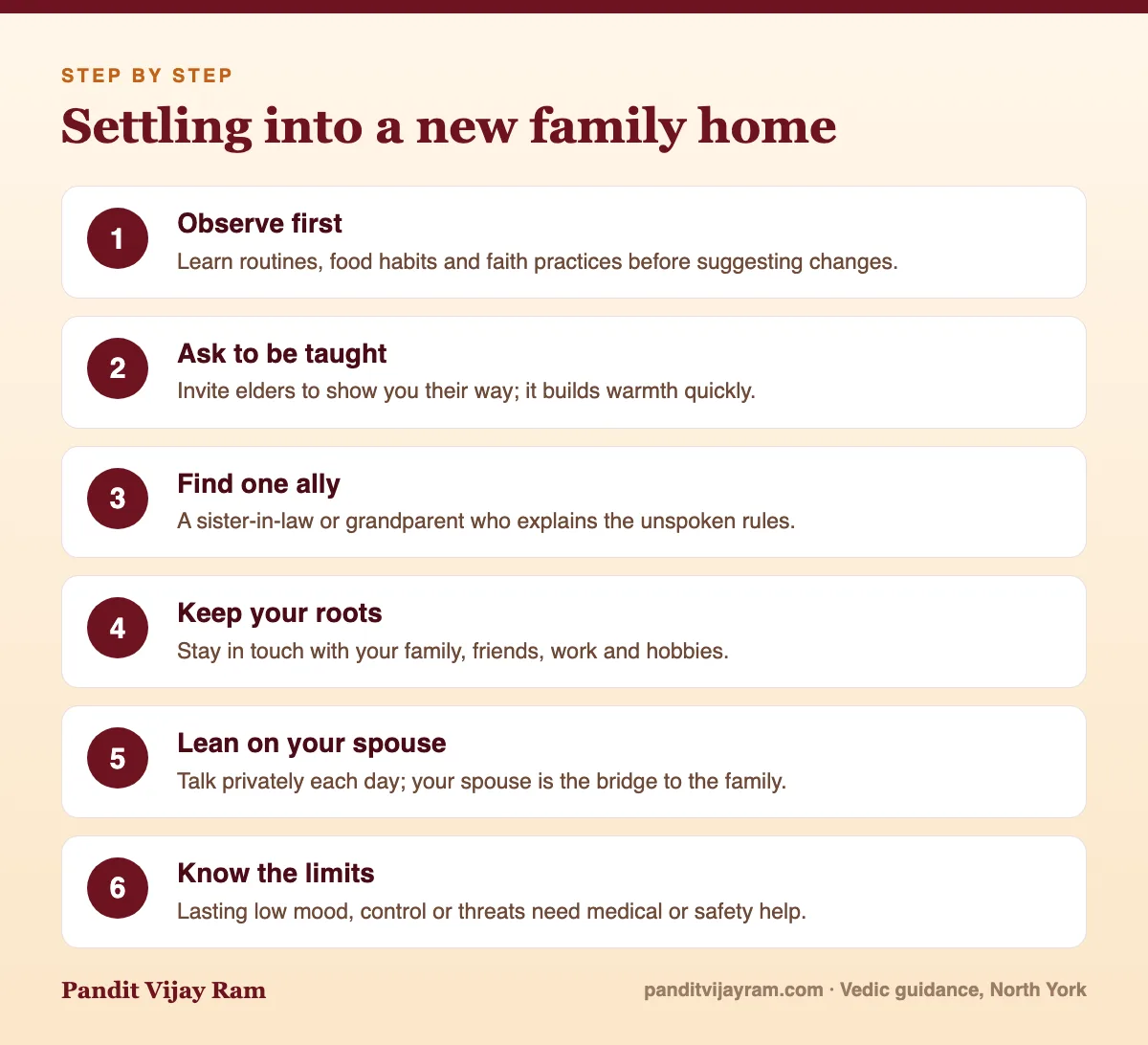
Observe for a few weeks before suggesting changes, ask elders to teach you their way of doing things, build one warm relationship at a time, keep in touch with your own family and friends, and protect parts of your identity such as work, study or hobbies. Speak to your husband privately when something feels hard.
A new bride often feels watched. Every dish and every greeting seems to be judged. These practical steps help many women settle in more gently:
- Watch and learn first. Spend the early weeks noticing how things are done. People feel respected when a newcomer learns their ways before offering new ones.
- Ask to be taught. "Mummy-ji, will you show me how you make this dal?" builds connection far faster than trying to get it right alone.
- Find one ally. A sister-in-law, a grandmother or a younger cousin who can quietly explain the unspoken rules.
- Keep your roots. Call your parents and friends regularly. Feeling connected to your own family makes it easier to open your heart to a new one.
- Protect your identity. Continue your job, studies, exercise or hobbies where you can. Losing all of them at once leads to low mood.
- Bring your own small traditions. Offering to make a festival dish from your family or teaching a song from your home region adds to the household instead of replacing anything.
- Talk to your husband in private. Raise worries calmly and specifically, and agree together on how to handle them.
Many brides also find comfort in prayer. Lighting a lamp in the family shrine or joining the evening aarti can become a shared moment with the elders. Short routines are listed in daily prayers for family peace.
What if the groom moves in with his wife's family?
In some families, a husband moves into his wife's family home for practical reasons such as caring for her parents or saving for a house. He faces the same adjustments a bride does, plus outdated community jokes about a ghar jamai. Respectful roles, clear expectations and pride in the arrangement help everyone.
This arrangement is more common in the GTA than many people admit. A wife may be an only child caring for ageing parents, a couple may be saving for a down payment, or the husband may be newly arrived in Canada and living with his in-laws while he finds work.
Common challenges for the groom:
- Status worries. Relatives may tease or criticise, and he may feel he has lost standing as a man in the household.
- Unclear role. Should he contribute rent, take on chores, make decisions about the home?
- Loyalty pressure. His own parents may feel hurt or abandoned.
- Newcomer stress. If he recently immigrated, he may also be dealing with job searches and loss of professional identity.
What helps: agreeing on a clear financial contribution and household role from the start, his in-laws treating him as a full adult rather than a guest or a helper, and the couple deciding together how long the arrangement will last. His wife can support him by speaking up when relatives make unkind remarks.
From a spiritual view, there is no shame in this choice. Caring for parents is part of dharma for sons and daughters alike, and a household where each person is respected reflects that well.
How can your spouse help you settle into their family?
The spouse is the bridge. They should explain the family's unwritten rules, introduce their partner to relatives properly, gently correct family members who are unkind, protect time alone as a couple, and never discuss their partner's struggles with their parents behind their back. Most adjustment problems shrink when the spouse is clearly on the couple's side.
Many husbands and wives do not realise how much their partner is adjusting, because for them it is simply home. A few deliberate actions make an enormous difference:
- Give a briefing. Before or soon after the wedding, explain how the family works: who is sensitive about what, which customs matter most and what usually causes friction.
- Check in daily. "How was today for you? Did anything feel awkward?" A simple question shows you notice.
- Speak up kindly. If a relative criticises your partner, address it with them privately, in your own words. Do not leave your spouse to defend themselves.
- Protect couple time. A weekly outing, an evening walk or simply time with the bedroom door closed matters more than most families realise.
- Keep confidences. What your partner shares in private should not reach your parents.
- Share household work. If your partner is expected to cook and clean for many people, take part openly so the family sees it is shared.
If everyday adjustment has already turned into clashes with your parents, the guide to in-law problems and boundaries covers that situation. Couples who married through family introductions may also recognise themselves in arranged marriage problems after the wedding.
When is difficulty adjusting to a new family more than homesickness?
It is more than homesickness when low mood, tearfulness or poor sleep last for weeks, when you feel isolated from your own family and friends, or when you face demands for money or dowry, control of your documents or phone, threats or harm. These need medical, counselling or safety support rather than more patience.
Homesickness usually eases as relationships grow and routines become familiar. Pay closer attention if you notice:
- Persistent low mood. Crying most days, losing interest in things you enjoyed, or feeling hopeless. See your family doctor, and if you ever feel unsafe with your own thoughts, call or text 988. The guide to South-Asian mental health support in the GTA lists culturally aware services.
- Isolation. Being discouraged from calling your parents, seeing friends, working or leaving the house alone.
- Money demands. Pressure for gifts, cash or dowry from your family, or your earnings being taken without agreement.
- Control. Your passport, immigration papers, bank cards or phone being kept from you.
- Threats or harm. Any shouting meant to frighten, threats about your immigration status, or physical harm.
These are not adjustment issues; some are forms of abuse. Call 911 in an emergency, and see the guide to domestic-violence help in the GTA for confidential support. Newcomers have rights in Canada regardless of how they arrived.
Where the home is safe but tense, families sometimes ask me for a reading or a prayer for harmony. The family problem guidance page explains how that works alongside practical steps.
The bottom line
Joint family adjustment is ordinary, tiring and usually temporary, as a newcomer learns a household's rhythms, rules and relationships. Observing before changing, finding allies and keeping your own roots all help, and a spouse who acts as a clear bridge makes the biggest difference. If homesickness deepens into lasting low mood, or the home involves control, money demands or threats, medical and safety support come first.
Key takeaways
- Feeling unsettled for months after moving into a joint family is normal.
- Observe and ask to be taught before suggesting changes.
- A groom living with his wife's family deserves the same respect and support.
- Your spouse is the bridge who explains the rules and protects couple time.
- Isolation, money demands or control of documents are abuse, not adjustment.