
Jinn in Islamic, South Asian and Folk Belief: What the Word Means

People often meet the word jinn in a frightening context first: a relative's story, a late-night video or a worried message from a cousin. That makes it hard to learn the plain jinn meaning without fear attached to it. Here in North York I speak with Muslim, Hindu, Sikh and Christian families who all use the word, and each group means something slightly different. This guide sets those meanings side by side calmly. You will learn where the word comes from, what the Quran and mainstream Islamic scholarship teach, how belief in jinn took shape in Pakistan, India, Bangladesh and the Caribbean, and how the cartoon genie drifted away from all of them. I work only in the Vedic tradition, so on Islamic questions I describe what scholars say and point you to your own imam. In more than forty years of practice I have seen that understanding a word usually lowers fear rather than raising it. If something unsettling is happening at home, the ordinary checks for sleep, health and stress still come before any spiritual explanation.
What does the word jinn mean?
The Arabic word jinn comes from the root j-n-n, which carries the sense of being hidden or covered. The same root gives janna, a garden whose trees shade the ground, and majnun, a person whose reason is veiled. So jinn literally names beings hidden from human sight, not beings that are evil by nature.
Language helps here. In Arabic, jinn is a collective noun; a single one is a jinni. English writers borrowed the word through French and Latin travel books, which is why you also see djinn, djinni and the more familiar genie. The spelling changed, and along the way the meaning shrank into something closer to a magic servant in a lamp.
The root idea of concealment matters because it frames how Muslim teachers talk about jinn. They are part of the ghayb, the unseen, which believers accept on the authority of revelation rather than proof. That puts belief in jinn alongside belief in angels: a matter of faith, not a reason for suspicion of neighbours.
Several related words travel with it:
- Shaytan (plural shayatin): a rebellious, harmful being, often from among the jinn.
- Ifrit: a powerful, defiant kind of jinni known from the Quran and later stories.
- Qarin: the companion said in hadith literature to accompany each person.
- Marid and ghul: terms that grew mostly in later folklore.
If you have arrived here because of frightening nights, the guide on whether it is sleep paralysis or a jinn is the better starting point. This article stays with the meaning of the word itself.

What does the Quran say about jinn?
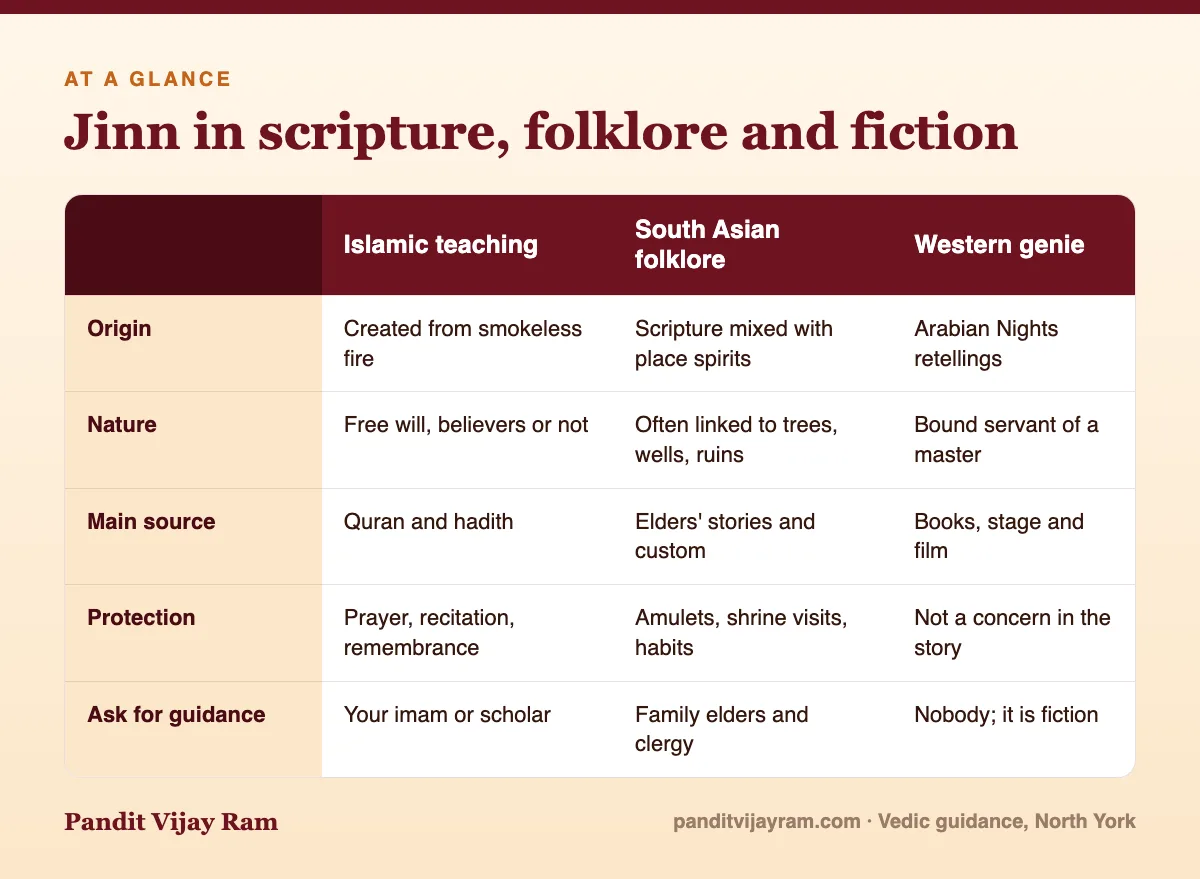
The Quran says jinn were created from a smokeless flame of fire, while humans were made from clay. Both were created to worship God, both are accountable, and both can choose good or evil. A whole chapter, Surah Al-Jinn, describes a group of jinn who heard the Quran recited and believed.
Mainstream Islamic scholarship draws on a small number of clear passages. Surah Ar-Rahman contrasts the creation of humans from clay with jinn made from fire. Surah Adh-Dhariyat says that jinn and humankind were created only to worship God. Surah Al-Jinn, the seventy-second chapter, gives the account of jinn who listened to the recitation and turned to faith.
The Quran also describes Iblis as one of the jinn, who refused to bow to Adam out of pride. This is why Muslim teachers speak of evil among jinn as a choice, not a nature. Some jinn are described as believers and some as wrongdoers, much as people are.
From these passages scholars draw a few common teachings:
- Jinn exist but are normally unseen.
- They have no power except by God's permission.
- Fear of them should never outweigh trust in God.
- Protection is sought through prayer, Quran recitation and remembrance, not through charms or bargains.
Details beyond this, such as what jinn eat or where they live, come mostly from hadith reports and the opinions of later scholars, and schools of thought weigh those reports differently. For a ruling that applies to your own life, speak with your imam or a qualified scholar you trust. You may also find the respectful comparison of ruqyah and Vedic protection useful if your household mixes traditions.
How do South Asian and Caribbean families talk about jinn?
In South Asia and its diaspora, jinn belief blends scripture with local custom. Families may link jinn to old trees, empty houses, wells or graveyards, and to sudden illness or changes in mood. Visits to Sufi shrines, amulets and family elders' remedies often sit beside formal prayer, and practices vary widely by region and household.
When Islam spread through Persia, Central Asia and the Indian subcontinent, the Quranic idea of jinn met older beliefs about place spirits. The result is a rich folk layer. In Punjab, Sindh, Uttar Pradesh or Bengal, a grandmother may warn children not to sit under certain trees after sunset, or not to leave hair and nail clippings carelessly. Those warnings sound like scripture but are usually custom.
Hindu and Sikh neighbours absorbed the word too. In many North Indian homes, jinn and bhoot are used almost interchangeably, even though they come from different worldviews. In the Vedic picture, a bhoot or pret is usually a restless human spirit, while a jinni is a separate created being. The glossary on bhoot, pret and pishach explains that side.
Indo-Caribbean families from Guyana and Trinidad sometimes carry these beliefs alongside Obeah stories and Hindu or Christian practice. The overview of Obeah, jadu and brujería shows how such traditions sit side by side.
None of this folk material is wrong to remember. It holds family memory and caution. The trouble starts when a story is used to blame a daughter-in-law, a sick child or an elderly aunt. That is never justified, in any tradition.
Are jinn the same as genies?
Not really. The genie of cartoons and films, who lives in a lamp and grants three wishes, comes from European retellings of One Thousand and One Nights. In Islamic belief, jinn are accountable beings with their own faith and choices, not servants bound to obey whoever rubs a lamp.
The tales known in English as the Arabian Nights include stories in which a jinni is trapped in a bottle or bound to a ring or lamp. French and English translators popularised these stories in Europe, and the translators chose the word génie, which echoed the Latin genius, a guardian spirit. Over time stage plays, comics and films turned that figure into the cheerful wish-granter most children know.
The differences are worth seeing plainly:
- Origin: jinn in the Quran are created beings; the genie is a literary character.
- Freedom: jinn choose belief or disbelief; the genie must obey a master.
- Ethics: scholars warn against trying to command jinn; the genie story celebrates it.
- Purpose: scripture places jinn under God's authority; the genie exists to serve a plot.
This matters in practice. Online sellers sometimes advertise a "jinn ring" or a jinni you can "own" to bring money or love. That is the genie myth sold as religion, and mainstream Muslim scholars reject it. It also overlaps with the fear-based sales covered in our guide to choosing a spiritual specialist safely.
When should a family worried about jinn seek help, and from whom?
Start with ordinary care: a doctor for health or sleep changes, a counsellor for stress or grief, and safety checks at home. If faith questions remain, a Muslim family should speak with their imam. Vijay Ram ji offers Vedic guidance and protective prayer to those who want it, without claiming authority over another religion.
Most worries about jinn arrive bundled with something ordinary. Night fears often follow poor sleep or shift work. Mood changes can point to depression, anxiety or a medical issue. Strange sounds in an older Toronto home usually have plumbing or heating explanations. Checking these first is respectful to faith, not a rejection of it.
A simple order of steps helps:
- See your family doctor about any change in sleep, appetite, mood or behaviour.
- If a person talks of harming themselves, call or text 9-8-8; in an emergency call 911.
- For Islamic guidance, approach your local imam or a scholar from your mosque.
- If you want Vedic support, a consultation can include a kundli reading and protective prayer.
Families who come to me from Hindu or mixed households sometimes want a Vedic path. The jinn-related Vedic support page describes what that involves, and the magic and entities hub lists related guides. I never ask anyone to leave their own faith, and I do not sell talismans claiming to bind jinn.
The bottom line
The plain jinn meaning is a hidden, created being, not a monster or a wish-granting genie. The Quran describes jinn as accountable creatures made from smokeless fire, while South Asian and Caribbean folklore adds local stories that deserve gentle handling. Ordinary health and safety checks come first, and Islamic questions belong with your imam.
Key takeaways
- The word jinn comes from an Arabic root meaning hidden or concealed.
- The Quran describes jinn as created from smokeless fire and accountable like humans.
- Folk customs about trees, wells and empty houses are culture, not scripture.
- The lamp genie is a European literary figure, not an Islamic teaching.
- Fear of jinn should never be used to blame a family member.